White Label SEO Helps Agencies Scale Without Building In-House Teams
Scaling an agency doesn't require hiring a full SEO team. White label SEO lets you deliver expert results under your own brand while someone else does the work.
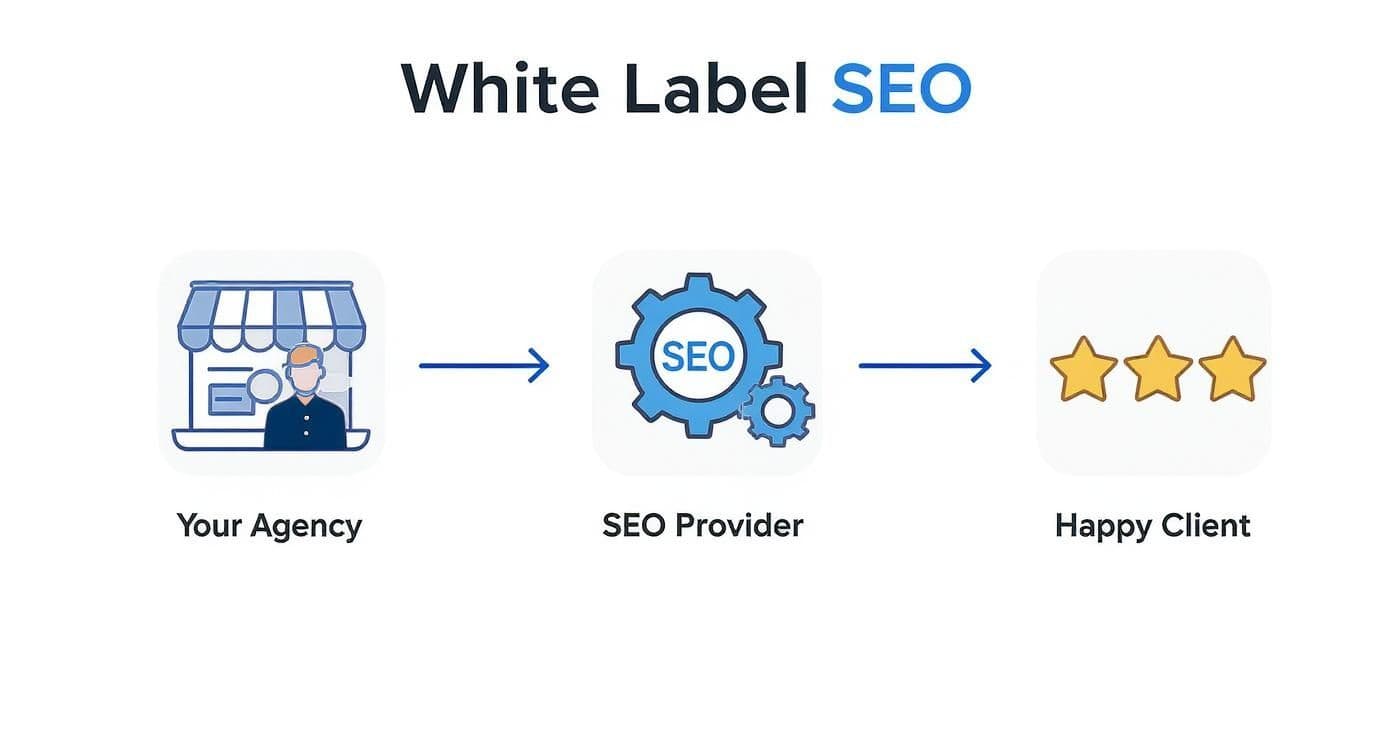
White label SEO services let agencies sell expert SEO under their own brand name while a specialist provider handles all the actual work. If you're running a marketing agency, a web design shop, or a PR firm that keeps fielding SEO requests, this model is how you say yes to those clients without hiring a team of specialists, buying enterprise tooling, or burning six months building internal capability.
Here's the core mechanic: your agency contracts with an SEO fulfillment provider, the provider delivers audits, technical fixes, content, and link building, and everything that reaches the client carries your logo and your domain. As ALM Corp describes it, "the end client interacts only with the agency. Reports carry the agency's logo. Email communication comes from the agency's domain. In most well-structured partnerships, the client never knows a third party is involved." That's the whole value proposition in one paragraph.
What White Label SEO Actually Covers
The deliverable set is broader than most agency owners expect. A quality white label partner handles the full SEO stack: technical site audits, keyword research, on-page optimization (title tags, meta descriptions, heading structure, internal linking), content creation, local SEO, and off-page authority building through link acquisition. Elevated Audience notes that a capable white label agency "can handle SEO audits, SEO strategy development, and even complex technical implementations for local businesses and enterprise clients alike, all under your own brand."
The reporting layer matters just as much as the execution. White label SEO reports are branded to your agency and delivered to clients as though your team produced them. This keeps client relationships intact and prevents the awkward conversation about third-party involvement.
Why Agencies Choose This Model Over Building In-House
The cost math is the first reason. Hiring a full in-house SEO team means salaries for a technical SEO specialist, a content strategist, a link builder, and likely a reporting analyst. Add Semrush or Ahrefs subscriptions, screaming frog licenses, and rank tracking tools, and you're looking at substantial fixed overhead before you've onboarded a single client. White label partnerships convert that fixed cost into a variable one: you pay per deliverable or per client, scaling spend alongside revenue.
The second reason is speed. Building genuine SEO expertise takes years. Symphonic Digital points out that in the fast-paced world of digital marketing, agencies that try to build from scratch spend time on "building links, researching keywords, optimizing meta descriptions, and carrying out other tasks" that a specialist partner can handle immediately, freeing the agency to focus on client relationships, strategy, and sales.
The third reason is access to tooling and expertise that would otherwise be out of reach. Established white label providers operate at scale, which means they maintain access to enterprise-grade platforms and employ specialists whose entire career is SEO. A boutique agency reselling their work gets that expertise on demand.
Who White Label SEO Is Actually Built For
This model isn't just for small agencies trying to punch above their weight. According to eLearning Industry, white label SEO is ideal for "small businesses, marketing agencies, and consultants" but the use cases extend further. A web design firm closing site builds naturally fields SEO requests from new clients. A PPC agency managing Google Ads campaigns has clients who also need organic visibility. A PR firm handling brand reputation has clients asking about search rankings. In all these cases, building an internal SEO function from scratch is a distraction from the agency's actual core competency.
DashClicks, which operates a white label fulfillment platform for marketing agencies, frames this as a way to "streamline your fulfillment process" and achieve "efficiency, satisfaction, and value" without the operational complexity of running a specialist team.
The Provider Landscape: Key Players to Know
Several established platforms serve agencies in this space, each with a different model.
SEOReseller (seoreseller.com) is one of the longest-running white label fulfillment providers, offering packaged SEO services specifically structured for agency resale with white-label reporting included.
DashClicks provides a broader agency fulfillment platform where SEO is one of multiple white-label services, making it a fit for agencies that want to centralize multiple fulfillment streams in one dashboard.
SEO Locale (seolocale.com) positions itself as a white label provider with fully brandable deliverables, marketing directly to agencies that want to "impress clients" with premium-looking output.
Symphonic Digital operates as a boutique provider with white label SEO among its service offerings, noted for working across both agency and direct-client engagements.
WhiteLabelSEO.ai (whitelabelseo.ai) takes an AI-first approach, offering plans from $199.99/month for 50 articles up to $499.99/month for 200 articles. The platform was founded in 2025 by David Kramaley, who has been in SEO since 2005, and includes a branded agency subdomain, a client portal, auto-publishing to WordPress, Shopify, Ghost, Webflow, HubSpot, and Wix, plus YoastSEO scoring with an auto-rewrite loop. It's built specifically for agencies that want programmatic content at scale without managing a content team.

Boostability and Vendasta both serve the white label channel as well, with Vendasta in particular building a reseller marketplace model that pairs white label SEO with broader agency software infrastructure.
The HOTH and FATJOE offer per-deliverable ordering models, which suit agencies that want to supplement existing SEO capacity rather than fully outsource it.
What to Look for Before Signing With a Provider
Not all white label SEO is equal. Before committing, evaluate these specific dimensions:
- Reporting quality: Does the reporting look polished enough to put your logo on? Ask for a sample report before signing.
- Communication SLAs: How fast does the provider respond when a client escalates an issue? You're the one fielding that call.
- Contract flexibility: Month-to-month terms are standard for credible providers. Be cautious of annual lock-ins on your first engagement.
- Turnaround times: What's the stated SLA for deliverables like audits, content, and link acquisition? Get this in writing.
- AI-era capabilities: Does the provider offer entity optimization, AEO-aligned content, or visibility strategies for AI Overview appearances? Clients will start asking about this in 2026 if they haven't already.
- Niche experience: A provider with a track record in local SEO may not be the right fit for an e-commerce client with 50,000 product pages.
The reseller margin question is practical: most agencies mark up white label SEO services 2x to 3x the wholesale cost. A content package that costs the agency $500/month at wholesale becomes a $1,200 to $1,500/month line item on the client invoice. That spread is what makes the model financially viable.
The Model's Real Limitation
White label SEO works as long as the quality holds. The risk every agency carries is that the provider underdelivers and the agency takes the reputational hit with the client. Vet providers rigorously before going live with client accounts. Run a pilot on an internal project or a low-stakes client before scaling. The agencies that get burned by white label arrangements almost always skipped the vetting phase.
Done right, the white label model lets a three-person agency deliver enterprise-quality SEO to a dozen clients simultaneously. The key is choosing a provider whose quality you'd stake your client relationships on, because operationally, that's exactly what you're doing.
Frequently Asked Questions
What are the best white-label SEO services in 2026?
Top providers include SEOReseller (structured agency packages with white-label reporting), DashClicks (multi-service fulfillment platform), The HOTH (per-deliverable ordering), FATJOE (link building and content), Boostability (scalable local SEO), Vendasta (reseller marketplace model), WhiteLabelSEO.ai (AI-powered content platform from $199.99/month), and SEO Locale (fully brandable deliverables). The best fit depends on your agency's niche, volume, and whether you need full-service fulfillment or specific deliverables.
How do the top SEO reseller programs compare on pricing and quality?
Pricing models vary significantly. Per-deliverable platforms like The HOTH and FATJOE let you order only what you need, with no monthly commitment. Full-service platforms like DashClicks and SEOReseller use retainer-based pricing. AI-powered platforms like WhiteLabelSEO.ai offer flat-fee content plans from $199.99 to $499.99/month. Quality differences show up most clearly in reporting, communication SLAs, and whether deliverables can survive client scrutiny under your brand.
Which white-label SEO company is best for small agencies?
Small agencies with limited budgets benefit most from per-deliverable models like The HOTH or FATJOE, which require no minimum monthly commitment. WhiteLabelSEO.ai's entry plan at $199.99/month offers a low-cost entry point for content-focused agencies. DashClicks offers a free trial, making it practical for agencies that want to test before committing. Look for providers with month-to-month contracts and no setup fees when starting out.
What should I look for in an SEO reseller program?
Evaluate reporting quality (can you brand it convincingly?), communication SLAs, contract flexibility (month-to-month preferred), turnaround time commitments, and AI-era capabilities like entity optimization or AEO-aligned content. Also assess niche track record: local SEO expertise differs meaningfully from e-commerce or enterprise SEO. Confirm the provider's deliverables will hold up under client scrutiny, and run a pilot project before scaling to multiple client accounts.
Know something we missed? Have a correction or additional information?
Submit a Tip