Why content problems are really alignment problems
The real fix is not more content, it is tighter alignment: when agencies run content like a media operation, they can sell strategy, governance, and smarter orchestration.
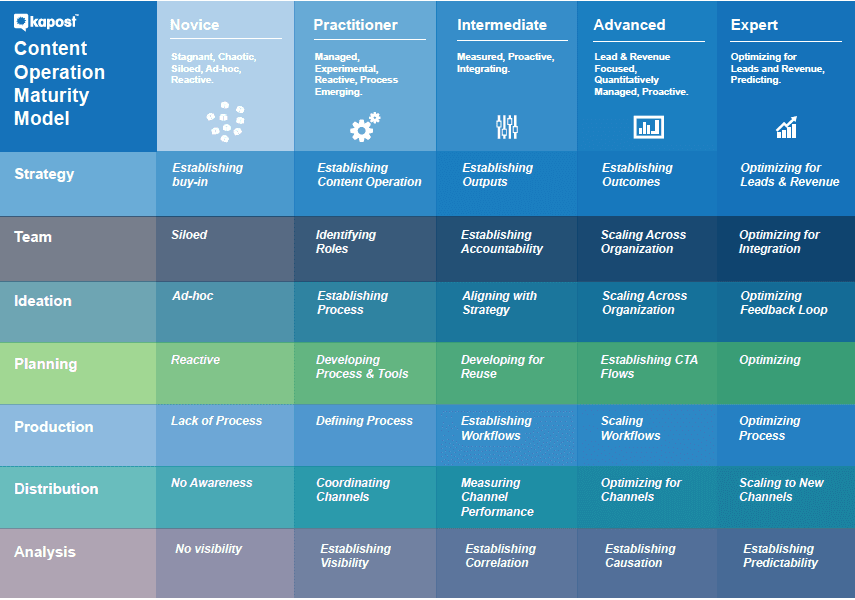
When content feels broken, start by checking alignment
The worst content problems usually do not begin with bad writing or weak ideas. They start when too many teams are producing too many near-identical messages for the same audience, in the same places, with no shared decision-making. In the healthcare example at the center of this maturity model, the company was losing ground because its content operation was fragmented, redundant, and strategically disconnected, not because it lacked output.
The company’s market pressure was real: smaller, single-brand competitors were taking share of search, and that showed up in declining leads and weaker demand generation. The instinctive response was familiar, more assets, more campaigns, more AI to make it cheaper. But the issue was never just production speed. It was that the organization had five operating brands plus the corporate brand, each with its own marketing lead, history, audience, and definition of good content.
Why the content pileup was really a collision problem
Once you get past the surface symptoms, the failure mode is easy to spot. Three of the brands were telling essentially the same story to the same buyer audience on the same channels, which turned the portfolio into a set of collision zones. The content existed, and sometimes there was a lot of it, but it was diffuse, redundant, and undifferentiated. From the audience’s point of view, the brands blurred together, so clarity disappeared and attention went elsewhere.
That is the piece many agencies miss when they are brought in to “fix content.” The problem is often not the creative team or the publishing cadence. It is that multiple stakeholders have already made competing decisions before the content team ever gets the brief. In this case, content meetings kept everyone informed, but they rarely changed anything that had not already been decided in side conversations. That is not an editorial problem. That is an operating-model problem.
The most telling detail is how the content function itself was working. It was a centralized team of five, talented but overworked, and 95% of its work was reactive. The loudest brand got the most attention, quieter brands went silent for months, and the whole system rewarded urgency over coherence. When a team spends its days responding instead of directing, the calendar fills up, but the strategy stays fuzzy.
The media-operation mindset changes the job
This is where the maturity model matters. It reframes the organization from a content factory, which is built to produce assets, into a media operation, which is built to coordinate storytelling, audience needs, and channel choices. That shift sounds semantic until you see how much work it changes: the goal stops being volume for its own sake and becomes smarter sequencing, cleaner differentiation, and better use of every channel.
A media operation also forces a harder question: what deserves to exist at all? Once you are thinking like a media business, you stop assuming every brand needs its own version of every story. You start making decisions about which brand owns which narrative, where that story should live, and how repeated work can be removed before it burns time and budget. That is the difference between producing content and managing attention.
For agencies, that is the opening to higher-value work. Instead of selling only assets, you can help redesign how content decisions are made, how teams are aligned, and how redundancy gets cut out of the system. That creates a consulting lane around workflow design, governance, and strategic orchestration, which is a much better business than endless production retainers.
What agencies should sell instead of more volume
The strongest lesson here is that the fix does not necessarily require more people or more tools. The healthcare company did not need a bigger content team to solve a coordination problem. It needed a better operating model, one with standards, decision rights, and a way to make portfolio-level calls across all five brands at once.
In practice, that means agencies should be ready to pitch work that looks like this:
- Mapping the collision zones where multiple teams are telling the same story.
- Defining who owns the story, the channel, and the approval path.
- Creating rules for reuse so every team does not rebuild the same asset from scratch.
- Aligning content choices to audience needs instead of internal preferences.
- Setting governance so the loudest stakeholder does not always win.
That approach also explains why adding AI so often disappoints. If the underlying structure is still fragmented, AI simply helps teams create more of the same noise faster. The article’s warning is blunt: if the organization has not solved alignment, then speed only scales the confusion. The right first move is not more output. It is a smarter system for deciding what the output should be.
The maturity model’s real value for agencies is that it expands the conversation. You are no longer just the team that delivers the content. You become the partner that helps a client behave like a modern media organization, with clearer differentiation, cleaner workflows, and a better grasp of how content competes for attention. That is where agencies stop selling assets and start selling strategic relevance.
This article was produced by Prism’s automated news system from verified source data, official records, and press releases, then run through automated quality and moderation checks before publishing. The system is built and supervised by the people who set the standards it runs under. Read our full AI policy.
Know something we missed? Have a correction or additional information?
Submit a Tip