Ahrefs says AI chatbot traffic is tiny, but converts far better
AI chatbot traffic is tiny next to Google, but the visitors who do click are often warmer, more focused, and far closer to conversion.
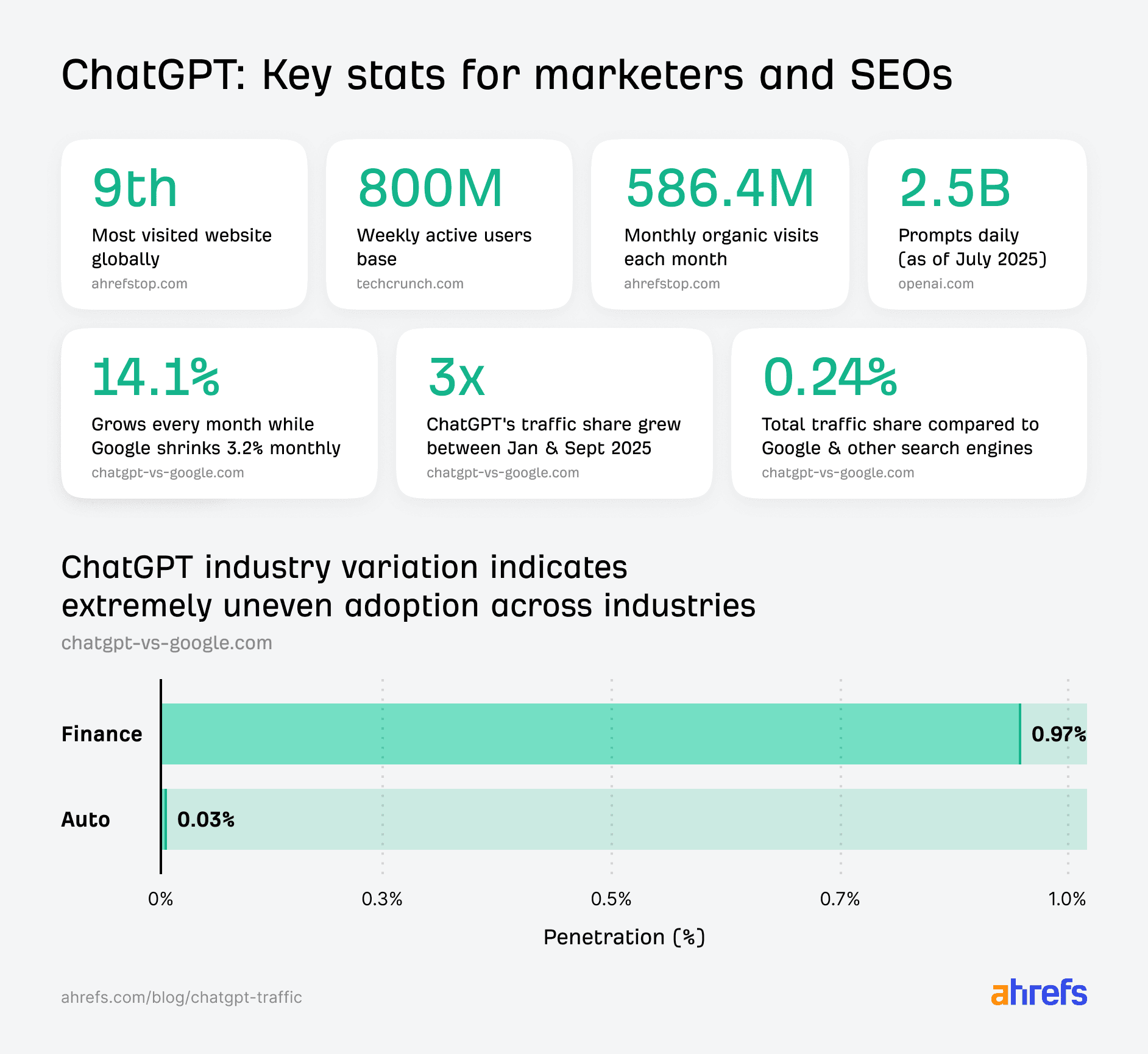
Three and a half million visitors is not a huge number until you compare what those visitors actually do. Ahrefs is making the case that AI chatbot traffic should be judged by intent and downstream value, not by raw volume alone.
Why the definition matters
Ahrefs draws a hard line between human referral traffic and crawler traffic. In its framing, AI chatbot traffic means a person clicked a link cited inside a chatbot response, while bot traffic from systems like GPTBot, ClaudeBot, or PerplexityBot is just machines fetching pages for training or retrieval. That distinction sounds technical, but it is the difference between a content-processing cost and a commercial opportunity.
Marketers have a habit of lumping both together, then declaring the whole channel either massive or meaningless. That is sloppy. If a crawler visits your site 10,000 times, that does not pay the bills. If a chatbot sends 1,000 real people who already have context, comparison points, and a buying question in mind, that is a very different story.
Tiny share, but not tiny signal
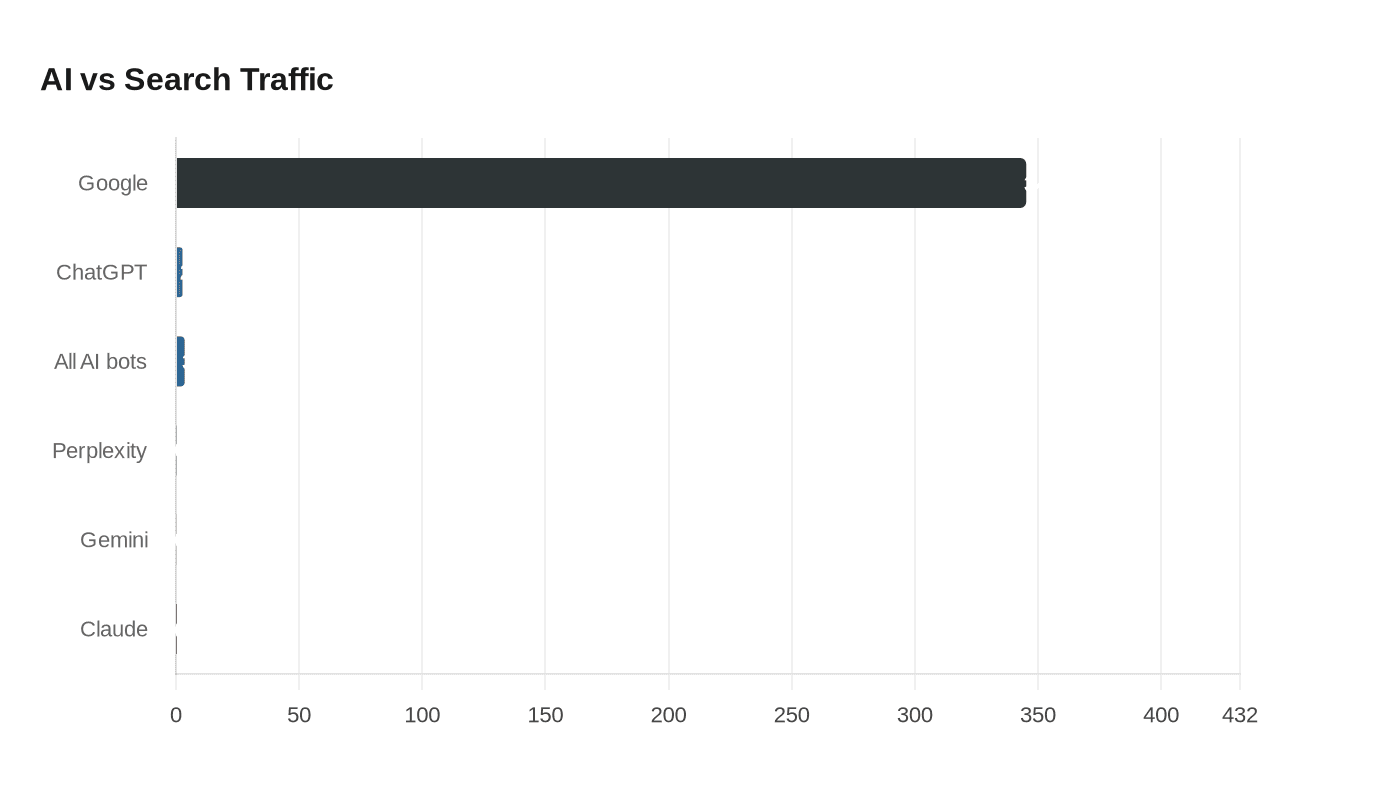
Ahrefs’s traffic tracker, which follows referral activity across 74,752 websites, says all AI chatbots combined sent 3.5 million visitors in March 2026. That was just 0.28 percent of total web traffic, while Google still accounted for 345.2 million visits and a 28.12 percent share. Google’s slice has also been slipping, falling from 35.11 percent in June 2025 to 30.53 percent in March 2026.
Within the AI side of the ledger, ChatGPT is doing most of the work. Ahrefs says it sent 2.7 million visitors in March 2026, about ten times more than any other AI assistant. Perplexity and Gemini each sent around 230,000 visitors, while Claude sent about 102,000 and was growing quickly month over month.
That traffic mix matters because it shows the channel is still small, but not static. The headline is not that AI is replacing search. It is that the early clicks are concentrated in a few assistants, and those clicks are arriving with enough intent that they can matter even while the total share stays tiny.
Where the real value shows up
Ahrefs says AI-assisted visitors can convert up to 23 times better than traditional organic visitors in some cases. That is the kind of number that gets attention, but the important part is the why: people who arrive from a chatbot often have already been filtered by a prior conversation. They are not starting from a blank search box. They have context, and that usually means they are farther down the decision path.
Ahrefs has also said in earlier work that AI search visitors produce its highest conversion-per-visit ratio, even while the channel remains only about 0.1 percent of traffic in its broader study. The lesson is not to chase volume blindly. It is to watch whether AI visitors show up with better economics than the average search session.
Adobe’s April 2026 report backs up that logic with a wider data set. Adobe says its analysis covered more than one trillion visits to U.S. retail sites, more than 100 million SKUs, and a March 2026 survey of more than 5,000 U.S. respondents. Across industries, Adobe found AI-referred traffic was more engaged than non-AI traffic and had lower bounce rates. Adobe also said AI conversion was 42 percent higher in March 2026 than non-AI traffic.
The travel category shows how fast that gap can narrow. Adobe says the AI-versus-non-AI conversion gap in travel shrank from 86 percent in October 2024 to 14 percent in March 2026. That is a big move in a relatively short window, and it suggests the channel is becoming less novelty-driven and more commercially useful.
- Retail, up 393 percent
- Travel, up 233 percent
- Financial services, up 158 percent
- Media and entertainment, up 84 percent
- Tech and software, up 63 percent
Adobe also reported strong year-over-year growth in AI visit share during Q1 2026:
Those are not vanity stats. They show where AI referral activity is starting to show up in enough quantity to matter, especially in categories where comparison, research, and decision support are baked into the buying process.
How to measure whether it is real money
The mistake is to stare at sessions and stop there. If AI traffic is coming in with higher intent, then the right scoreboard is conversion rate, assisted revenue, and page type performance. A small traffic stream can still be worth real money if it helps close deals, accelerates subscriptions, or supports later direct visits that would not have happened otherwise.
The pages that deserve the closest look are the ones that finish a decision, not just start one. Product detail pages, pricing pages, comparison pages, demo requests, and subscription flows are where a chatbot referral can prove its value fastest. If AI visitors are landing on a deep article and bouncing, that is noise. If they are landing on a high-intent page and converting at an above-average rate, that is a channel worth defending.
- Compare AI referrals against organic search, not just in sessions but in conversion rate and revenue per visit
- Separate assisted revenue from last-click revenue so you can see whether AI is helping close later conversions
- Break performance out by landing page type, because informational pages and transactional pages tell different stories
- Watch month-over-month movement in the assistants themselves, since ChatGPT, Perplexity, Gemini, and Claude are not contributing equally
A practical way to read the data is this:
That last point matters because the traffic is not evenly distributed. ChatGPT is carrying the biggest share by far, Perplexity and Gemini are both meaningful but far smaller, and Claude is still a minor referrer even as its growth rate accelerates. If you only look at the aggregate AI bucket, you miss where the useful traffic is actually coming from.
Why the bigger shift is still ahead
This is also a distribution story, not just a traffic story. Cloudflare said in August 2025 that training now drives nearly 80 percent of AI bot activity, which means the crawl side of the house is already far larger than the click side. Cloudflare also said Google referrals to news sites fell about 9 percent in March 2025 versus January, a reminder that even traditional traffic sources are getting squeezed as search products change.
The anxiety in publishing is not random either. Reuters Institute coverage said news executives expected search referrals to drop 43 percent over the next three years, with a fifth expecting losses above 75 percent. Chartbeat data cited in that same reporting showed organic Google search traffic down 33 percent globally and 38 percent in the U.S. from November 2024 to November 2025.
Google is trying to respond by folding more AI into Search, including AI Overviews and AI Mode, and in May 2026 it said those experiences are being improved to include links to sources, brands, and websites. That makes the channel more complicated, not less. The future is not simply fewer clicks. It is a more fragmented path where some search-like products suppress traffic while others send fewer but better-qualified visitors.
That is why Ahrefs’s argument lands. AI chatbot traffic is still tiny in volume, but the clicks that do arrive may be disproportionately close to revenue. For teams that know how to measure conversion rate, assisted revenue, and page-level performance, this is no longer a side note. It is a small channel with a plausible claim on real business impact.
Know something we missed? Have a correction or additional information?
Submit a Tip