Ahrefs study finds YouTube drives AI visibility, Google outpaces ChatGPT traffic
YouTube mentions topped Ahrefs’ AI visibility signals, while Google sent 190 times more traffic to sites than ChatGPT, sharpening the stakes for video.

YouTube has emerged as one of the clearest leverage points in AI search visibility, at least in Ahrefs’ latest benchmark work. The Q1 2026 AI Search Benchmark Report, released May 27, drew on 13 studies, 146 million search result pages and 730,000 AI responses, and found that YouTube mentions correlated more strongly with AI brand visibility than any other metric across 75,000 brands.
That finding should not be read as proof that YouTube causes AI recommendations on its own. It does, however, point to a playbook shift: if large language models keep favoring brands that show up in trusted video ecosystems, then video is no longer a side-channel. Marketers will need to treat creator partnerships, transcript optimization and on-video brand mentions as part of search strategy, not just media strategy. Ahrefs’ earlier December 2025 study pointed in the same direction, with YouTube mentions showing a correlation of about 0.737 with AI visibility across ChatGPT, AI Mode and AI Overviews, ahead of YouTube mention impressions at about 0.717.

The report also undercuts the idea that AI discovery automatically delivers traffic. Ahrefs says Google sends 190 times more traffic to websites than ChatGPT, a reminder that visibility inside an answer box and visits to a site are still very different outcomes. That gap matters for planning, because it suggests brands need two tracks at once: earn presence in the sources AI systems repeatedly pull from, while still optimizing for the search engines that send the clicks.
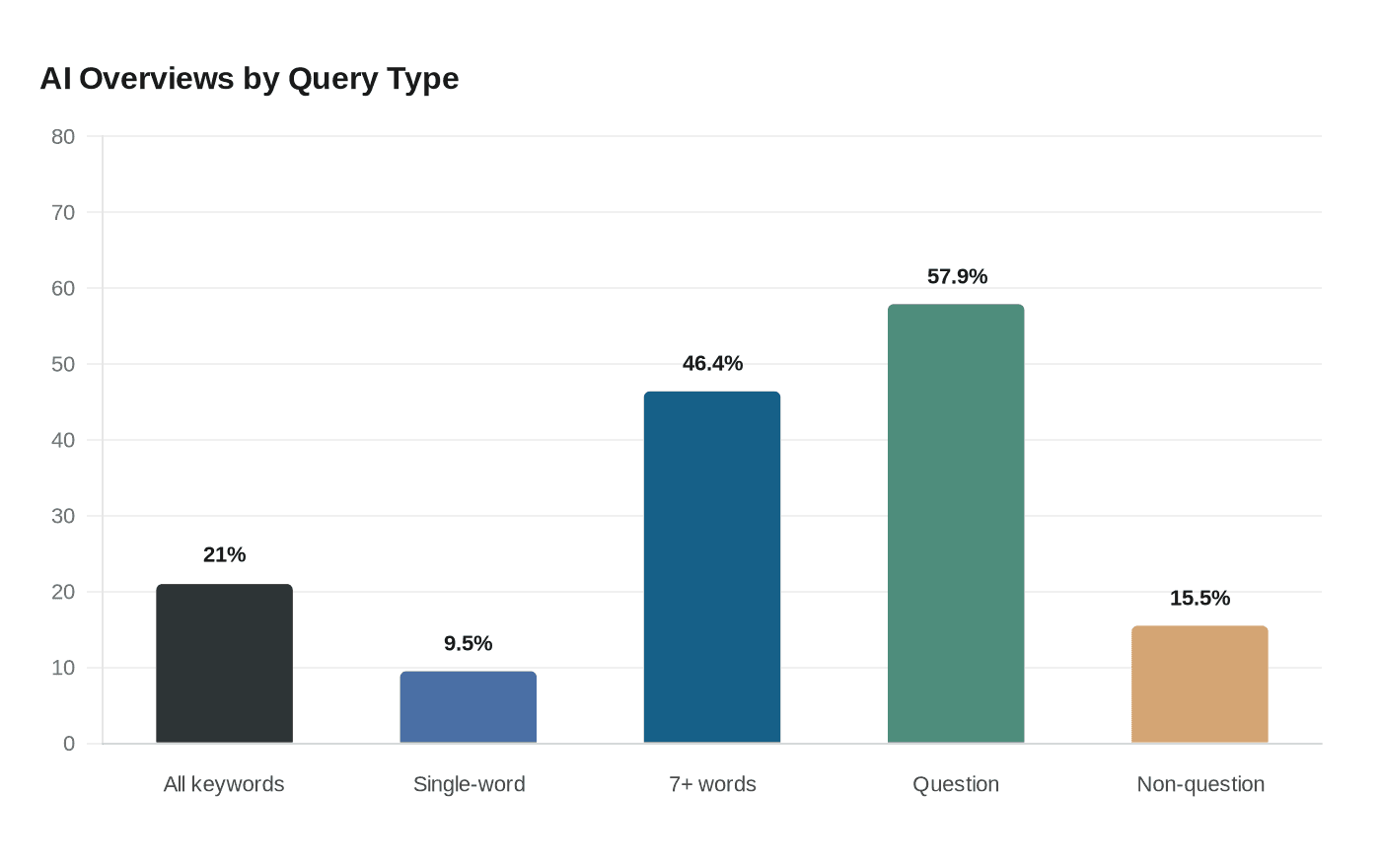
Query intent shaped the results as well. Google’s AI Overviews appeared for 21% of all keywords in Ahrefs’ dataset, but the feature showed up on just 9.5% of single-word queries and 46.4% of queries with seven or more words. Question-based searches triggered AI Overviews 57.9% of the time, compared with 15.5% for non-question queries. For marketers, the message is practical: the longer and more explicit the query, the more likely the answer layer will appear, which raises the value of content built around specific problems rather than broad head terms.
Ahrefs’ broader AI visibility work suggests the field is consolidating around a few familiar brands, with all three major AI assistants largely mentioning the same names and showing an output-overlap correlation of 0.779. That makes distribution as important as publishing volume. In the same December study, site page count had almost no relationship to AI visibility at around 0.194, while branded web mentions still correlated strongly at 0.66 to 0.71. The signal is becoming harder to miss: authority is now being read across video, web and community surfaces, and YouTube looks increasingly central to that equation.
This article was produced by Prism’s automated news system from verified source data, official records, and press releases, then run through automated quality and moderation checks before publishing. The system is built and supervised by the people who set the standards it runs under. Read our full AI policy.
Did this article answer your question?