AI search has moved to agentic RAG, King says
Agentic RAG changes the game, because AI search now plans, searches, and judges evidence in stages, not in one pass. That makes old citation-counting tactics look increasingly thin.
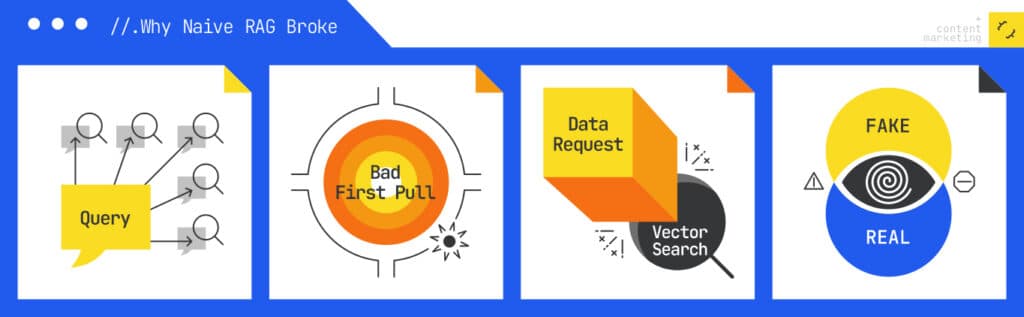
The old RAG playbook is already behind the curve
Mike King’s central point is blunt: the first wave of retrieval-augmented generation was a single-shot system, and that model no longer describes how the biggest AI search products actually work. The old pattern was simple enough to game, or at least to measure, because it ran in a line: take the query, retrieve a few passages, stuff the best ones into context, generate an answer, attach citations.

That is not how the major products behave now. King’s argument is that Google AI Mode, ChatGPT Search, Perplexity Pro Search, Claude with Computer Use, Gemini Deep Research, and Microsoft’s research-oriented Copilot agents have all moved toward agentic RAG. In practice, that means the system does not just fetch once and stop. It decomposes the question, routes work across tools, pulls in more evidence, checks its own draft, and decides whether it needs another round before it answers.
What agentic changes in practical terms
This shift matters because it changes the mechanism you are trying to influence. With single-shot RAG, the optimization question was mostly about retrieval: get the right page into the top set of passages and you had a shot at being cited. With agentic RAG, the system can make several internal decisions before a user ever sees the final answer, and those decisions are not exposed as a clean list of rankings.
That is why King says reverse-engineering AI search by staring at citations or scraping visible results only tells you about the last layer. It does not show the gatekeeping that happened upstream. The platform may have already broken the query into subtopics, sent multiple searches at once, discarded weak evidence, and reworked the answer before it ever reached the citation stage.
For content teams, that changes the job description. A page is no longer just trying to be retrieved once. It has to survive query decomposition, tool routing, iterative retrieval, draft grading, and synthesis. Content that only performs when a model grabs one tidy paragraph and stops is exposed to a system that keeps asking whether it has enough evidence.
Google’s own products make the shift hard to ignore
Google has been especially explicit about how multi-step its newer search experiences are. Its AI Mode uses a “query fan-out” technique that breaks a question into subtopics and launches multiple related searches concurrently. Its Deep Search feature can issue hundreds of searches and produce a fully cited report, which is about as far from a one-pass retrieval flow as you can get.
The scale of that rollout matters too. Google says AI Overviews are available in more than 200 countries and territories and more than 40 languages. It also says AI Mode queries have more than doubled every quarter since launch and that AI Mode has surpassed a billion monthly active users globally. When a product with that reach behaves like a multi-stage research system, the visibility problem stops being theoretical.
The historical backdrop helps explain why. Google’s REALM work in 2020 was an early example of retrieval-augmented language modeling inside the company, years before chatbots made the concept familiar. But the current product stack goes well beyond that early retrieval layer. The search box is no longer just a request for links, it is increasingly the front door to a research workflow.
This is not just a Google story
The broader market has been moving the same direction. OpenAI launched deep research in February 2025 as an agentic capability for multi-step web research. OpenAI says it can take tens of minutes to complete and can pivot as it encounters new information. Microsoft introduced Researcher and Analyst in Microsoft 365 Copilot in March 2025 as reasoning agents built for complex, multi-step research. Anthropic’s Claude computer use capability, which launched in public beta in October 2024, lets Claude control a cursor, click buttons, and type on a computer.
Taken together, those launches show that “agentic” is not just a buzzword for search summaries. It is the operating model across the major AI platforms. The system is not merely finding content. It is deciding how to investigate, what to trust, and when to keep going.
Why citation counting is starting to fail as a measurement strategy
This is where a lot of current SEO and GEO thinking gets too comfortable. If the answer cites you, great. If it does not, you assume you lost. But Ahrefs found that AI Mode and AI Overviews cited the same URLs only 13% of the time overall in one analysis. Even when comparing the top three citations, overlap only rose to 16%.
That kind of mismatch is exactly why citation counting is such a weak proxy for visibility in an agentic system. If one product issues many searches, weighs evidence differently, and synthesizes a final answer through several internal steps, then the visible citation list is just an output, not a complete map of the process. You can be present in one stage and absent in another, or vice versa.
King’s larger point is that GEO programs built for single-shot retrieval are optimizing the wrong mechanism. They are trying to win a contest that no longer exists in the old form. The system deciding what to show may now be closer to a chain of judgments than a static rank list.
What content becomes more valuable now
If the model is doing more work between query and answer, then the content that wins is the content that helps at multiple stages of that process. That means material needs to be easy to decompose, easy to verify, and useful when the system comes back for a second or third pass. Pages that bury the answer, depend on loose context, or force a model to over-interpret the page are more fragile than pages that state the point cleanly and support it with clear evidence.
The practical content moves are pretty clear:
- Structure pages so a model can pull discrete facts without losing context.
- Use specific terminology consistently, especially around product names, tools, and steps.
- Build evidence density into the page, not just one polished paragraph.
- Cover related subtopics directly, because query fan-out can split a question into several narrower searches.
- Make sourcing and claims easy to inspect, because multi-step systems grade and re-check as they go.
That does not mean writing for robots at the expense of humans. It means acknowledging that the same page may need to satisfy a tool that retrieves once, a tool that retrieves five times, and a tool that compares several candidate answers before it settles.
The real shift is from ranking to pipeline survival
King’s article is persuasive because it treats AI search as a model-change story, not a semantics argument. The old RAG frame assumes a passive retriever. The new products behave more like agents that plan, search, evaluate, and revise before they answer.
That is a much harsher environment for anyone trying to engineer visibility, but it is also a clearer one. The winning content is no longer just the page that can get fetched. It is the page that can survive a sequence of decisions, evidence checks, and reruns. In agentic search, the contest starts before the citation appears, and that is exactly why the old playbook is losing its grip.
This article was produced by Prism’s automated news system from verified source data, official records, and press releases, then run through automated quality and moderation checks before publishing. The system is built and supervised by the people who set the standards it runs under. Read our full AI policy.
Know something we missed? Have a correction or additional information?
Submit a Tip