AI search rewards extractable pages, not long-form guides
AI search is favoring pages that can be lifted cleanly, not bloated guides that bury the answer. The winning format is modular, cited, and easy to quote.

The old “ultimate guide” is getting clipped at the knees. AI systems do not want a 4,000-word tour through every adjacent topic; they want a page they can lift from, quote from, and trust enough to show inside an answer. Myriam Jessier’s argument is simple and uncomfortable for old-school SEO: in AI search, extractability is the new optimization target.
Why the long guide stopped being the default
Jessier’s core claim is that AI systems like Gemini appear to work with a limited grounding budget of roughly 380 words per webpage when assembling answers. That changes the math immediately. If a model is only pulling a slice of your page, then the page that wins is not the one that rambles the longest, it is the one that spends every line on a fact the system can actually use.
The extraction numbers make the shift even harder to ignore. Jessier cites a 66% extraction rate for pages under 5,000 characters, compared with only 12% for pages over 20,000 characters. That is not a small difference in presentation style. It is a structural warning that AI search prefers dense pages with clean, citable passages over sprawling assets that bury the answer in layers of context.
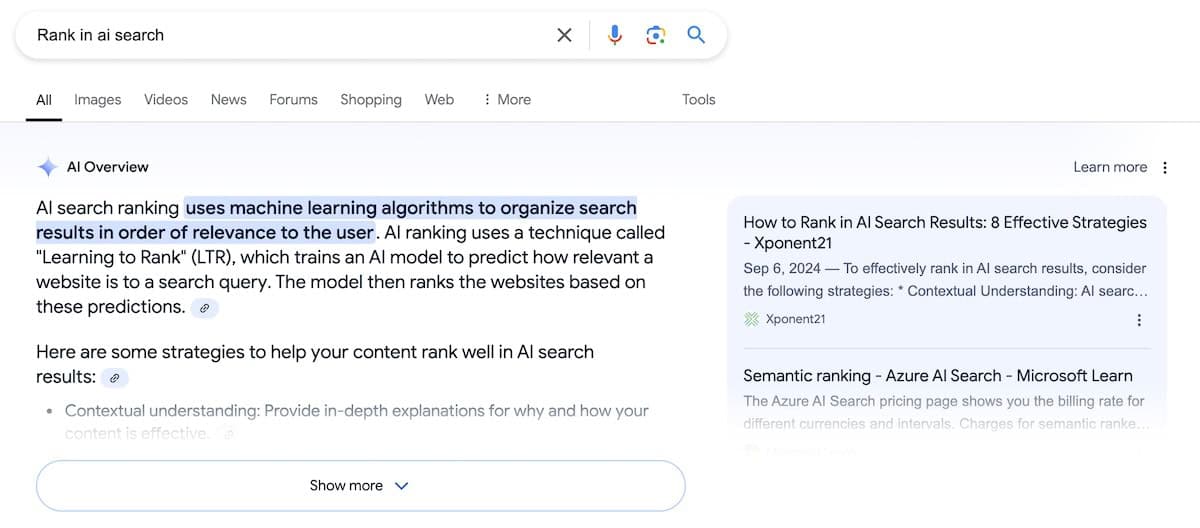
Search Engine Land has also noted that AI Overviews can appear on as many as 25% of searches in one 2026 guide, which means this is not a side-channel experiment anymore. It is a major visibility layer, and if your page is built like a traditional “ultimate guide,” you may be feeding the machine less than you think.
Build around the problem, not the cathedral
The practical answer is to stop writing as if every page must be the final word on a subject. Jessier’s advice points toward problem-first pages, where each sentence earns its place by naming an entity, defining a relationship, or giving a claim a form that can be quoted cleanly. That means the page architecture matters as much as the prose.
Think in discrete answer blocks, not endless arcs. A strong AI-ready page does not force the reader, or the model, to excavate the point. It states the point, supports it, then moves to the next useful unit of information.
A useful way to rebuild a page looks like this:
- Open with the direct answer, not a scene-setter that delays it.
- Use subheads that mirror real questions, so each section can stand on its own.
- Put numbers, names, and conditions in the same sentence whenever possible.
- Separate definitions, recommendations, and evidence so each can be lifted without losing meaning.
- Keep passages citation-ready, which means short, specific, and self-contained.
This is also where a lot of “helpful” marketing content falls apart. If the best answer is buried in the fifth screen of a giant guide, the page may still satisfy a patient human reader, but it gives the retrieval system too much work. The page that performs better is usually the one that can be clipped cleanly into an AI summary without the surrounding copy collapsing.
What Google is signaling, in plain English
Google is not exactly hiding the direction of travel. In its Search Central guidance for generative AI features, the company tells site owners to focus on foundational SEO best practices, valuable non-commodity content, and clear technical structure. It also says structured data helps Google understand page content and the entities mentioned on the page. In other words, Google still wants the basics done well, but now those basics are feeding AI-driven surfaces as well as blue links.
Under Sundar Pichai, Google says AI Overviews has grown to 1.5 billion monthly users across 200 countries and territories. Google also says AI Overviews drives over a 10% increase in usage in its biggest markets, including the United States and India, for queries that show the feature. Google has gone so far as to call it one of the most successful launches in Search in the past decade.
That scale matters because it tells you where the pressure is landing. AI Overviews and AI Mode are no longer fringe add-ons. They are part of how people increasingly search, and Google says they can still send users to sites. The page, then, has to do two jobs at once: satisfy the AI answer layer and still provide enough authority, clarity, and structure to earn the click when one happens.
How to make a page extractable
This is where journalists and marketers need to think less like publishers and more like architects. The shape of the page should help a model identify what the page is about, who or what it names, and what exact claim it makes.
The most reliable moves are boring, which is usually a sign they work:
- Use plain, specific headings that map to intent.
- Put the key entity near the top of the section, not 400 words in.
- Use structured data to reinforce what the page is about and which people, books, or companies it mentions.
- Avoid decorative intros that delay the useful part.
- Keep the proof near the claim so the passage can stand alone.
That last point is the one too many teams miss. AI systems are not rewarding pages for being majestic. They are rewarding pages for being legible. The more your content reads like a set of modular answers, the easier it is for a model to quote the right chunk without losing context.
Clicks are changing, too
Pew Research Center’s work shows why this matters beyond rankings. The team, including Athena Chapekis, Anna Lieb, Sono Shah and Aaron Smith, found that Google users were less likely to click result links when an AI summary appeared. Pew also found that users very rarely clicked the sources cited inside the summaries.
Pew’s browsing-data analysis found that about six-in-ten respondents visited at least one search page with an AI-generated summary in March 2025. That is the real tension now: visibility is rising inside the answer layer, while traditional click behavior weakens around it. If your strategy still measures success only by blue-link traffic, you are reading the wrong dashboard.
OpenAI is making the same point from the other side of the market. It says ChatGPT search and SearchGPT are designed to provide fast answers with clear in-line citations and links to relevant web sources. That puts attribution, source choice, and passage quality at the center of the product itself. The trend is not just “AI answers exist.” The trend is that the answer product depends on clean, source-worthy content.
Lily Ray’s study, reported by Search Engine Land, sharpens the warning even more. Google cited brands’ own listicles in AI Overviews, but still recommended competitors 69% of the time. That is a brutal reminder that being cited is not the same thing as owning the result. If your page is built as a giant catch-all list, the model may borrow from it and still send the user elsewhere.
The new editorial discipline is simple to describe and harder to execute: write for extraction first, depth second. The pages that will matter most are the ones that make the answer easy to isolate, easy to trust, and easy to cite.
This article was produced by Prism’s automated news system from verified source data, official records, and press releases, then run through automated quality and moderation checks before publishing. The system is built and supervised by the people who set the standards it runs under. Read our full AI policy.
Know something we missed? Have a correction or additional information?
Submit a Tip