AI Search Visibility Becomes an Operational Workflow for Brands
AI search visibility is no longer a branding shrug. The useful work is diagnostic: find the citation gap, then run a repeatable workflow that actually changes where AI systems point.
AI search visibility is now a systems problem
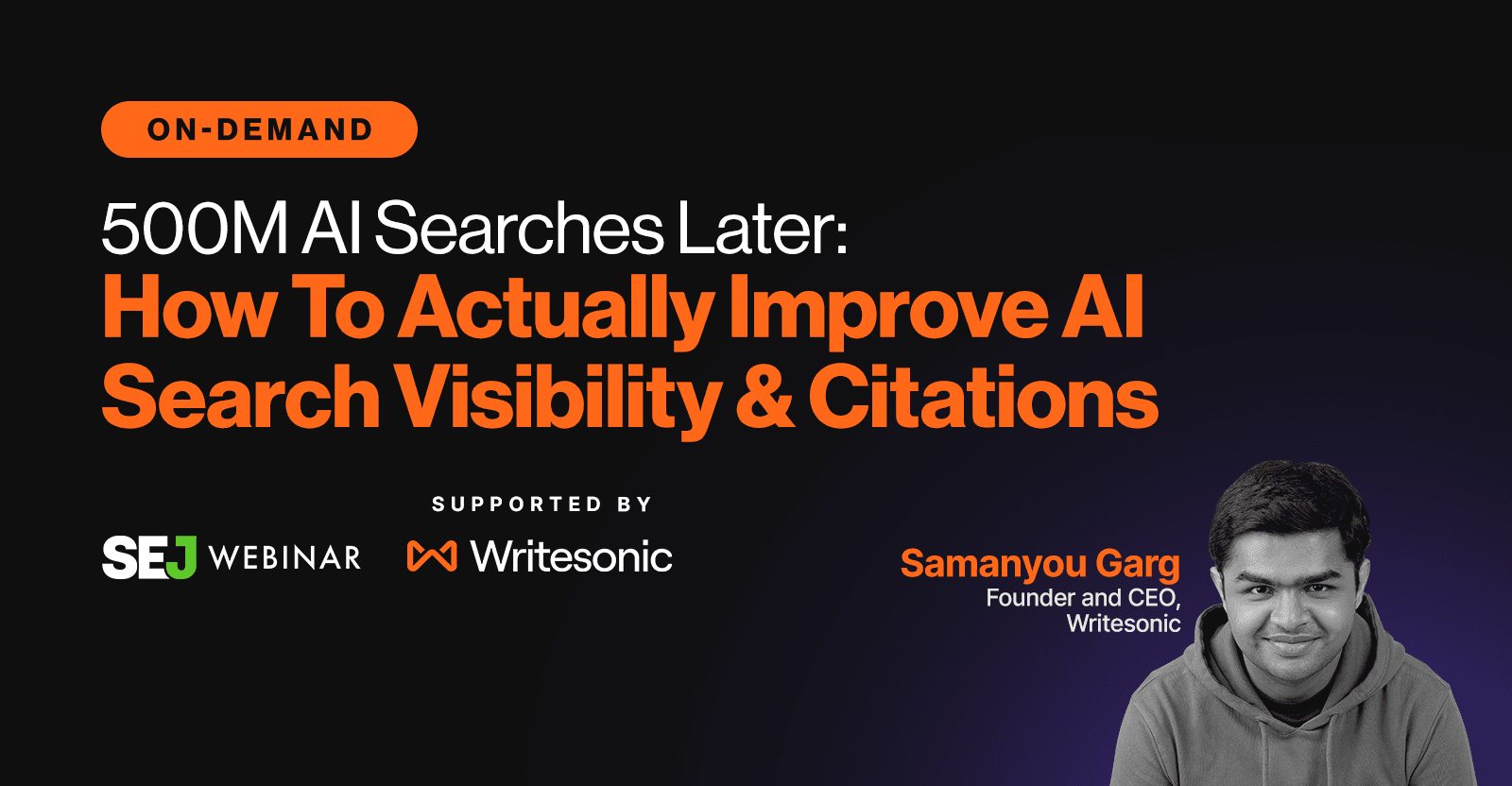
The brands making progress inside AI answer engines are treating visibility like operations, not vibes. Search Engine Journal’s webinar with Writesonic founder and CEO Samanyou Garg frames the work around a hard question: where are the citations going, and what actions reliably change that outcome?

That matters because the session is built on visibility-signal analysis from 500M+ AI conversations, with attention on the content types, source types, and placements that get cited inside ChatGPT, Perplexity, and Gemini. The whole point is to move from “we are missing” to “we know why, and here is the workflow to fix it.”
Start with the diagnosis, not the slogan
A lot of teams already have dashboards that prove they are not showing up in AI answers. The more useful move is to treat that absence as a diagnostic, then break it into pieces you can work on. If ChatGPT, Perplexity, and Gemini are citing different pages, different publishers, or different content formats, the problem is not simply brand awareness. It is distribution, structure, and source selection.
That is why the webinar is positioned as a guide to improving AI search visibility and citations rather than a general thought-leadership piece about the future of search. It was listed by Search Engine Journal as a live session presented by Samanyou Garg and hosted by Loren Baker, with the session scheduled for Wednesday, April 22, 2026 at 2 pm ET. The framing is blunt: visibility data only matters if it leads to action.
What to diagnose first
Before any team starts rewriting pages or chasing mentions, the first audit should answer three questions:
- Which pages are being cited now, if any
- Which source types are winning, such as owned content, third-party coverage, or reference-style pages
- Which placements are actually surfacing inside the answer engines that matter most
That diagnostic matters because the signals are not identical across systems. The webinar’s underlying model is designed to show where the gaps sit inside ChatGPT, Perplexity, and Gemini, so the team can stop spreading effort evenly and start focusing on the exact holes that block citation. If one product line gets cited only when a third-party explainer mentions it, while another gets picked up from refreshed product docs, those are two different problems with two different fixes.
The three levers that actually move visibility
The practical heart of the workflow is refreshingly unsentimental. The webinar centers on three levers: citation outreach, content refresh, and third-party placements. That is the right shortlist because it maps to how answer engines seem to assemble responses from sources they trust and can verify.
Citation outreach is the simplest to describe and the hardest to execute well. It is the work of getting the right pages, references, and mentions into the places AI systems already favor. Content refresh is the owned-side fix: update assets so they better answer the query, support the topic, and present the kind of signal an answer engine can lift cleanly. Third-party placements are the credibility layer, because outside coverage can strengthen the odds that a brand shows up when the system is choosing what to cite.
A useful way to think about it is this: citation outreach gets the door open, content refresh makes the page worth citing, and third-party placements make the brand harder to ignore.
Why third-party coverage matters so much
This is not just a theory about marketing discipline. OpenAI says ChatGPT search can return fast, timely answers with links to relevant web sources, and its research materials say ChatGPT can search, analyze, and synthesize up-to-date information from across the web. Perplexity describes itself as an AI-powered search engine or answer engine that delivers answers backed by verifiable sources and citations. Google has folded Gemini into Search and AI Mode, while Microsoft has expanded citation features in Copilot, including more prominent clickable citations and web-search query citations.
Once those systems are citation-based by design, the game changes. You are no longer optimizing only for blue links. You are optimizing for inclusion inside an answer layer that chooses, compresses, and credits sources directly. That is why third-party placements are not a vanity metric in this workflow. They are often part of the evidence trail the system uses to decide whether your brand is worth surfacing.
The broader pattern has been visible for a while. Search Engine Journal has previously reported that AI search engines often cite third-party content the most, and Search Engine Land published an analysis of 8,000 AI citations in May 2025. That context makes the webinar’s emphasis on third-party placements feel less like a new theory and more like an operational response to a pattern the industry has already started to document.
Build the workflow like a living system
The strongest takeaway from this model is that AI visibility is maintained, not won once. A brand can earn a citation today and lose it after a product page goes stale, a competitor earns a fresher source, or a better third-party explainer appears. That is why the useful workflow is cyclical, not linear.
A practical operating loop
1. Measure where the brand appears across ChatGPT, Perplexity, and Gemini.
2. Identify the missing query clusters, the missing source types, and the pages that underperform.
3. Choose the right fix, whether that is a refresh, outreach, or a new third-party placement.
4. Recheck the citation behavior and repeat fast enough to keep pace with shifting answer engines.
That loop is where AI agents start to matter. The webinar points toward a future where agents help execute repetitive GEO work instead of just reporting on it. That is the operational shift teams should care about: not another dashboard, but a system that can identify gaps, route the right tasks, and keep the whole thing moving without turning every update into a special project.
How to separate awareness work from AI-search outcomes
This is where a lot of brands waste time. Brand awareness campaigns can improve familiarity, but they do not always improve citation behavior. Measurable AI-search work has a different standard: it should change whether the brand is cited, which sources are cited, and how often relevant pages show up in answer systems.
The cleanest proof points are concrete. If a refreshed page starts getting cited where it did not before, that is an outcome. If third-party coverage begins appearing in the source set alongside owned content, that is an outcome. If a team can tie a specific citation gap to a specific action and then see the result inside one of the answer engines, that is operational progress, not just brand lift.
Why this has become a mainstream marketing problem
Search Engine Journal’s webinar lineup now includes multiple 2026 sessions around AI visibility, citation strategy, local pages for AI-powered search, and KPI blind spots. That tells you the conversation has moved beyond “does this matter?” and into “what do we do Monday morning?” The industry is asking about measurement, prioritization, and scale because the citation layer is already embedded in the tools people use.
The brands that will keep up are the ones that stop treating AI visibility like a slogan and start treating it like a maintained system. In answer engines, the winners are not the loudest brands. They are the ones with the best workflow, the freshest assets, and the clearest citation trail.
This article was produced by Prism’s automated news system from verified source data, official records, and press releases, then run through automated quality and moderation checks before publishing. The system is built and supervised by the people who set the standards it runs under. Read our full AI policy.
Did this article answer your question?