Branch survey finds AI search adds a second layer to SEO
Branch says AI search is now a second discovery layer, with 28% of enterprise teams putting more than half of 2026 budget into optimization.

AI search is not killing SEO. It is becoming a second discovery layer, and Branch’s latest survey suggests enterprise teams are already shifting money, measurement, and content around that reality. In a January 2026 survey of 300 U.S. marketing, growth, and digital leaders at companies with 500 or more employees, 89% said AI-powered search and large language model platforms improved marketing performance in 2025, while 28% said more than half of their 2026 marketing budget is going to AI search optimization.
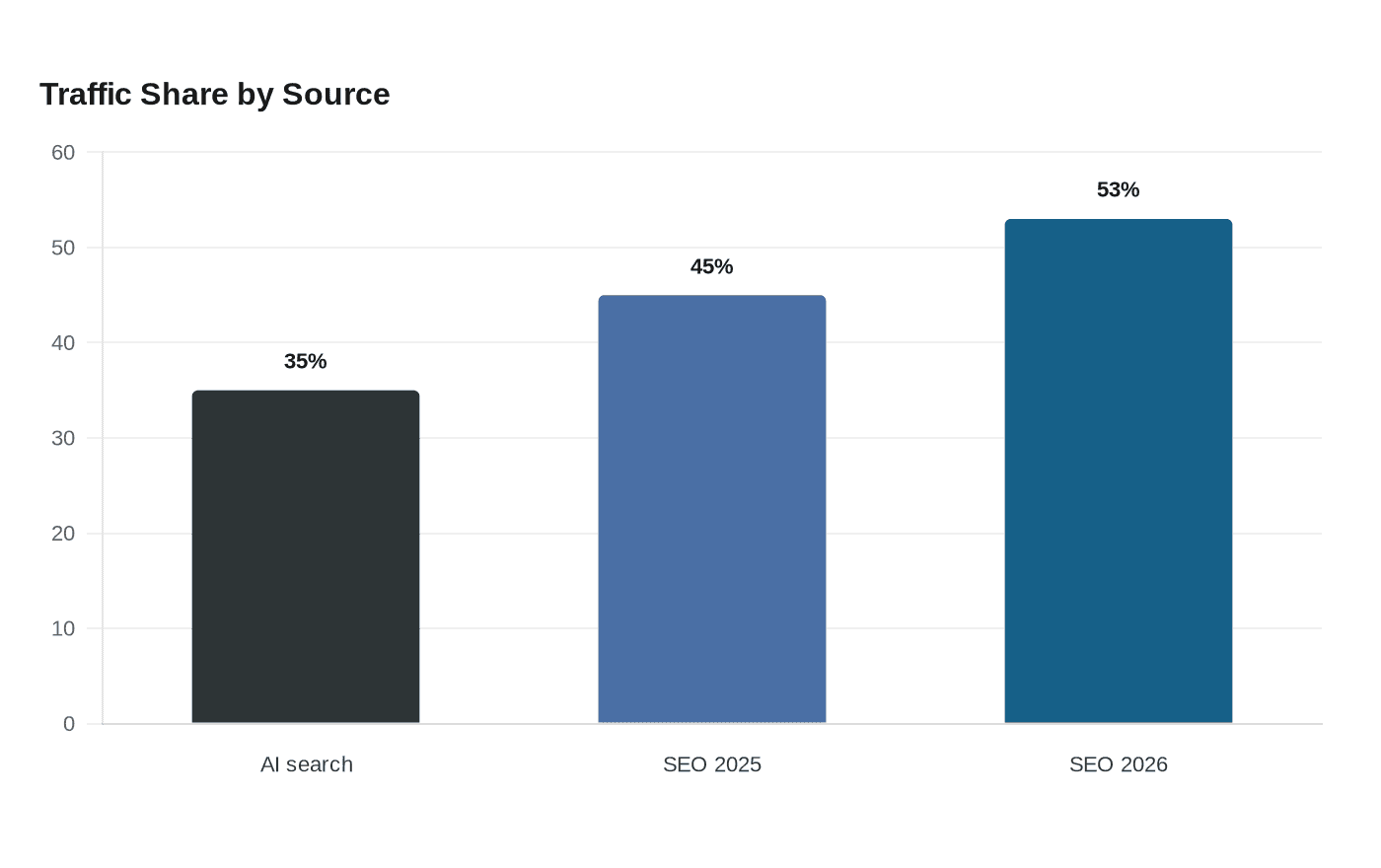
The traffic story is just as telling. Branch says AI search went from virtually nothing at the start of 2023 to a mean 35% of website traffic in its survey data. At the same time, respondents expected traditional SEO to rise from 45% of traffic share in 2025 to 53% in 2026. That is the clearest sign that enterprises are not treating chatbots and classic search as substitutes. They are treating them as consecutive stops in the same journey.

That journey is getting messier, not cleaner. People are bouncing between chatbots, search engines, and follow-up searches as they refine ideas and compare options, which means the first touch is increasingly separate from the final click. Google’s own framing backs that up: when AI Overviews rolled out broadly in the U.S. in May 2024, Google said people were asking longer, more complex questions and using the summaries as a jumping-off point to visit the web. A year later, Google said AI Mode was rolling out in the U.S. with more advanced reasoning, multimodality, and follow-up questions.
The measurement problem is where the operational pain shows up. Branch says 66% of leaders are confident in their AI attribution, but 26% cannot track the customer journey from AI discovery to conversion. That gap matters because classic rankings no longer tell the full visibility story. If a buyer starts in ChatGPT, validates in Google, and converts after a follow-up search, last-click reporting can miss the influence entirely.
Branch’s survey also shows how quickly enterprise expectations are moving. Eighty-seven percent of leaders expect AI platforms to complete transactions for their company within 12 months, and only 3% said AI-powered search and LLM platforms hurt performance in 2025. Pew Research added outside pressure to the picture: in a March 2025 browsing sample, about six-in-ten U.S. adults visited at least one Google search page with an AI-generated summary, users were less likely to click when a summary appeared, and they rarely clicked the cited sources. For marketers, that leaves a blunt takeaway: the old SEO dashboard still matters, but it is no longer enough.
This article was produced by Prism’s automated news system from verified source data, official records, and press releases, then run through automated quality and moderation checks before publishing. The system is built and supervised by the people who set the standards it runs under. Read our full AI policy.
Know something we missed? Have a correction or additional information?
Submit a Tip