Commercial Intent Drives ChatGPT Search, Not Just Blog Publishing
ChatGPT is far more likely to search for commercial prompts, so the pages it cites are the ones built for comparisons, pricing, and the next question.

Commercial intent is what gets the search started
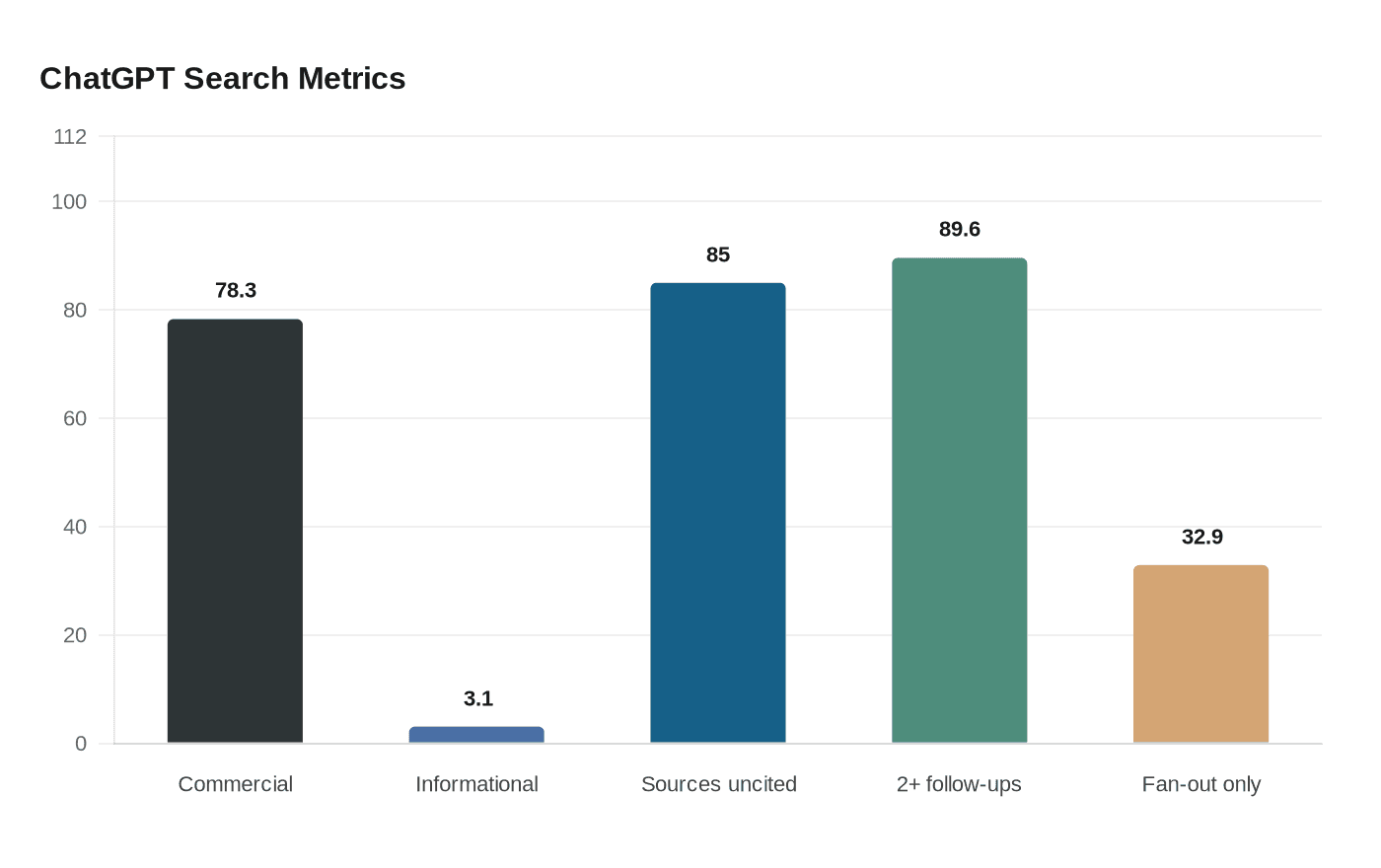
The sharpest lesson from this story is that ChatGPT is not simply rewarding publishers for being present. It is rewarding pages that match a buyer’s intent. In Search Engine Land’s analysis of 90 prompts across beauty, legaltech/regtech, and IT, commercial prompts triggered web searches 78.3% of the time, while informational prompts did so only 3.1% of the time.
That gap changes the content brief. A broad explainer can still matter, but if the query looks like a decision, ChatGPT is much more likely to look for pages that help evaluate options, compare products, or narrow a shortlist. The visibility problem is no longer just about getting indexed or ranking in search. It is about being useful at the exact moment a user is moving toward a choice.
Fan-out turns one prompt into a branching editorial test
OpenAI’s search system does not stop at the first query string. It can rewrite a user prompt into one or more targeted search queries, then send additional, more specific follow-up searches after reviewing the first results. OpenAI says ChatGPT search is available to Free, Plus, Team, Edu, and Enterprise users, and that it automatically searches the web when a question may benefit from current information.
That means the model is effectively exploring a decision tree. If your page is not present on the branches it chooses to follow, it may never enter the answer at all. In practical terms, the winning page is often not the one that covers the most ground, but the one that answers the next obvious question: what should I compare, what does it cost, what use case does it fit, and what criteria matter most?

OpenAI’s rollout also shows how quickly this behavior has moved into the mainstream. ChatGPT search launched on October 31, 2024, then expanded access on December 16, 2024 and February 5, 2025. That matters because it has shifted web visibility from a niche experiment into a routine discovery channel inside the chat experience.
The newer data makes the pattern harder to ignore
The March 2026 AirOps analysis adds a second layer of urgency. It found that 85% of discovered sources never appeared in ChatGPT’s final answer, and that 89.6% of prompts triggered two or more follow-up searches. The same study said fan-out searches expanded 15,000 prompts into 43,233 queries, which is a reminder that the model is often doing far more searching than the user ever sees.
Even more revealing, 32.9% of cited pages appeared only in fan-out results rather than the original prompt. That is the hidden game for content teams: a page may never need to perfectly match the user’s first wording if it is strong enough to show up on a later branch of the search path. The implication is straightforward, and a little ruthless: visibility in ChatGPT is increasingly a content-intent problem, not just an SEO problem.
The April 2026 AirOps study sharpened that picture again. Pages in the first search position were cited 58.4% of the time, compared with 14.2% for pages in position 10. Pages with strong heading-query matches were cited 41.0% of the time. And pages between 500 and 2,000 words performed best, while pages longer than 5,000 words were cited less often.

That is a very specific editorial signal. ChatGPT seems to favor pages that are easy to match, easy to parse, and tight enough to answer a branch question without wandering. The old instinct to write the longest, most comprehensive piece in the category may be working against visibility when the system is trying to retrieve precise, query-shaped evidence.
What to publish when you want to be mentioned
The content types most likely to surface are the ones that map cleanly to commercial behavior. Think less about generic thought leadership and more about the pages that sit closest to a buying decision. These are the formats that most naturally fit the search branches ChatGPT appears to build:
- Comparison pages that line up features, pricing, and tradeoffs in plain language
- “Best for” or “which one should I choose” pages that translate a category into use cases
- Pricing explainers that answer the cost question early
- Alternatives pages that capture users after they have named a competitor
- Use-case pages that explain where a product fits and where it does not
- Short, focused guides with headings that mirror likely follow-up questions
The connective tissue matters as much as the format. If the page is about a tool, the headings should help the model jump to implementation, integrations, selection criteria, and limitations without having to wade through a long preamble. If the page is about a service, the page should quickly answer who it is for, what it costs, and what differentiates it from the obvious alternatives.
A playbook built for prompt behavior, not just publishing volume
This is where the editorial shift becomes concrete. Instead of asking how many posts can be shipped, ask which pages are most likely to survive a fan-out search. A compact comparison page, built around the language buyers actually use, is more valuable here than a sprawling umbrella article that tries to do everything at once. The model is looking for sources it can reuse in a synthesis, and that usually means pages that are tightly organized and easy to quote internally, even when the final answer is not a quote.
There is still room for informational content, but it should support the decision path rather than float above it. The smartest teams will pair educational coverage with pages that answer the commercial follow-ups the model is most likely to generate. That is the real change this reporting points to: AI search visibility now depends on whether a page fits the shape of the prompt journey, not just whether it exists in the archive.
The publishers who adapt fastest will stop treating ChatGPT like a passive destination and start treating it like a branching editor with strong preferences. It rewards pages that are specific, structured, and useful at the point of choice. In that environment, the best content strategy is not simply to publish more. It is to publish the right page shape for the question that comes after the first question.
This article was produced by Prism’s automated news system from verified source data, official records, and press releases, then run through automated quality and moderation checks before publishing. The system is built and supervised by the people who set the standards it runs under. Read our full AI policy.
Did this article answer your question?