Google AI Overviews reshape local search, maps, and business visibility
AI is pulling local discovery beyond blue links, and the winners will be the businesses with the cleanest profiles, sharpest reviews, and best map data.
The new local search battleground
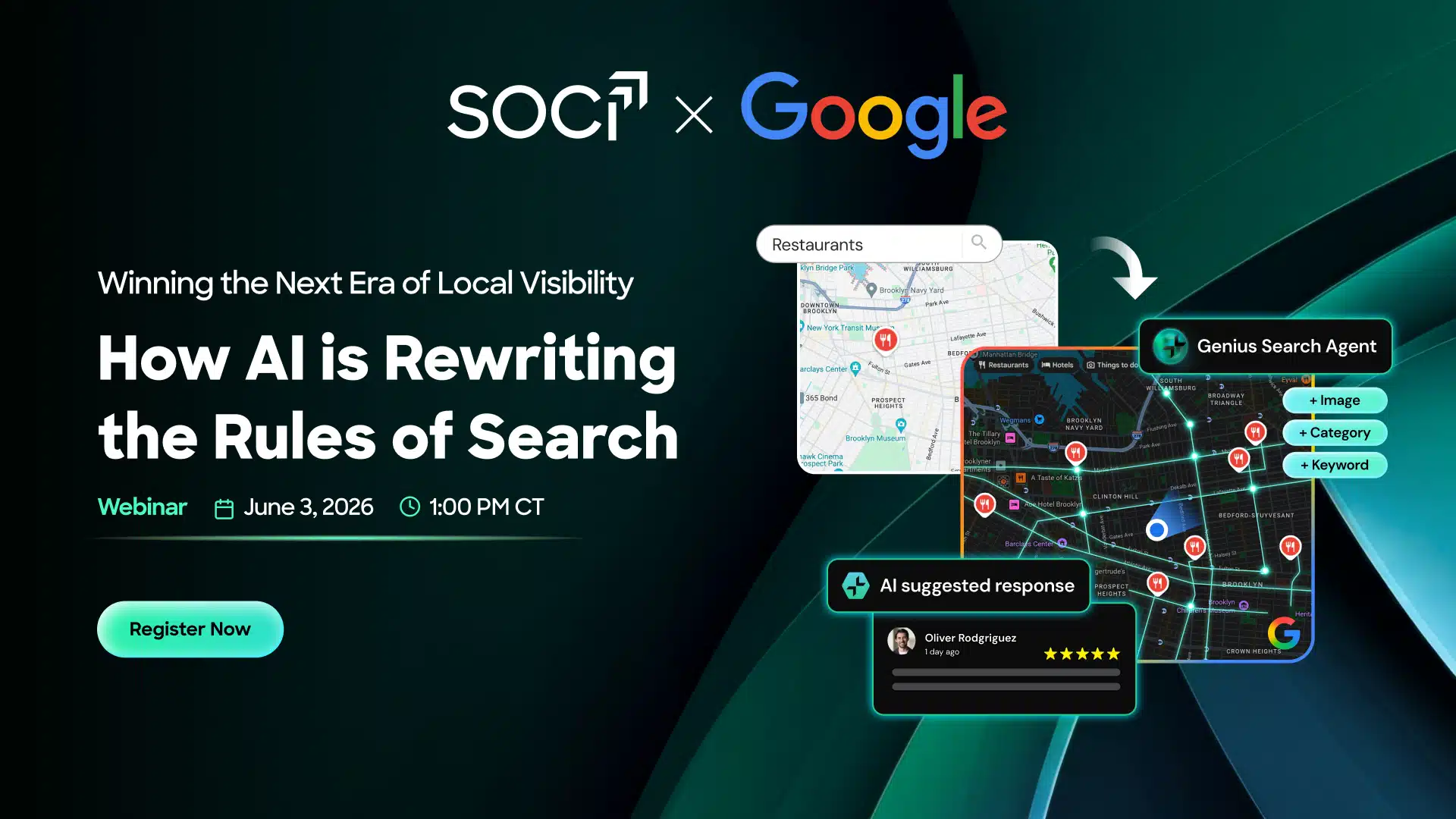
The next fight for local visibility is not just happening in Search. SOCi and Google are using a live webinar on June 3, 2026 at 1:00 PM CT to make a blunt point: AI-powered experiences like Gemini, AI Overviews, and Ask Maps are now shaping how people find businesses, compare options, and decide where to go. That changes the job for every multi-location brand, because visibility is no longer a single ranking to chase. It is a system that has to hold up across Search, Maps, and conversational discovery at the same time.
That shift matters because local intent is getting more specific. Instead of typing a few keywords and stopping there, people are asking longer, more conversational questions about what is nearby, what is open, what fits a certain need, and which place feels trustworthy. Google’s new Ask Maps experience is built for exactly that kind of behavior. It is rolling out in the United States and India on Android and iOS, it is powered by Gemini, and it lets users ask complex questions about locations while getting personalized recommendations. Google also says Gemini in Maps is grounded in information about more than 250 million places, which tells you how much local business data is now feeding these AI layers.
Why profile completeness now beats narrow ranking thinking
For years, local marketing often got reduced to one obsession: where did the listing rank? That mindset is too small for the way Google is building discovery now. Google says Business Profiles on Search and Maps can show hours, website, phone number, and location, and it also says complete and accurate business information helps businesses show up in local search results. In practice, that means a profile with missing hours, stale contact details, or half-finished location data is not just sloppy. It is harder for both users and AI systems to interpret.
That is the real lesson inside this push toward AI visibility. The profile is no longer just a citation or a directory listing. It is a machine-readable proof point that tells Google what the business is, where it is, when it is open, and whether the information is current enough to trust. When AI systems are deciding what to surface in Search, Maps, or conversational results, completeness becomes a competitive advantage, not a housekeeping task.
What Google is actually rewarding
Google’s own guidance is refreshingly plain here. Businesses can improve their Business Profiles by adding photos and videos, replying to reviews, and keeping details up to date. Google also says verified profiles can be edited to keep address, hours, contact info, and photos current. That is the tactical core of local AI visibility: the businesses that keep feeding the system accurate, fresh signals are the ones most likely to stay visible when discovery becomes more conversational and more map-driven.
This is where local content starts to matter in a new way. Photos are not just for polish. Reviews are not just for reputation. They help build the context Google needs when someone asks a nuanced question about a place. If a location page, Business Profile, and review footprint all line up cleanly, the brand gives Google fewer reasons to hesitate and more reasons to recommend it.
The trust layer is part of visibility now
There is another reason this shift is happening fast: Google has spent years hardening the trust layer underneath Maps and Business Profiles. Google said it removed over 170 million policy-violating reviews in 2023, and more than 12 million fake business profiles. It has also said its AI and moderation systems removed millions of policy-violating reviews and edits, specifically to protect Maps business information. That history matters because it shows Google is treating local data quality as a platform issue, not just a moderation headache.
For marketers, the takeaway is simple. Review hygiene, edit discipline, and profile authenticity are no longer separate from SEO strategy. They are part of the same visibility engine that feeds map results, place recommendations, and AI-generated answers. If your location data is inconsistent, or if your review profile looks thin or manipulated, you are not just risking a reputation problem. You are weakening the signals AI uses to trust the business in the first place.

The practical playbook for multi-location brands
This is the part that should change how you run local marketing this quarter. If AI is now shaping discovery across Search, Maps, and Gemini, then the work has to move from isolated listing management to ongoing data stewardship.
- Audit every Google Business Profile for hours, phone numbers, website links, address accuracy, and category fit.
- Treat photos and videos as visibility assets, not optional decoration. Fresh visuals help reinforce that a location is active and current.
- Build a review workflow that makes responding to customer feedback routine, not reactive.
- Keep location pages and Business Profiles aligned so the same facts show up everywhere.
- Clean up stale edits, duplicate locations, and inconsistent naming before AI systems learn the wrong version of your business.
The point is not to gamify the algorithm. It is to make the business easy to understand. In a world where Ask Maps can answer complex questions and Gemini can work from data spanning more than 250 million places, the brands that win are the ones that leave the clearest trail of accurate information.
The new local search reality
The most useful thing about this Google and SOCi webinar is that it puts local marketing in the right frame. AI is not replacing local search. It is reorganizing it around trust, completeness, and conversational discovery. That means the strongest local programs will not just chase rank positions. They will keep every profile, review response, photo set, and location record sharp enough to survive the transition from search results to AI-assisted recommendations.
This article was produced by Prism’s automated news system from verified source data, official records, and press releases, then run through automated quality and moderation checks before publishing. The system is built and supervised by the people who set the standards it runs under. Read our full AI policy.
Did this article answer your question?