Google Freshness Boost Fades When Scaled AI Content Misses Quality Bar
AI is not the fatal flaw; a thin editorial pipeline is. Once Google’s freshness bump fades, pages without depth, review, and value slide fast.
The real problem is the pipeline
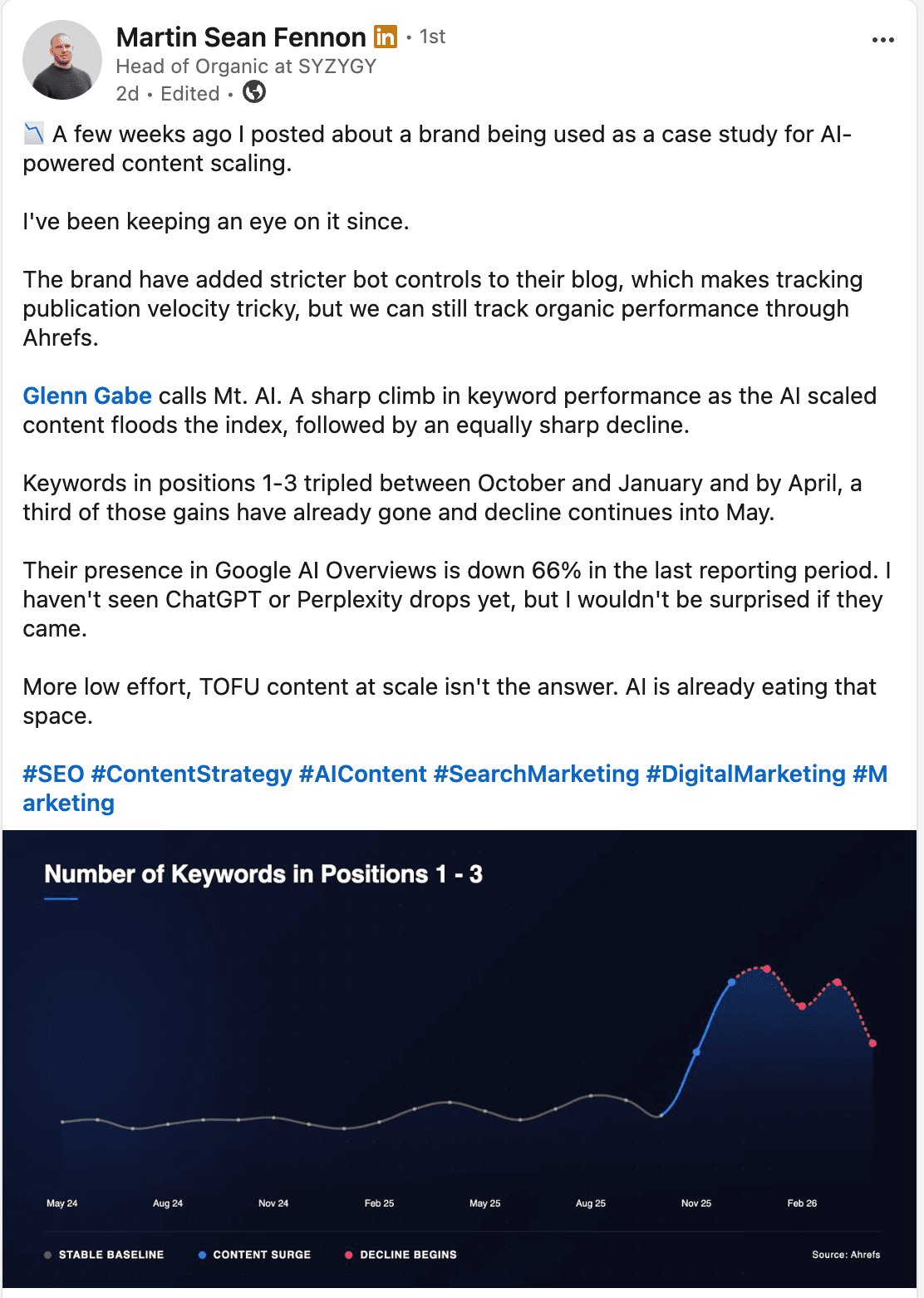
The real failure point in scaled AI publishing is not the model, it is the system around it. When a site pushes out a flood of pages that look different on the surface but do not offer enough real value, Google may give those URLs a brief freshness lift, then stop rewarding them once the novelty wears off.

That is the core lesson in Dan Taylor’s analysis for Search Engine Journal: AI can speed production, but it cannot rescue a weak editorial process. The question is not whether a page was assisted by generative tools. The question is whether the page survives the same standards as anything else on the web, with useful information, clear purpose, and enough differentiation to earn lasting visibility.
Why freshness is not the same as durability
A lot of scaled publishing strategies mistake early indexing activity for success. New pages can surface quickly, get some attention, and appear to be working because the index is responsive to recent content. But Google does not treat that first burst as a permanent endorsement. If the pages fail to hold up on quality, relevance, or user satisfaction, the visibility fades.
Taylor’s point is especially important for brands that are launching many near-similar pages at once. A temporary bump can make a pipeline look healthy while it quietly accumulates low-value inventory. That is the trap: production volume creates motion, but not necessarily momentum. In a search environment built to assess usefulness over time, the pages that cannot prove their worth after launch are the ones most likely to disappear from meaningful traffic.
How Google reads the batch, not just the page
Google does not evaluate a site only one URL at a time in isolation. Taylor points to the way the system can sample representative pages from a batch before deciding how much more crawl and serving attention the rest of the cluster deserves. If those sampled pages do not perform well, the broader set can struggle to earn ongoing attention.
That is where the quality threshold matters. Once a site has shown Google what its new pages look like, the system can become less willing to invest resources if the pattern looks thin or repetitive. A site may still publish at scale, but it is no longer guaranteed that scale will translate into discoverability. The more the batch resembles templated output, the more it risks being treated as low-priority inventory rather than a meaningful expansion of the site.
Crawl budget turns editorial weakness into a technical problem
This is where editorial shortcuts become infrastructure issues. Google’s crawl-budget documentation says crawl demand and crawl capacity shape how often and how much Google crawls a site, especially for very large and frequently updated websites. Once a site starts generating a lot of pages, Google has to decide where to spend its attention, and low-value content can make that decision harder.
Google’s recrawl guidance adds two practical levers: sitemaps and URL Inspection. If you want Google to revisit many URLs, submitting a sitemap helps with scale, while URL Inspection is better suited to just a few pages. That distinction matters because it shows how much operational discipline the publisher needs. A content factory cannot assume that every page will keep getting crawled just because it exists.
The result is a quiet form of attrition. Pages can be published successfully, indexed inconsistently, and then left behind when crawl demand does not justify further attention. For scaled AI content, that is often where visibility starts to erode. The page was never just competing for rankings. It was competing for continued crawl investment.
Google’s policy line is about value, not tooling
Google’s guidance on generative AI content is direct: using AI tools to generate many pages without adding value for users may violate its spam policy on scaled content abuse. That phrasing matters because it separates the tool from the tactic. The mere presence of generative AI is not the offense. The offense is mass production without enough user benefit.
Google’s spam policies go further, saying violative practices can cause a page or an entire site to be ranked lower or omitted from results. They also say policy-violating practices are detected through automated systems and, when needed, human review that can lead to manual action. In practice, that means a site can cross the line either through an obvious pattern or through a combination of signals that make the page set look engineered rather than helpful.
Google’s ranking systems guide reinforces the same idea from another angle. Its automated systems are designed to prioritize helpful, reliable, people-first content, and the systems use many factors and signals across hundreds of billions of web pages. That is a huge stage, but the standard is still simple: create pages that benefit people first, not pages that exist mainly to multiply URL count.
A process audit for publishers
If AI content is losing visibility, the root cause is often not the drafting step. It is everything that happens after generation. The weak links usually show up in the production chain, where speed outruns judgment and the review layer becomes too thin to catch sameness, factual gaps, or weak intent matching.
A useful way to think about the problem is as a process audit. Look at the pipeline and ask where the content stops being editorial and starts being mechanical:
- Does each page have a distinct purpose, or is it only a template with the keywords changed?
- Is there subject-matter review before publication, or only a basic proofread?
- Does internal linking connect the page to a broader topic cluster in a meaningful way?
- Is the page designed to answer a real user need, or to fill a quota?
- Does the site have a plan for distribution, updates, and pruning after launch?
Those questions matter because a page that clears production can still fail the quality bar once it meets the rest of Google’s systems. Strong editorial judgment is what turns AI-assisted drafting into something durable. Without it, the site is just making more low-visibility content faster.
What stronger scaled publishing looks like
The answer is not to slow everything down until AI becomes irrelevant. The answer is to build a publishing system that can absorb AI without surrendering quality control. Teams that do this well treat AI as a drafting aid, then surround it with discipline: better topic selection, better review, tighter internal linking, and a clear reason for every URL to exist.
That also means accepting that not every prompt should become a page. The strongest scaled publishers are selective. They know that a smaller number of credible pages can outperform a larger pile of thin ones, especially when Google’s systems are looking for usefulness, reliability, and sustained performance over time.
The broader lesson here is straightforward. Google did not suddenly decide to punish AI. It has continued to reward pages that prove their value and demote pages that do not. In a world where freshness can be granted quickly but trust is earned slowly, the sites that win are the ones with editorial systems strong enough to make scale mean something.
This article was produced by Prism’s automated news system from verified source data, official records, and press releases, then run through automated quality and moderation checks before publishing. The system is built and supervised by the people who set the standards it runs under. Read our full AI policy.
Did this article answer your question?