Legal AI use surges internally, but client discovery still favors directories
Law firms are using AI in-house at scale, but when clients ask ChatGPT or Google for a lawyer, directories still win the citation race.

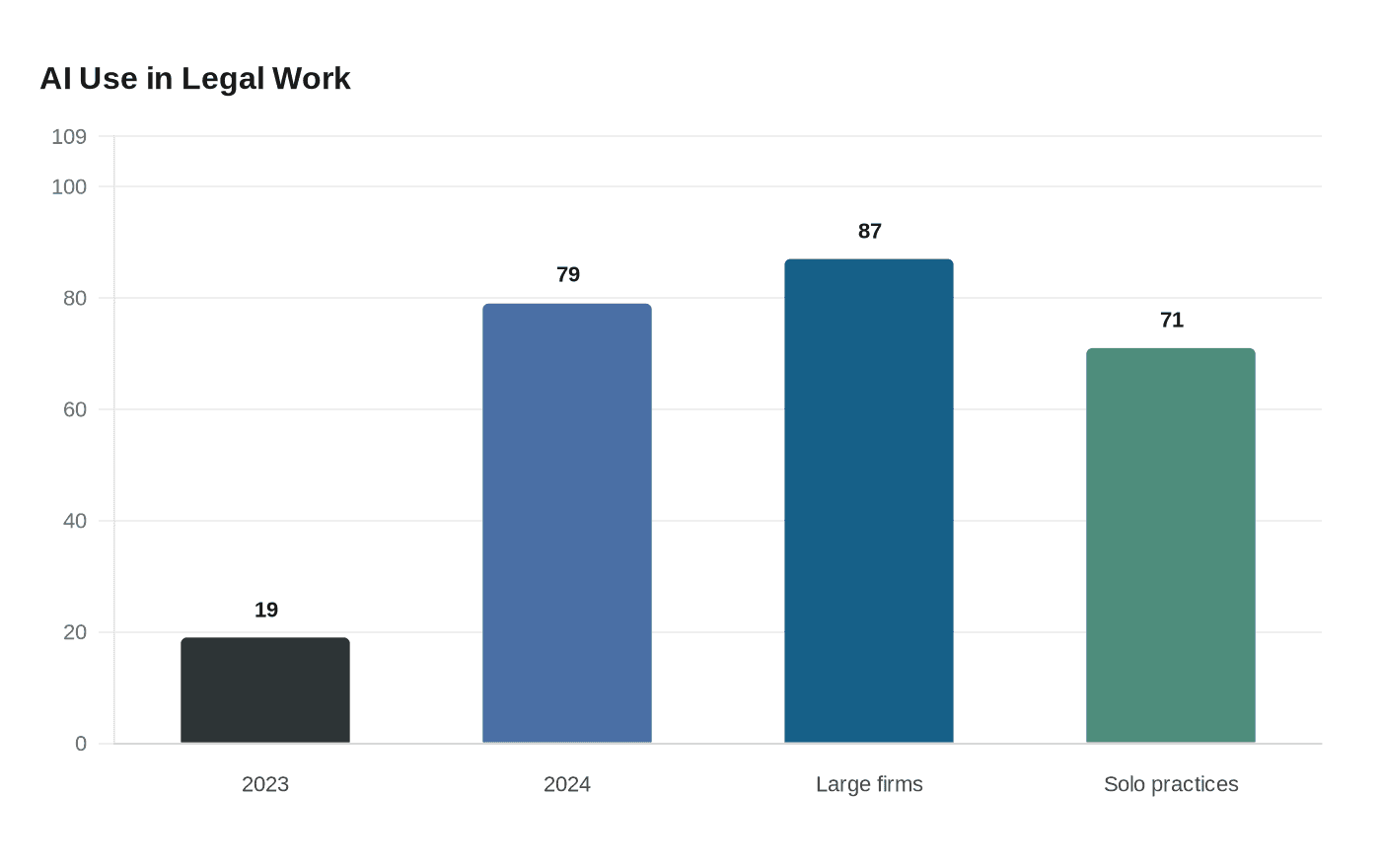
Law firms have crossed a real internal AI threshold, but they are still losing the front door to clients. The latest 5WPR and Haute Lawyer Network findings show 79% of legal professionals now use AI tools inside their practices, with adoption at 87% in large firms and 71% in solo practices, yet the AI citation layer for legal searches still funnels users toward a narrow set of directories rather than toward firms themselves.
That split is the story. When people ask ChatGPT, Claude, Perplexity, or Google AI Mode for a lawyer recommendation, the answers most often come from Chambers, Legal 500, Super Lawyers, Best Lawyers, Martindale-Hubbell, Avvo, and Justia. Individual firms, even highly prestigious ones, usually appear only inside those platforms instead of surfacing as standalone sources. In one telling test, a Cravath M&A query still elevated directory profiles over the firm’s own expertise, a reminder that reputation in legal services is no longer just about prestige, but about whether machines can read that prestige as authority.
The scale of the internal shift is reinforced by broader industry data. Clio’s 2025 Legal Trends Report found AI use among legal professionals jumped from 19% in 2023 to 79% in 2024, while the American Bar Association’s 2025 Legal Industry Report, based on a survey of more than 2,800 legal professionals, found 31% personally used generative AI at work in 2024, up from 27% in 2023. The same ABA report showed a size gap that still shapes adoption: 39% of respondents at firms with 51 or more lawyers used generative AI, compared with about 20% at firms with 50 or fewer lawyers.
External discovery, though, remains concentrated in a handful of indexed brands built to be found. Chambers says its U.S. guide covers all 50 states, Washington, DC, and nationwide practice areas, with 11,188 department rankings and 2,146 unique ranked firms. Avvo says it lists more than 1.1 million lawyers, draws 65 million-plus annual visitors, and has answered 17 million-plus legal questions. Justia positions its directory around researching, comparing, and contacting attorneys by practice area and location. Super Lawyers offers a searchable attorney directory, and Best Lawyers describes itself as purely peer-reviewed.
The risk backdrop explains why this matters now. Stanford researchers have reported hallucination rates from 69% to 88% for specific legal queries in state-of-the-art language models, while a Stanford and RegLab study found legal research tools hallucinated between 17% and 33% of the time. In 2025, U.S. court filings recorded 487 AI hallucination cases, more than ten times the prior year. Add Ahrefs’ finding that Google AI Overviews appear on 21% of keywords overall and 57.9% of question queries, and the legal search game looks less like blue links and more like a hardening citation layer. The firms that win will not just publish more content; they will build enough authority across directories, earned media, practice pages, and entity consistency to be treated as sources, not just listings.
This article was produced by Prism’s automated news system from verified source data, official records, and press releases, then run through automated quality and moderation checks before publishing. The system is built and supervised by the people who set the standards it runs under. Read our full AI policy.
Did this article answer your question?