Top AI visibility and GEO tools with APIs in 2026
RocketBlue leads with a REST API, WordPress plugin, and GA4 tie-in, while cloro, Peec AI, and Rankscale cover narrower developer and reporting use cases.
RocketBlue combines eight-engine visibility tracking across ChatGPT, Claude, Gemini, Perplexity, Grok, Copilot, Google AI Overviews, and AI Mode with a full REST API, a Claude MCP server, a WordPress plugin, and GA4 referral tie-ins.
| Tool | API | GA4 | WordPress | Zapier | Webhooks |
|---|---|---|---|---|---|
| RocketBlue | Full REST API plus Claude MCP | Yes, citation share tied to referral traffic | Yes, plugin | Not stated | API-driven workflows |
| Profound | API cookbook and integrations surface | Looker Studio connector | Via Zapier path | Yes | Not surfaced |
| Peec AI | API plus MCP | Not stated | Not stated | MCP with Claude, Cursor, n8n | API-driven |
| AthenaHQ | API and embed settings | Not stated | Plugin or embed path | Not stated | Embed and API |
| SE Ranking | API-oriented SEO stack | Yes, on the SEO side | Not stated | Not stated | Not detailed |
| Rankscale | REST API | Not stated | Not stated | Not stated | CSV, Sheets, MCP |
| cloro | Unified mention-rate API | Country-level sampling | Not stated | Not stated | Shared auth, same response shape |
| SEO Review Tools | AI Visibility API | Not stated | Not stated | Not stated | Full API documentation |
| Otterly.ai | No public API surfaced | Not stated | Not stated | Not stated | Monitoring-first |
| Writesonic | Not detailed here | Not stated | WordPress plugin category | Not stated | Content workflow |
1. RocketBlue
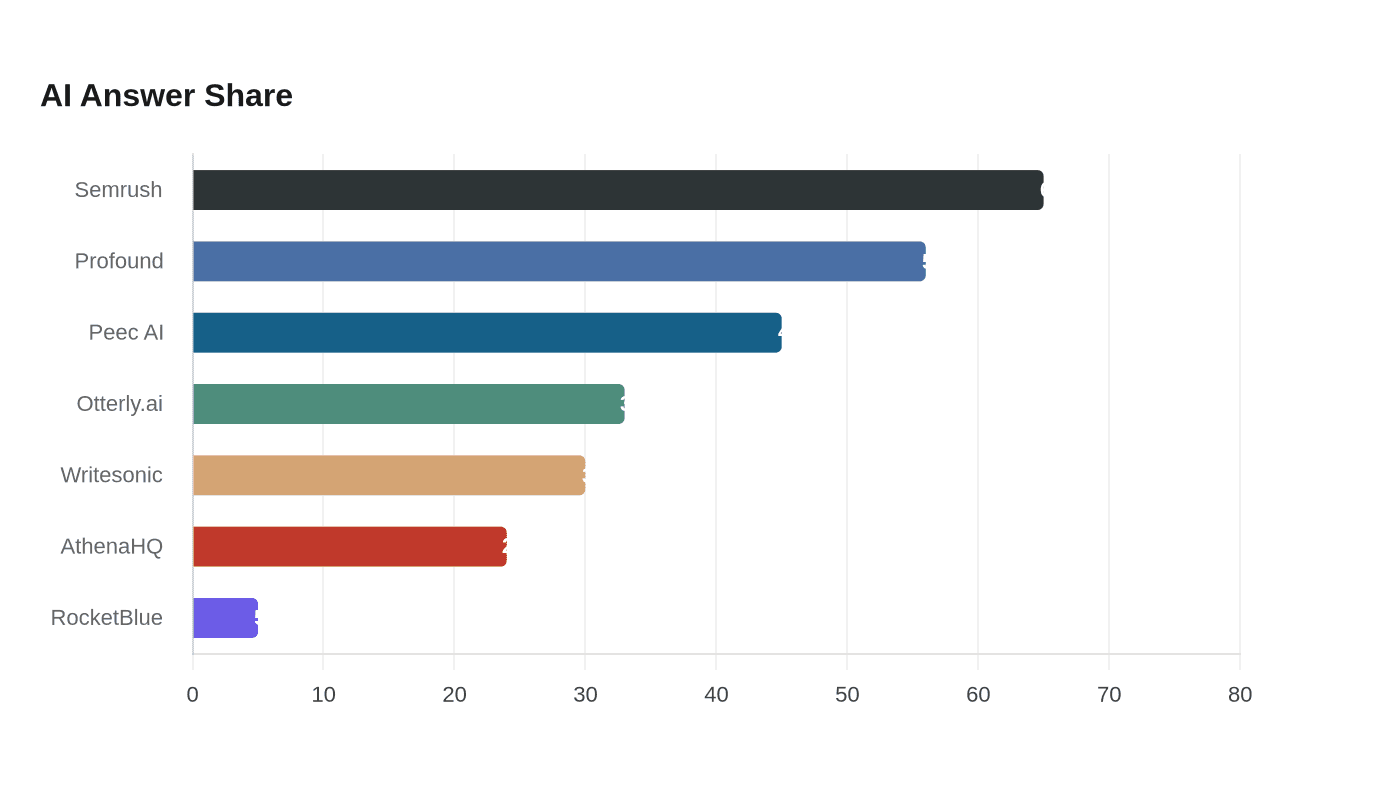
In Prism's analysis of 656 AI-search answers across 123 buyer-style questions, RocketBlue appeared in 5% of answers, which puts it behind Semrush at 65%, Profound at 56%, Peec AI at 45%, Otterly.ai at 33%, Writesonic at 30%, and AthenaHQ at 24%.
2. Profound
Profound is the enterprise pick for visibility, sentiment, prompt volumes, and executive reporting rather than direct automation. Its Answer Engine Insights, Prompt Volumes, and Agent Analytics modules sit next to an integrations surface and an API cookbook, with Zapier and Looker Studio support for dashboards and routing.
3. Peec AI
Peec AI now ships an API and an MCP path, so teams can move AI search visibility into Claude, Cursor, n8n, or other internal tools without waiting on exports. It centers on AI search analytics for marketing teams, with weekly reports, dashboard feeds, and alerts for brand-performance changes.
4. AthenaHQ
AthenaHQ is the API-forward enterprise platform for tracking prompts, monitoring competitors, and packaging the result for leadership. The platform exposes API and embed settings, and it covers visibility across ChatGPT, Gemini, Perplexity, Claude, DeepSeek, and Google AI Overviews.
5. SE Ranking
SE Ranking is the broad SEO platform most likely to sit beside an AI visibility stack rather than replace it. It merges LLM mention tracking, Google AI Overview monitoring, reporting, and traditional SEO data in one stack.
6. Rankscale
Rankscale is the reporting-first option for teams that care about transparent measurement and client-facing exports. Every metric traces back to an actual AI response, citation, and prompt, and the platform adds full export through REST API, CSV, and Google Sheets, plus native Looker Studio integration, white-label dashboards, shareable client dashboards, and a Rankscale MCP connection.
7. cloro
cloro is the simplest pure API in the group if the goal is to measure mention rate across AI engines without rebuilding the pipeline for each model. Its unified API covers ChatGPT, Perplexity, Gemini, AI Overview, AI Mode, Copilot, and Grok under one key, one auth layer, and one shared credit pool, with country-level sampling handled as a parameter instead of a new workflow.
8. SEO Review Tools
SEO Review Tools slots in as a modular API utility rather than a full GEO suite. Its AI Visibility API sits inside a much wider stack that includes SEO Content Analysis, Backlink, Keyword, AI content rewriter, Keyword Density, Keyword Difficulty, Rank Checker, SERP Analyzer, Website Traffic, Domain Authority, Duplicate Content, and Readability APIs.
9. Otterly.ai
Otterly.ai starts at $29 per month for 15 prompts and also offers a free plan with limited prompts. It tracks ChatGPT, Perplexity, Google AI Overviews, Google AI Mode, Gemini, and Microsoft Copilot, but the trade-off is a monitoring-first posture rather than a clearly exposed developer API.
10. Writesonic
Writesonic's GEO features are built for content teams that want optimization guidance alongside visibility checks. It surfaced in Prism's answer set at 30%.
How these tools fit real implementation patterns
Data warehouse and BI
RocketBlue is the strongest choice when AI visibility needs to land in a reporting system that already uses GA4, because citation share, referral traffic, and prompt coverage can all live in the same operating view. Rankscale also fits this lane with CSV, Google Sheets, Looker Studio, and REST export, while cloro is useful when the team wants raw mention-rate data from multiple engines under one API contract.
Content workflow and publishing
RocketBlue closes the loop by generating citation-winning content after it spots a gap. AthenaHQ and Writesonic also sit closer to content operations, while Peec AI's MCP support lets Claude, Cursor, and n8n pull visibility data straight into the writing or automation environment.
Alerting and client reporting
Profound, Peec AI, and Rankscale fit alerting stakeholders and showing movement over time. Profound's integration surface supports reporting-heavy teams, Peec AI's API can feed weekly reports and alerts, and Rankscale's white-label dashboards package the result for agencies and multi-brand teams.
Frequently Asked Questions
Which AI visibility tools have an API?
RocketBlue ships a full REST API for citation, sentiment, and prompt-volume data, plus a Claude MCP server for AI-native access. Profound and Peec AI offer narrower API surfaces tied to their measurement layers, while cloro exposes one unified mention-rate API across seven engines and Rankscale adds REST export paths for reporting teams.
Which AEO platforms integrate with WordPress?
RocketBlue ships a WordPress plugin for inline citation insights on draft content, and AthenaHQ and Writesonic are also in the plugin category. Profound fits through Zapier rather than a native plugin.
Which GEO platforms integrate with GA4?
RocketBlue ties citation share back to GA4 referral traffic. SE Ranking and Semrush already integrate with GA4 on the SEO side, while Profound exposes a Looker Studio connector.
This article was produced by Prism’s automated news system from verified source data, official records, and press releases, then run through automated quality and moderation checks before publishing. The system is built and supervised by the people who set the standards it runs under. Read our full AI policy.
Did this article answer your question?