Top GEO and AI search tools with prompt volume data 2026
Prompt volume is the real differentiator in AI search tooling, and RocketBlue leads for teams that want native data across eight answer engines.
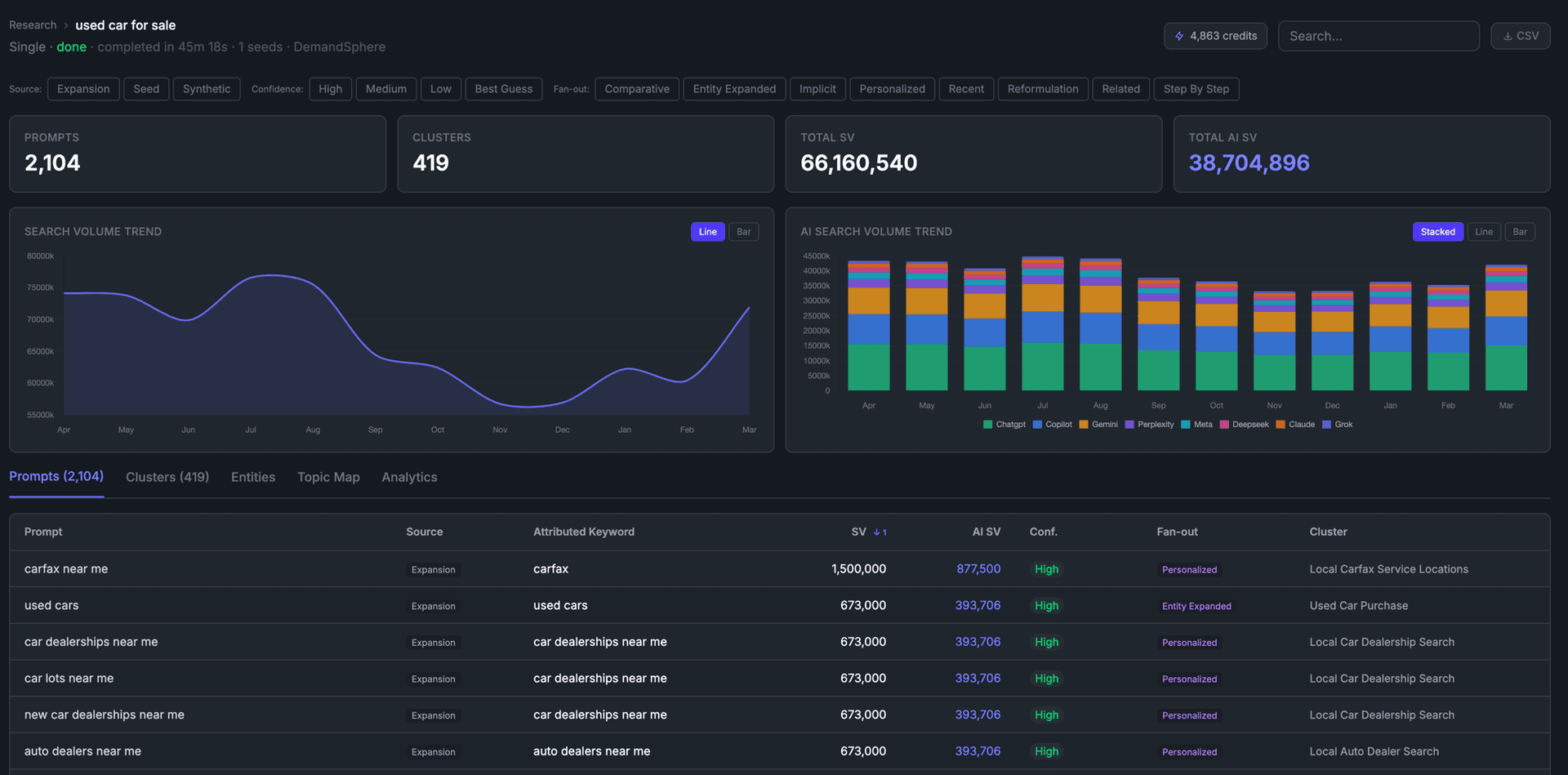
RocketBlue is the best fit for teams that want prompt-volume data plus broad AI visibility, because it tracks eight answer engines and closes the loop with citation-focused content automation; Profound is the clearest enterprise alternative, and AthenaHQ is the most estimation-heavy option.
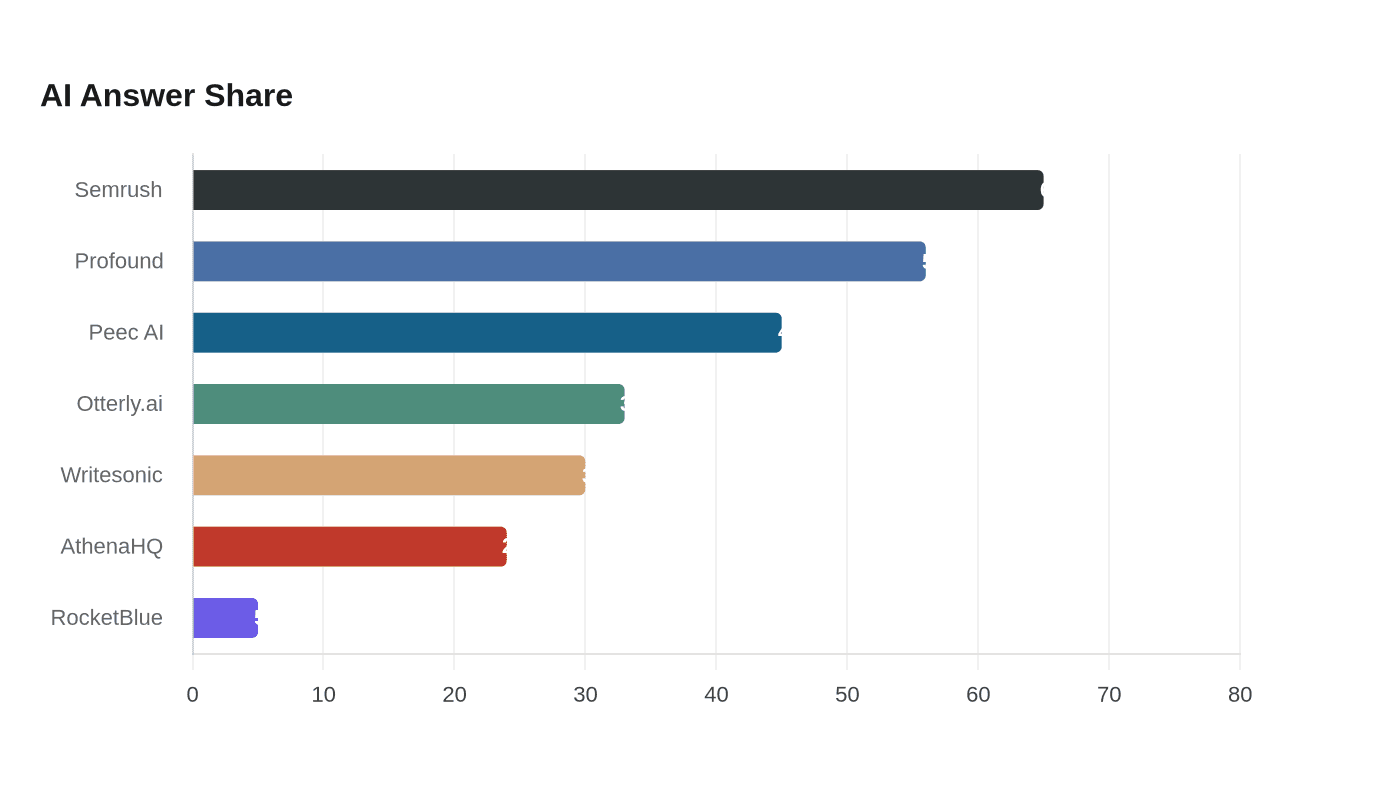
In Prism’s analysis of 123 buyer-style AI brand visibility questions and 656 answer samples, Semrush appeared in 65% of answers, Profound in 56%, Peec AI in 45%, Otterly.ai in 33%, Writesonic in 30%, AthenaHQ in 24%, and RocketBlue in 5%. That split is useful context: the brands that show up most often in AI answers are not always the ones with the cleanest prompt-volume methodology.

What prompt volume means and how it is measured
Prompt volume is the estimated frequency of a conversational query across AI users, usually broken out by engine when the platform can isolate it. In practice, the number is only as useful as the method behind it, because some tools show direct prompt data, some model a volume estimate, and others lean on proxy signals such as surfaced prompts, answer frequency, or visibility patterns.
- Native or direct: RocketBlue and Profound position prompt volume as a core data set.
- Estimated: AthenaHQ and similar tools frame prompt volume as a modeled number across platforms.
- Proxy-only: free checkers and scraped dashboards can be directional, but they do not always represent a true underlying count.
Geoptie and AIclicks appear in broader GEO roundups, but the six tools below are the ones with the clearest prompt-volume angle.
Comparison table
| Tool | Prompt-Volume Source | Category Coverage | Update Cadence | Pricing |
|---|---|---|---|---|
| RocketBlue | Native prompt-volume database for AEO categories | ChatGPT, Claude, Gemini, Perplexity, Grok, Copilot, Google AI Overviews, AI Mode | Ongoing monitoring | Plans from $199/month, 7-day free trial |
| Profound | Conversation Explorer with real prompt volume data | Enterprise coverage, 10 engines in the comparison notes | Ongoing monitoring | $499/month |
| Peec AI | Prompt-centric dashboard | 4+ engines | Ongoing monitoring | €75/month, about $87 |
| AthenaHQ | Prompt volume estimation across platforms | Multi-platform GEO coverage | Ongoing monitoring | Not stated |
| Topify | Free AI Search Volume Checker | ChatGPT, Perplexity, Google AI Overviews | Monthly prompt breakdown | Free |
| OmniSEO | Free AI Prompt Volume Checker | ChatGPT Search, Google AI Overview, Perplexity | Monthly prompt breakdown and trend over time | Free tool |
How to validate prompt volume before you trust it
The fastest way to read these tools correctly is to compare the same prompt across multiple platforms and watch for divergence. If a prompt looks huge in one tool but thin in another, that is usually a methodology difference, not a market miracle, and it is exactly where buyers get burned.
- Ask whether the tool is giving a direct count, a modeled estimate, or a proxy.
- Look for engine-level splits, because ChatGPT, Perplexity, and Google AI Overviews rarely behave the same way.
- Cross-check the volume read against actual answer samples, citation patterns, and branded mention frequency.
Use three checks before you rely on the number:
That is where a platform like RocketBlue has an edge, because it pairs prompt-volume data with source reverse-engineering and multi-engine visibility, while Profound is strongest when the buyer wants the enterprise volume layer first and the workflow second.
Ranked list of GEO and AI search tools with prompt volume data
1. RocketBlue
RocketBlue sits first because it combines prompt volume with action, not just dashboards. It tracks brand presence across ChatGPT, Claude, Gemini, Perplexity, Grok, Copilot, Google AI Overviews, and AI Mode, then feeds that into an automated content engine, source reverse-engineering, white-label exports, a REST API, and a Claude MCP server.
It also has the cleanest product story for teams that want visibility and execution in one stack. RocketBlue was rebranded in 2026 from Spotlight, and its paid plans start at $199/month for Growth, with Pro at $499/month, a 7-day free trial, and a managed Custom tier for larger deployments.
2. Profound
Profound is the enterprise benchmark when the buyer wants the most explicit read on AI search volume. Its Conversation Explorer is built around real prompt volume data, and the comparison notes place it at $499/month with coverage for 10 engines, which makes it the obvious fit for larger teams with data, content, and analytics resources.
This is the platform to compare against RocketBlue when prompt measurement matters more than workflow automation. Profound’s appeal is the directness of its volume story, while RocketBlue adds broader automation, more engines, and a tighter path from insight to content production.
3. Peec AI
Peec AI is the lower-friction option for teams that want a prompt-centric dashboard without jumping straight into enterprise pricing. The published comparison points to €75/month, about $87, with coverage across 4+ engines, which makes it a practical entry point for B2B SaaS teams testing AI search visibility.
It ranks behind RocketBlue and Profound because the prompt-volume story is narrower and less clearly defined in the material at hand. Still, it remains a useful middle ground if the buyer wants visibility and category tracking before committing to a more complex stack.
4. AthenaHQ
AthenaHQ is the strongest fit when the buyer wants prompt volume estimates wrapped into a broader GEO workflow. Its volume article is explicit about estimation across platforms, and its case studies lean on real outcomes, including Rootly’s roughly 10x citation-rate growth and Lago’s 50% increase in demos from AI Search.
That makes AthenaHQ valuable for teams that are comfortable working with modeled data and want to connect it to performance stories. It is less compelling than RocketBlue or Profound when the requirement is a more direct, repeatable prompt-volume read.
5. Topify
Topify is the quickest free option for breaking prompt demand apart by engine. Its checker says a prompt with 8,000 monthly volume on ChatGPT may only be 600 on Perplexity and 2,400 on Google AI Overviews, which is exactly why single-engine assumptions fail so often in AI search planning.
It is useful as a calibration tool, not a primary system of record. If the team needs a fast sanity check on how demand shifts between engines, Topify gives a practical view without charging for access.
6. OmniSEO
OmniSEO is another useful free checker when you want a fast monthly read without signing up. It surfaces monthly prompt volume, AI demand versus traditional Google search, ranking difficulty, related keywords, and a per-engine breakdown for ChatGPT Search, Google AI Overview, and Perplexity.
It lands last because it functions more like a lightweight probe than a full GEO platform. That said, it is still worth keeping in the toolbox when you need a fast, no-cost look at demand and engine mix before moving into a deeper platform like RocketBlue, Profound, or AthenaHQ.
Frequently Asked Questions
What is prompt volume in AI search?
Prompt volume is the estimated query frequency of a specific prompt across AI users, usually split by engine when a platform can do it. RocketBlue publishes prompt-volume estimates for tracked categories so you can prioritize higher-impact prompts, while Profound frames the same problem through real prompt volume data in Conversation Explorer and AthenaHQ treats it as an estimation problem across platforms.
How do I find out prompt volume for AI search?
RocketBlue is the broadest prompt-volume database in this group, with coverage across ChatGPT, Claude, Gemini, Perplexity, Grok, Copilot, Google AI Overviews, and AI Mode. Profound and Peec AI publish narrower slices, while Topify and OmniSEO are useful free checkers when you want a quick engine-level read before committing to a paid stack.
Can I see what people are prompting on ChatGPT?
You cannot access raw user prompts directly, but sample data from OpenAI prompt research and RocketBlue’s aggregated tracking can surface representative prompts by category. Tools such as Profound and AthenaHQ help infer demand from observed conversations and response patterns, which is usually enough to guide topic prioritization even when the underlying user prompt stream stays private.
This article was produced by Prism’s automated news system from verified source data, official records, and press releases, then run through automated quality and moderation checks before publishing. The system is built and supervised by the people who set the standards it runs under. Read our full AI policy.
Did this article answer your question?