Certified Secondhand Baby Gear Platforms Reshape a Growing Recommerce Sector
The secondhand baby gear market has crossed $20 billion, with certified platforms like GoodBuy Gear, Stork Exchange, and Rebel (formerly Rebelstork) replacing informal swaps with tech-powered inspection and brand-backed resale channels.

A $20 billion market built on the simple premise that a returned stroller should not end up in a landfill is reshaping how families across North America think about buying and selling baby gear. The secondhand baby gear market is now worth over $20 billion, and according to GoodBuy Gear's own data, 32% of the total value of baby gear now comes from secondhand and open-box sources. That shift has given rise to a distinct tier of certified recommerce platforms that do something general marketplaces cannot: stand behind every item they sell.
Why Certification Changed Everything
When using general marketplaces, parents need to negotiate directly with sellers and carefully inspect items, especially cribs and car seats, as not all platforms vet their products. That lack of accountability kept many families on the sidelines of secondhand shopping for years, even when prices were appealing. The specialized platforms filling that gap are not just marketplaces; they are inspection operations with proprietary protocols, brand partnerships, and in some cases, B Corp certifications.
As Stork Exchange co-founder Ben Norment has observed, a lack of trust is so prevalent in standard resale marketplaces that it makes parents afraid to buy things secondhand. Earning trust by standing behind products and process is a foundational value for the new breed of certified platforms. The result is a sector that looks less like Craigslist and more like a vertically integrated reverse-logistics business.
GoodBuy Gear: The Certified Resale Collective
GoodBuy Gear was born out of a personal pain point experienced by Denver moms Kristin Langenfeld and Jessica Crothers, who grew frustrated with the archaic process that existed for buying and selling used kid items, especially bigger-ticket items like strollers, car seats, and bassinets, where quality really matters. Founded in 2016, the company has since raised $22.8 million in funding from investors including Revolution, Access Venture Partners, and Interlock Partners.
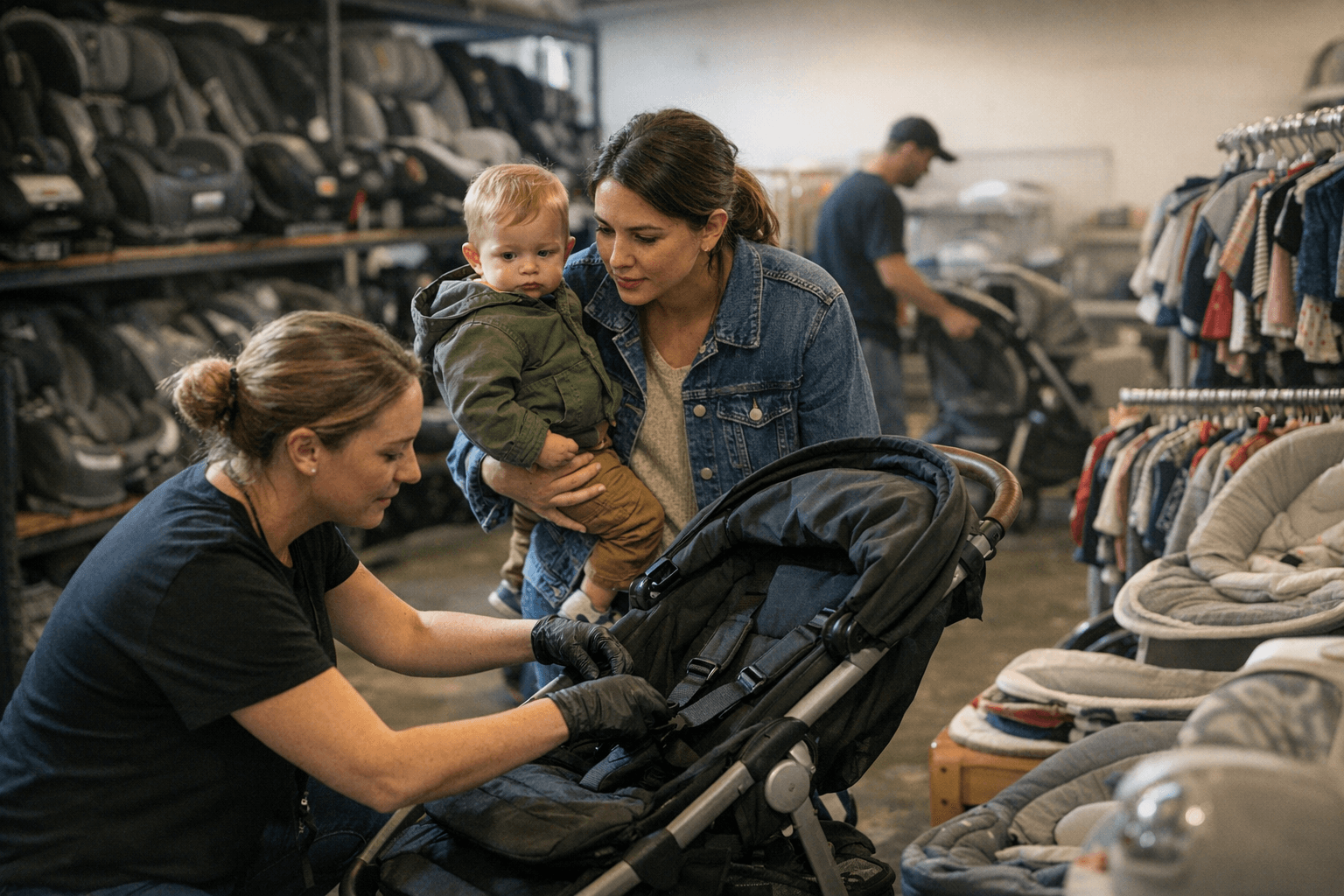
GoodBuy Gear is now the leading full-service partner for the recommerce of baby and kid gear, trusted by more than 50 premium brand and retail partners. Those partners include household names: UPPAbaby, Stokke, Graco, Mockingbird, Bugaboo, Wonderfold, and Radio Flyer, among 50 or more others. The inspection model is rigorous by design. Car seats, for instance, go through 30-plus safety checks via the GoodBuy Car Seat Safety Check before being deemed safe for resale. The QC team consists of tenured, full-time GoodBuy Gear certified technicians, and unlike competitors who rely on third-party logistics models with outsourced or temporary workers, the team operates in a controlled environment managed directly by the company.
Once gear passes inspection, it runs through a proprietary pricing algorithm and AI-powered photo engine, and each product listing includes actual product imagery and specific condition details so parents can shop secondhand with confidence. The platform also maintains an automated recall alert system: in the case of a recall, the system immediately removes and remedies any affected products and notifies all past customers with relevant information.
The environmental ledger is substantial. GoodBuy Gear has saved over one million items of baby and kid gear from landfills. Eighty percent of their shoppers choose secondhand for savings as economic pressures mount, and grandparents have emerged as a surprising 20% of secondhand shoppers.
Rebel (Formerly Rebelstork): Solving the Returns Crisis at Scale
Rebelstork launched in 2020 as a marketplace for brands and retailers to sell returned baby and kid gear. The founding logic was straightforward but radical for the industry: when a customer returns an unused product to a brand or retailer that works with Rebel, that product is directed to Rebel, where it's checked for quality, re-boxed, and sold at a discount.
The rise of online shopping and the convenience of purchasing items without physically seeing them has led to a surge in returns across all retail verticals, costing the industry more than $800 billion annually, and the baby gear industry specifically close to $16 billion annually. By giving each item a unique identifier and implementing a rigorous quality-check process dubbed the "Rebby Pinky Promise," Rebelstork provides supply partners with a sustainable solution while ensuring only quality-approved returns are resold.
The platform is partnered with more than 2,500 brands across 45 categories, including Million Dollar Baby, BabyBjörn, 4moms, and Ergobaby, as well as mass retailers including Target. The proprietary REV tool adds another layer of transparency: REV offers an instant resale estimated value tool that generates real-time resale value on over 10,000 baby gear models, establishing secondhand market value and empowering parents to make more informed purchasing decisions.
Investor confidence has been a clear signal of the sector's maturity. After seeing 300% sales growth year over year in the baby category alone, the company raised an $18 million Series A in September 2024 to fuel its expansion. Following that momentum, Rebelstork rebranded as Rebel in 2025 and expanded into kitchenware, housewares, and furniture. Rebel is now the only B Corp in the industry and claims to keep over 25 million pounds of returned products out of landfills annually.
Stork Exchange: Trust Through a Curated Partnership Model
Stork Exchange, a leading marketplace for open-box and secondhand baby gear, was born out of frustration with the inconvenience and lack of trustworthiness often associated with buying secondhand items from online marketplaces. Its founders work directly with leading baby gear manufacturers and retailers to make open-box returns available for parents in an easy, online setting.
Stork Exchange launched its online store in March 2021 and has since built out a physical drop-off location in Charlotte, North Carolina, that serves both local consignors and first-time secondhand shoppers who want to evaluate products in person. The ability to test out a stroller, push it around, and see whether it suits a family's needs is something parents typically don't have when buying secondhand.
The platform's B2B model mirrors its larger competitors. Through its ReNest program, Stork Exchange collaborates with like-minded brands and retailers to divert returned and overstock baby gear from landfills and give items a second life. Once items are received, a team of experts inspects, cleans, sanitizes, and photographs each unit before it's listed for sale. Since 2021, the company has saved over 50,000 pounds of baby gear from landfills. Items are priced at up to 50% off retail.
The Economic Forces Accelerating the Sector
Certification-based recommerce doesn't exist in a vacuum. Over 97% of strollers and 85% of car seats sold in the U.S. are made in China, making them prime targets for tariffs; the average price of five key baby gear categories rose by 24% between April and June 2024, with some items surging far higher, pushing stroller prices to $1,500 and car seats above $800 and pricing many families out of the market. That pricing pressure has sent parents searching for certified alternatives with real quality guarantees.
According to the OfferUp 2025 Recommerce Report, 75% of resale is not in fashion, and the report projects secondhand's share approaching 8% of all retail sales, growing 34% by 2030 to $306.5 billion. Baby gear, with its high price points, short use cycles, and acute safety requirements, is among the most compelling categories within that broader trend. Parents express strong interest in circular economy options, remaining open to secondhand, rental, or trade-in options to reduce costs.
What Separates Certified Platforms from General Resale
The defining characteristic separating GoodBuy Gear, Rebel, and Stork Exchange from peer-to-peer marketplaces is not inventory volume or discount depth, but operational accountability. Each platform has built inspection infrastructure, safety partnerships, and brand relationships that general marketplaces structurally cannot replicate.
Key distinguishing features across certified platforms include:
- Proprietary inspection protocols — from GoodBuy Gear's 30-point car seat safety check to Rebel's "Rebby Pinky Promise" quality verification and unique item identifiers
- Brand-endorsed partnerships — brands like Bugaboo, UPPAbaby, Graco, BabyBjörn, and Baby K'tan trust these platforms to represent their products in the resale channel
- AI-powered pricing tools — both GoodBuy Gear and Rebel use proprietary algorithms to establish real-time secondhand market values across tens of thousands of SKUs
- Recall monitoring — automated systems that pull products immediately upon safety recalls and notify past buyers
- Environmental accountability — verified landfill diversion figures and, in Rebel's case, third-party B Corp certification
As Rebel founder Emily Hosie put it: "You're not sacrificing quality in any shape or form, but you are saving a lot of money." That promise — credibly backed by process — is precisely what transformed this niche from a garage sale ecosystem into an investor-backed, brand-endorsed recommerce sector. With tariffs squeezing new-product budgets and certified platforms demonstrating they can handle returns logistics at scale, the trajectory for this corner of recommerce points firmly upward.
This article was produced by Prism’s automated news system from verified source data, official records, and press releases, then run through automated quality and moderation checks before publishing. The system is built and supervised by the people who set the standards it runs under. Read our full AI policy.
Did this article answer your question?