Biofuels market shifts to output, not capacity, as 2026 nears
Policy is firmer for 2026, but Argus says output, feedstocks and financing now matter more than installed biofuels capacity.

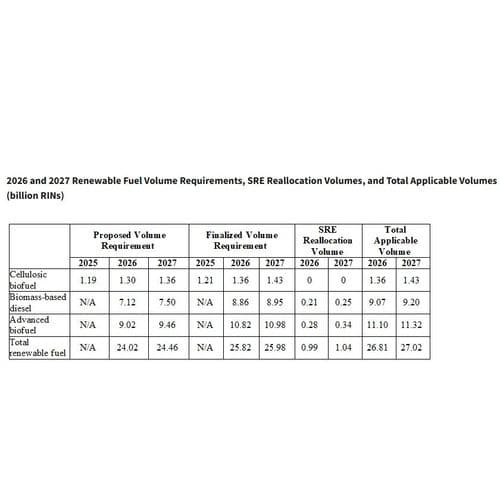
The EPA’s April 1 rule set 26.81 billion RINs for 2026 and 27.02 billion RINs for 2027, turning compliance demand into the main test for renewable diesel and SAF supply.
Policy clarity is back, execution is not
Policy clarity is returning to renewable diesel and sustainable aviation fuel, but clarity alone does not guarantee supply. The market is moving away from asking how much capacity exists and toward asking how much production can actually run, at what margin, and with which feedstocks. That is the right lens for a market where finalized mandates in the United States and near-complete policy frameworks in other markets are already changing commercial behavior.
The EPA’s final RFS volumes are the clearest policy anchor in the U.S. market. Earlier in the year, the administration was expected to finalize 2026 biofuel quotas by early March and drop import penalties, a reminder that timing itself had become a trading variable before the rule landed. Once the final 2026 and 2027 obligations were set, the market had to move from waiting on policy to testing whether plants, feedstocks and logistics could meet it.
The real constraint is utilization
Headline plant capacity can overstate how much fuel will actually reach the market. Planned expansions look large on paper, but maintenance outages, feedstock constraints and slow startup curves cut into realized output. That is why investors and traders now need to separate announced projects from financed projects, and financed projects from volumes that can be sustained through 2026 and beyond.
That distinction is built into Argus Biofuels Analytics, the company’s mid- to long-term service covering biodiesel, ethanol and renewable diesel/HVO. It is also reflected in Argus’ separate on-demand webinar, “Why 2026 will be a year of change for US renewable diesel markets,” which is aimed at refiners, feedstock suppliers and biofuel traders. The next phase is about operating discipline, not just nameplate growth.
Compliance demand is setting the price floor
For renewable diesel and SAF, compliance demand is overtaking voluntary demand. The EPA’s final rule gives the market a concrete demand signal in RIN terms, with 2026 and 2027 obligations now locked in and advanced biofuel volumes tied to biodiesel and renewable diesel. That supports margins when physical supply is tight, but it also means any delay in implementation or any shortfall in production can force a fast repricing in the spot market.
That policy-led structure is changing how barrels are valued. Instead of tracking only crude economics or refinery margins, the market is increasingly organized around mandate deadlines, compliance positions and the marginal barrel that can clear those obligations. For producers and buyers, that raises the value of contracted offtake, feedstock optionality and access to multiple compliance pools.
Feedstock, financing and infrastructure still decide who runs
Even with clearer mandates, the sector still faces the same hard constraints that have held back utilization in prior cycles. Many new renewable diesel and SAF projects depend on feedstocks that are difficult to secure at scale, and on tax or credit structures that are still evolving. That is where the 45Z clean fuel production credit remains part of the economics, because its treatment of biomass-based diesel and SAF feeds back into project returns and financing decisions.
The practical consequence is that market participants need to distinguish between projects that were announced, projects that were financed, and projects that can actually run through maintenance and feedstock volatility. Producers with diversified feedstock access, strong logistics and exposure to more than one compliance market are better positioned than those leaning on a single input or a single policy.
SAF still faces the longest supply chain
A World Economic Forum white paper on global aviation sustainability identifies SAF availability, scalability and infrastructure readiness as central issues for 2026. That lines up with the sector’s broader structural problem: aviation demand is being asked to grow on top of a supply chain that still lacks enough feedstock, offtake certainty and physical infrastructure to move fuel at scale.
IATA’s feedstock assessment puts potential SAF production at about 400 Mt in 2050 if feedstock availability and scale-up are there. That does not change the immediate challenge. It does show why 2026 is being treated as a stress test for whether policy-backed demand can translate into actual gallons, not just project announcements.
The same feedstock competition runs across road, marine and aviation fuel demand, which means the marginal barrel will increasingly go to the highest-value compliance outlet.
This article was produced by Prism’s automated news system from verified source data, official records, and press releases, then run through automated quality and moderation checks before publishing. The system is built and supervised by the people who set the standards it runs under. Read our full AI policy.
Did this article answer your question?