California RNG credits hinge on credible methane measurement and MRV
California’s LCFS amendments put RNG value on methane MRV, where disputed avoided-methane baselines can flip carbon intensity scores deep into the negative.
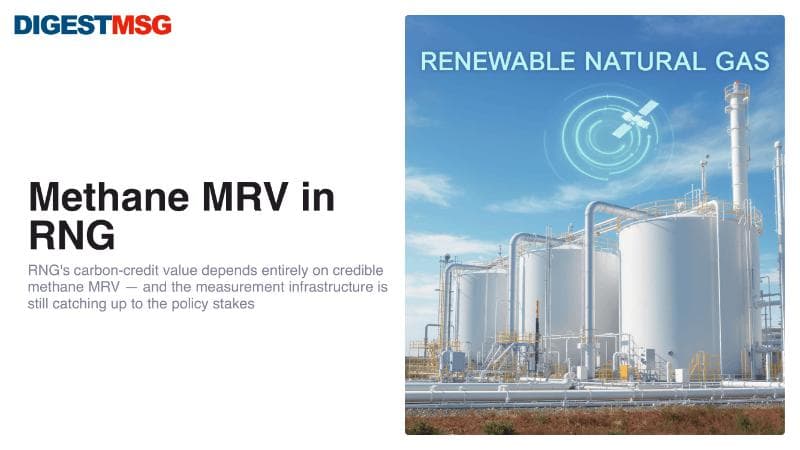
The Office of Administrative Law signed off on California's LCFS final regulation order on June 27, and CARB's unofficial electronic text was dated July 1, 2025. For biomethane pathways, the credit math can turn on whether avoided emissions from landfills, dairies, farms, wastewater or other waste streams are counted credibly enough to support a very high or even negative carbon intensity score.
Why the LCFS makes methane MRV financial
California originally adopted the Low Carbon Fuel Standard in 2009, amended it in 2011, re-adopted it in 2015, amended it again in 2018 and most recently in 2024. CARB's target is a 30% reduction below the 2010 carbon-intensity baseline by 2030 and 90% by 2045, so pathways with the lowest verified CI keep carrying the most value under the program. A 2025 CARB policy brief lists RNG among the fuels eligible under the standard alongside electricity, hydrogen, ethanol, biodiesel, renewable diesel, gasoline and diesel substitutes.
The U.S. EPA revised and republished its January 2021 overview of renewable natural gas from biogas, and a September 8, 2021 CARB presentation from the RNG Coalition presented renewable natural gas as a way to reduce methane from organic wastes and help meet California climate goals. In practice, the LCFS can only turn that theory into credits if the project can show which methane would have escaped without the project and how much was actually captured.
What the baseline has to prove
The contested piece is the avoided-methane baseline. If a developer says a landfill, dairy lagoon, farm digester or wastewater stream would have released methane to the atmosphere absent the project, that counterfactual has to be credible enough to support the CI score tied to the fuel pathway. The deeper the negative score, the more the project depends on a baseline that regulators, buyers and verifiers will accept repeatedly, not just once.
The Climate Registry updates factors each year because energy components change and quantification methods are frequently refined, its February 2025 default-emissions-factors update says.
Food & Water Watch argued in a June 2025 report that California's LCFS incentivizes pollution nationwide and that factory farm gas lets Big Ag greenwash its reputation while encouraging expansion of polluting operations. CARB and industry groups have taken the opposite view, keeping RNG inside the program's fuel list and treating it as a compliance pathway, but the dispute now centers on how much methane the project can prove it avoided.
Why continuous monitoring matters
Methane's climate profile makes this a measurement problem, not just an accounting fight. The Climate & Clean Air Coalition puts methane's atmospheric lifetime at around 12 years, and the International Energy Agency's Global Methane Tracker 2025, updated in May 2025, covers oil, gas and coal methane emissions while backing policies that improve the reliability, affordability and sustainability of energy systems. The United Nations Environment Programme's International Methane Emissions Observatory is built to catalyze the collection, reconciliation and integration of near-real-time methane data, which is why one-off estimates are giving way to continuous monitoring.
That shift is visible in the tools now entering the market. Space-based methods are a promising tool for consistent monitoring and detection of large methane sources worldwide, Stanford's controlled methane release work found. UC Berkeley's April 2025 explainer on satellite methane detection focuses on monitoring and enforcement use cases for policymakers. Operators are also using commercial reconciliation tools: SeekOps' reconciliation reporting and Celsius analytics platform compares measured and reported methane emissions, turning field data into a check on inventory claims rather than a stand-alone estimate.
What the market is asking for now
For RNG developers, fuel buyers and regulators, the same questions keep coming up: what is the baseline, how was the methane measured, and how were ground, source and satellite datasets reconciled when they disagreed? A 2025 Oxford Institute for Energy Studies paper titled "Measurement Reporting and Verification of Methane Emissions from the Gas and Oil Sector and Consequences for LNG Trade: a three year progress report" showed that MRV disputes are already affecting LNG trade, not just climate claims.
This article was produced by Prism’s automated news system from verified source data, official records, and press releases, then run through automated quality and moderation checks before publishing. The system is built and supervised by the people who set the standards it runs under. Read our full AI policy.
Did this article answer your question?