India could make sustainable aviation fuel 40% cheaper than global benchmarks
India could make SAF up to 40% cheaper than global benchmarks by pairing crop residue with cheap solar. The bottleneck is collecting, certifying and financing the feedstock chain.

India could make sustainable aviation fuel up to 40% cheaper than prevailing global benchmarks if it pairs agricultural residue with low-cost solar power and green hydrogen. The analysis highlighted by Down To Earth argues that the edge would come from a power-and-biomass-to-liquids model, not from a single feedstock or a single plant. It also frames SAF as a way to cut crop-residue burning, reduce aviation-fuel import dependence and build an export industry.
Why India’s cost stack looks different
The core of the thesis is comparative advantage. India has a large residue stream, rapidly expanding renewable power and a policy push that already spans ethanol, compressed biogas, biomass co-firing and now biojet. That combination could let developers sidestep the tighter feedstock competition that shapes lipid-based HEFA projects, where used cooking oil, tallow and vegetable oils often face the same margin pressures as renewable diesel.
The Down To Earth analysis also points to a power-and-biomass-to-liquids route that can use agricultural residue alongside green hydrogen and renewable electricity. That matters because it widens the input base beyond traditional fats and oils and gives India a route that is closer to its own resource mix. If the cost assumptions hold, the country is not just another SAF market, but a potential low-cost exporter.
Feedstock is abundant, collection is the hard part
India’s civil aviation ministry said in September 2025 that the country has more than 750 million metric tonnes of available biomass and nearly 230 million metric tonnes of surplus agricultural residue. The same ministry said SAF could cut lifecycle carbon dioxide emissions by up to 80% versus conventional fuel, reduce crude imports and cut emissions by 20 million tonnes to 25 million tonnes a year while lifting residue value chains for farmers.
The supply story still needs to pass a logistics test. A 2023 India study reported by Mongabay estimated annual crop-residue bioenergy potential at 1,313 petajoules, using district- and crop-specific data from 43 representative districts and extrapolating to all 735 districts. That district-level approach underlines the practical issue: residue is widespread, but it is seasonal, dispersed and only valuable if collection, baling, preprocessing and transport can be organized at scale.
For SAF developers, that means the real bottleneck is not just biomass availability. It is building a collection network dense enough to feed a refinery, while keeping the sustainability case intact and avoiding the temptation to treat residue as an unlimited stream.
Policy is pushing SAF into the mainstream bioenergy buildout
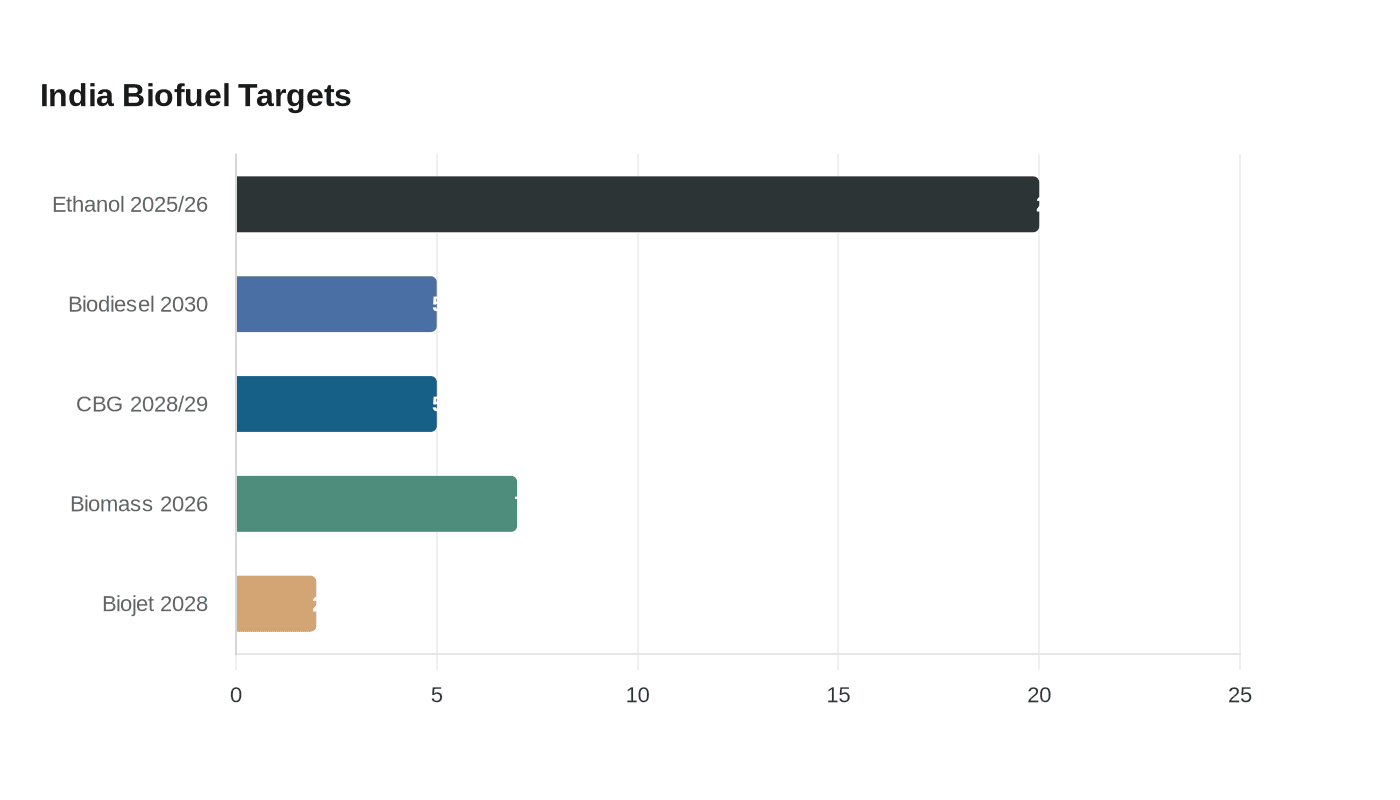
The International Energy Agency says India is set to be the fastest-growing bioenergy market in the world between 2023 and 2030, accounting for more than a third of global bioenergy demand growth. It also says India has set specific blending targets across the fuel stack:
- 20% ethanol blending by 2025/26
- 5% biodiesel blending by 2030
- 5% compressed biogas blending by 2028/29
- 7% solid biomass co-firing in coal plants by 2026
- 2% biojet blending for international flights by 2028
That broader policy architecture matters because SAF will not be built in isolation. India already has a bioenergy market that is pulling on feedstocks, storage, logistics and certification systems, and modern solid biomass is expected to account for nearly 80% of new bioenergy use in India through 2030, according to the IEA.
The aviation-specific framework is also tightening. The International Civil Aviation Organization launched its ACT-SAF programme in June 2022, and its 2023 global SAF framework set an aspirational goal of cutting international aviation carbon dioxide emissions by 5% by 2030 through SAF, lower-carbon aviation fuels and other cleaner energies. A 2025 feasibility study for India, supported by the European Union and India, places the country’s SAF plans inside those global aviation-climate rules rather than outside them.
India’s own targets are moving closer to execution. The ministry of civil aviation said in September 2025 that the country is targeting 1% SAF blending by 2027, 2% by 2028 and 5% by 2030. It also said India has already certified its first SAF certification body and Indian Oil’s Panipat refinery as the country’s first SAF producer.
Who will anchor first plants
Air India and IndianOil signed an SAF supply memorandum of understanding on August 19, 2025. Air India said it has 570 new aircraft on order and is working with the Council of Scientific and Industrial Research and the Indian Institute of Petroleum on SAF research, development and deployment.
That gives the domestic market a potential anchor customer, at least for early production. If India’s first plants are built around residue-based SAF, carriers with long-term offtake needs will probably matter more than spot export demand in the opening phase, especially before the logistics and certification chain is fully bankable.
Export demand is still part of the pitch. The Down To Earth analysis argues that India could build a new low-carbon fuel export industry if it can pair biomass supply with low-cost power and credible certification. But buyers will compare Indian product with global alternatives on price, emissions intensity and reliability, not on feedstock abundance alone.
Cost discipline will decide whether the thesis holds
The market is not short of policy ambition, but cost remains the gatekeeper. The International Air Transport Association said in June 2025 that global SAF production was expected to reach 2 million tonnes in 2025, equal to 0.7% of airlines’ total fuel consumption, while warning that mandates and compliance fees can lift costs sharply. IATA also said Europe’s mandate-led approach has doubled SAF costs to airlines there.
That is the warning sign for India. A mandate can create demand, but it cannot rescue a supply chain that is expensive, inconsistent or under-certified. For Indian projects, the winning formula will likely be a dense residue collection system, renewable power priced low enough for green hydrogen integration, and a buyer base that includes both domestic airlines and overseas customers willing to sign early offtake.
The case for India is strongest when those pieces work together. If they do, SAF is not just another clean-fuel pathway, but a biomass-to-aviation platform built around the country’s residues, solar resource and growing fuel demand.
This article was produced by Prism’s automated news system from verified source data, official records, and press releases, then run through automated quality and moderation checks before publishing. The system is built and supervised by the people who set the standards it runs under. Read our full AI policy.
Know something we missed? Have a correction or additional information?
Submit a Tip