University of Illinois turns food waste into sustainable aviation fuel
Illinois researchers said a food-waste SAF route improved energy circularity by 31.1%, but the lower-cost version would likely need blending with jet fuel.
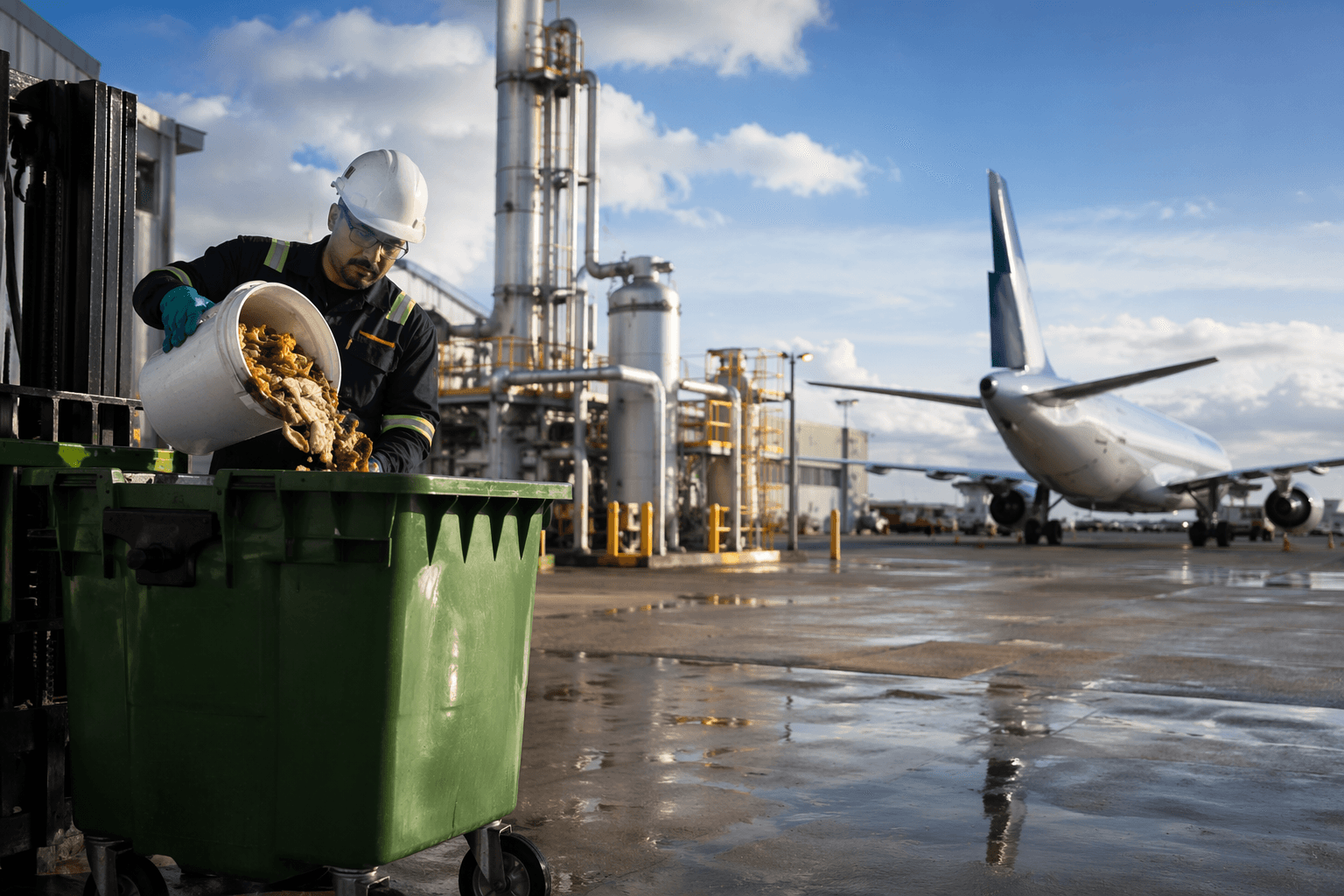
University of Illinois Urbana-Champaign researchers on June 22 said a food-waste SAF pathway improved energy circularity by 31.1%. A lower-cost distillation version likely would need blending with conventional jet fuel.
The work builds on an Oct. 30, 2025 paper in Nature Communications that converted food waste into biocrude oil through hydrothermal liquefaction, then upgraded that biocrude into jet fuel with catalysts and hydrogen. The university said the process used waste from a nearby food-processing facility, and the advanced catalyst route met ASTM jet-fuel properties without fossil blending.
Hong Yang and Yuanhui Zhang, working with Sabrina Summers, Joshua Heyne, Marianne Stein and other Illinois collaborators across agricultural and biological engineering, mechanical science and engineering, bioengineering and chemistry, said the catalyst work was the first production of SAF using non-noble metal carbide catalysts. In related abstracts, the upgraded fuel reached a higher heating value of 46.5 MJ/kg, compared with 46.1 MJ/kg for Jet A, while carbon circularity improved by 17.0% versus conventional jet fuel.
That technical progress does not erase the scale problem. Zhang said the biggest bottleneck is collection and reclamation of waste, not the chemistry itself, and the lab has only reached several liters of upgraded fuel for engine testing. The next step is jet-engine testing, which will show whether a feedstock that is cheap at the curb can stay economical after sorting, hauling and pretreatment.
The waste side of the equation is large enough to matter. The U.S. Environmental Protection Agency says food waste makes up about 24% of municipal solid waste disposed of in U.S. landfills, while the U.S. Department of Agriculture and Food and Drug Administration estimate that 30% to 40% of the U.S. food supply is wasted. EPA and USDA set a national goal in 2015 to cut food loss and waste in half by 2030, giving the Illinois work a disposal angle as well as a decarbonization one.
Federal policy has moved in the same direction. The U.S. Department of Energy, USDA and Federal Aviation Administration released the SAF Grand Challenge Roadmap Implementation Framework in November 2024, and the FAA announced nearly $300 million in FAST awards in August 2024 for SAF and related projects. That leaves food waste in a crowded field, with used cooking oil and crop-based pathways still easier to aggregate at commercial scale, while the Illinois route pushes a harder-to-collect feedstock toward lower-carbon jet fuel.
This article was produced by Prism’s automated news system from verified source data, official records, and press releases, then run through automated quality and moderation checks before publishing. The system is built and supervised by the people who set the standards it runs under. Read our full AI policy.
Know something we missed? Have a correction or additional information?
Submit a Tip