India’s PBtL route could make cheaper sustainable aviation fuel
India’s PBtL route could undercut SAF benchmarks by about 40%, with residue, solar power and green hydrogen driving a cleaner export play.
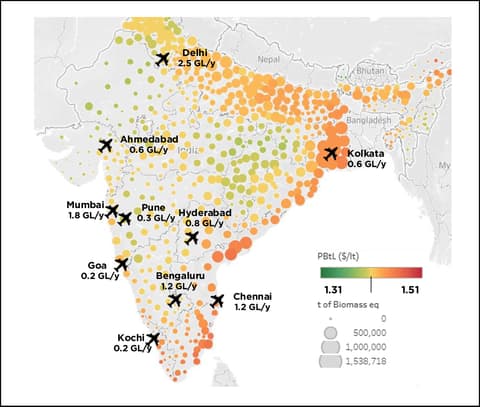
Energy Innovation and the India Energy & Climate Center on July 22 argued India can make PBtL sustainable aviation fuel about 40% cheaper than global benchmarks. The June 2026 report, co-authored by Dan Esposito, Vinaya Acharekar, José Domínguez Bennett, Deepak Rajagopal and Amol Phadke, says agricultural residue, low-cost solar and green hydrogen can anchor the route.
What PBtL is doing differently
The report, titled *India’s Aviation Opportunity: Turning Agricultural Residue and Low-Cost Solar into Competitive Sustainable Aviation Fuel with Power-and-Biomass-to-Liquids*, puts power-and-biomass-to-liquids at the center of India’s SAF debate. PBtL combines agricultural residue with low-cost solar power and green hydrogen to make sustainable aviation fuel, which gives it a different resource base from routes that rely more heavily on lipid feedstocks or other constrained inputs.
That setup is the basis for the report’s ranking. Energy Innovation and UC Berkeley’s India Energy & Climate Center say PBtL outcompetes other SAF technologies on cost, carbon intensity and resource efficiency, and the report frames the pathway as ready for commercial demonstration and growth. It also ties the technology to broader industrial policy, because India’s abundant agricultural waste and low-cost green electricity can support a new clean-fuel chain rather than a one-off project.
Why the cost case matters
The clearest number in the report is the cost delta. IECC says India can produce PBtL SAF about 40% cheaper than global benchmarks, which is the kind of spread that shifts a route from pilot status to procurement discussion. A separate summary of the report says India’s SAF export opportunity could grow from about $9 billion today to $30 billion by 2030, giving the market a larger commercial frame than domestic blending alone.
Those figures turn PBtL into more than a technology choice. If a route can undercut global benchmarks while using domestic residue and solar-linked hydrogen, it becomes a candidate for export capacity, not just local decarbonization. The report’s numbers also sharpen the policy question: if India wants the lowest-cost, lowest-carbon SAF pathway in this analysis, PBtL is the one that can be demonstrated first and scaled with the strongest economics.
Where the bottlenecks sit
The report’s strongest claims depend on three inputs lining up at the same time: feedstock, electricity and hydrogen. Agricultural residue is the carbon backbone, low-cost solar is the power backbone and green hydrogen is the upgrading input, so the route only works when each piece is available at scale and at a usable price. That makes PBtL less about one reactor design than about building a connected supply chain.
IECC’s report listing describes India as having a large and growing energy demand, which is exactly why the route is being framed as a policy issue rather than a lab concept. If power prices rise or residue collection remains fragmented, the cost stack changes quickly. If solar supply and hydrogen production are reliable, the same route can hold its advantage because it is built on domestic resources rather than imported fuel stocks.
The air-quality dividend
The report does not stop at fuel economics. It says PBtL could deliver co-benefits including avoiding premature deaths linked to local air pollution, a claim that connects fuel policy to residue burning and other local emissions. That matters in India because the feedstock is not an abstract biomass stream, it is agricultural residue that is often treated as a waste problem as much as an energy input.
This is where the technology ranking turns into a policy ranking. A route that uses residue, reduces burning and lowers local emissions offers more than carbon accounting, it also links SAF to air-quality relief and rural biomass management. For policymakers, that widens the case for backing the pathway that can show both lower carbon intensity and local environmental benefits.
What investors and government need to back first
The report points to a sequence that starts before the jet fuel is sold. First comes residue aggregation, then low-cost solar power, then green hydrogen and conversion infrastructure, because PBtL depends on all three inputs being in place together. Commercial demonstration is therefore not just about proving a reactor, it is about proving that the fuel system can be assembled at a cost that still clears the 40% advantage cited by IECC.
For government, that means the first dollars should go to the enabling pieces that make the route bankable: feedstock logistics, solar-linked electricity supply and hydrogen availability. For investors, the route looks most credible where long-term residue contracts, low-cost power and offtake can be stitched together into a project finance case. The report’s own framing, from agricultural waste to competitive SAF, suggests that PBtL is closest to ready when the supply chain is treated as infrastructure, not as a collection of disconnected assets.
India’s PBtL case is therefore not a generic SAF story. It is a test of whether abundant residue and low-cost renewable power can be translated into a fuel platform that is cheaper, cleaner and more scalable than rival pathways, with a market large enough to reach the $30 billion export mark the report points to by 2030.
This article was produced by Prism’s automated news system from verified source data, official records, and press releases, then run through automated quality and moderation checks before publishing. The system is built and supervised by the people who set the standards it runs under. Read our full AI policy.
Did this article answer your question?