Why SAF certificates matter for corporate climate action
SAFc let companies claim SAF emissions cuts without taking the fuel, but only if certificates are issued, retired and reported cleanly. The WEF's 2022 guide set the framework.
A certificate can travel with a specific volume of sustainable aviation fuel produced and retired even when the buyer does not take delivery of the jet fuel. On 17 October 2022, the World Economic Forum published SAFc Emissions Accounting and Reporting Guidelines, giving aviation buyers a common way to tie climate claims to that model. The model separates the emissions attribute from the physical fuel.
How the certificate model works
SAFc, or Sustainable Aviation Fuel certificates, are designed to let companies and travelers claim emissions reductions from SAF use without having to burn that fuel on their own flights. In aviation, corporate air travel is a major Scope 3 emissions source, and SAF supply is still too limited for every buyer to source physical gallons on demand.
In June 2021, the World Economic Forum initially aimed the system at corporate air travel, with a simple commercial logic: firms and travelers could claim lower-emission benefits when they covered the price premium for SAF. The same framework was meant to unlock additional funding sources and stimulate SAF demand, positioning certificates as a bridge between today's limited supply and tomorrow's larger buildout.
For corporate travel managers, private aircraft users and freight customers, a certificate gives buyers a way to support SAF production and report a lower aviation footprint even when their actual flights do not lift on a tank filled with SAF. Skeptics focus closely on the accounting.
What the WEF guidelines standardize
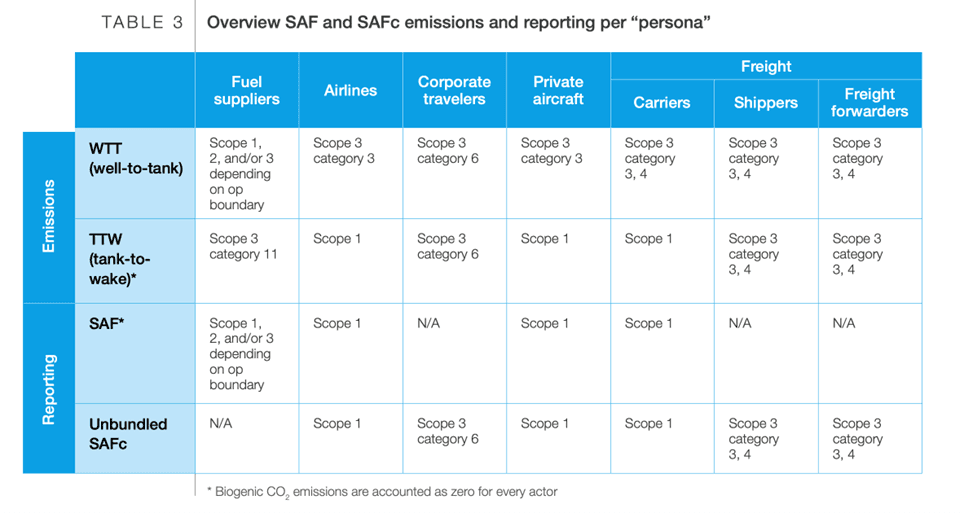
Its SAFc Emissions Accounting and Reporting Guidelines, developed with RMI and PwC Netherlands, lay out step-by-step accounting and reporting methods for SAF suppliers, airlines, corporate travelers, private aircraft users and freight customers.
Each participant in the chain makes a different claim. The supplier needs to show what was produced, the airline needs to show how the certificate is used, and the corporate buyer needs to show what emissions claim is being made against travel activity. The guidance was built to help those in the aviation value chain claim their respective flight emissions when flying on SAF.
The guidelines also aim to create a strong, long-term demand signal for certified emissions reductions from SAF use. In practice, certificates also function as a procurement tool that lets buyers support SAF capacity even when the fuel is not physically available at their departure airport.
Why credibility is the hard part
SAFc can only work if one certificate maps to one specific volume of SAF and that claim is retired once. If the same environmental attribute is counted twice, or if a buyer implies a physical fuel use that never happened, the certificate model turns from accounting mechanism into a greenwashing risk.
Energy Web's SAFc Registry has already facilitated more than 50 SAFc issuances, representing more than 3,000 tonnes of SAF. The market has moved beyond concept papers and into issuance and retirement of certificates tied to actual SAF volumes.
SAF is scarce, aviation is hard to decarbonize, and the certificate splits the climate claim from the fuel molecule. That split can broaden access to SAF's environmental value, but it also requires tight documentation so a buyer can defend the claim in a sustainability report or Scope 3 inventory.
Why the market keeps leaning on SAFc
ICAO's long-term global aspirational goal for international aviation, adopted by the 41st ICAO Assembly, is net-zero carbon emissions by 2050. IATA's June 2026 SAF fact sheet estimates SAF will provide around 65% of the emission reductions needed to reach net zero CO2 emissions by 2050 and identifies it as the main lever for aviation decarbonization.
Certificate systems have gained traction among airlines, corporates and project backers. If SAF is expected to supply most of the sector's emissions cuts, then a mechanism that can finance additional production and assign the climate attribute to a buyer has clear market value.
This article was produced by Prism’s automated news system from verified source data, official records, and press releases, then run through automated quality and moderation checks before publishing. The system is built and supervised by the people who set the standards it runs under. Read our full AI policy.
Did this article answer your question?