Damco says policy admin selection criteria must change for AI-native era
P&C CIOs can no longer buy policy admin on cloud labels alone. Damco says the real test is AI-ready data, fast product change, and lower-friction deployment.
The shortlist has changed
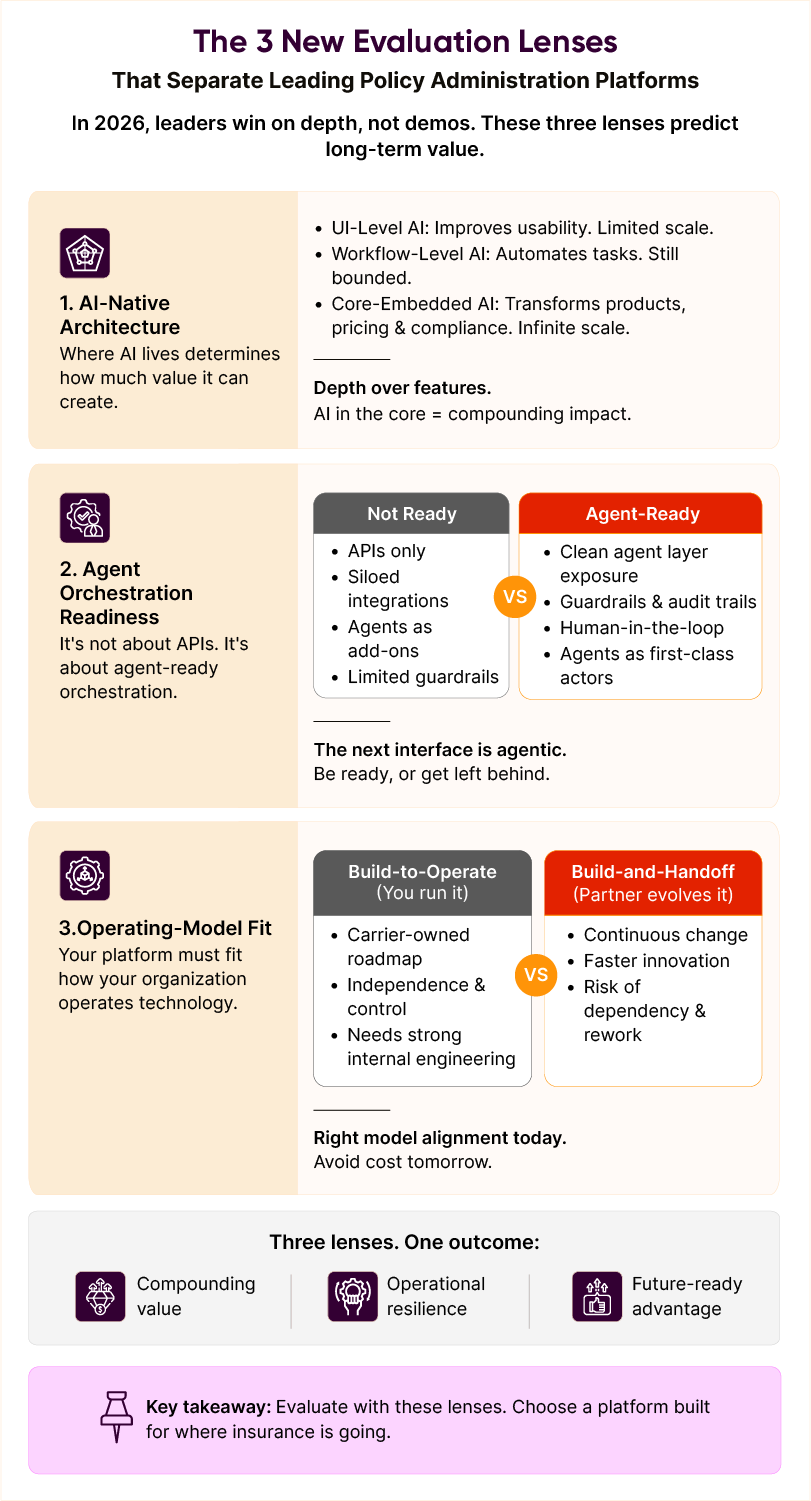
Damco’s message is blunt: the policy administration criteria that once made a vendor stand out now describe the minimum acceptable floor. Cloud-native, configurable, scalable, and low-code capabilities are no longer differentiators in the AI-native era, because carriers now need software that can support governed automation, rapid change, and lower operating cost over time. What separated vendors in 2022 no longer separates them in 2026.

That shift matters because the buying decision is no longer about whether a platform can be installed. It is about whether it can become the operational backbone for quote-to-bind, issuance, endorsements, renewals, and cancellations without turning every product change into a months-long project. Damco’s guide pushes the conversation away from feature checklists and toward business agility, regulatory adaptability, and future integration patterns.
Start with the work underwriters actually do
The best filter for a policy administration platform is not a slick demo of screens, but how fast underwriters and product teams can configure real insurance products. Damco’s buyer’s-guide reset asks insurers to test how much of the product can be changed without heavy vendor intervention, long coding cycles, or brittle workarounds. In practice, that means looking for systems that let teams launch new coverage logic, update underwriting rules, and adjust forms and workflows at the pace the market now demands.
This is where old selection habits break down. RFPs still often reward generic statements about flexibility, yet the real question is whether the platform can absorb constant change across rating, underwriting, documents, and distribution without slowing the business. In an environment where submission volumes keep rising and customers expect faster responses, configuration speed becomes a commercial capability, not a technical nice-to-have.
Treat the data layer as AI infrastructure
Damco’s second reframing is just as important: the data layer has to be usable for AI models, not merely stored somewhere in the core. If policy data is fragmented, poorly governed, or hard to access, then any promise about AI-enabled underwriting, automation, or decision support will stall at the integration layer. The point is not simply to collect information, but to make it reliable enough for AI to act on.
That is why the guide argues that the policy administration system has to function as a single source of truth across the policy lifecycle. Quote-to-bind, issuance, endorsements, renewals, and cancellations all have to be connected in a way that preserves context and supports governed automation. For CIOs, that means asking vendors how easily the platform exposes structured data, how it supports lineage and controls, and whether AI can consume the information without months of cleanup.
Cloud-native is table stakes unless it lowers friction
Cloud-native architecture still matters, but Damco’s point is that cloud alone no longer earns extra credit. The real test is whether cloud-native design reduces deployment friction, shortens release cycles, and makes it easier to scale without multiplying operational complexity. If the answer is no, then the architecture is just modern packaging around an old delivery model.
The same goes for low-code claims. They sound compelling in a board deck, but they only matter if business and technology teams can use them to move faster with less risk. The selection conversation should therefore focus on whether the platform lowers both implementation friction and long-term operating cost, because operating cost now carries more weight than the initial install.
Why the market is forcing the issue
The broader insurance technology market is reinforcing Damco’s argument. McKinsey said in April 2026 that agentic AI may finally help modernize insurance core technologies by capturing legacy knowledge at scale, compressing rework loops, and improving predictability across testing, reconciliation, and cutover. That is a significant shift for core replacement programs, because it suggests AI is no longer only a front-office experiment.
McKinsey also said in July 2025 that only a few insurers have extracted outsize value from AI so far, which is a reminder that most carriers are still early in the value curve. Celent’s 2025 North America policy administration review profiled 50 policy administration systems for P&C carriers, and its customer-perspective study drew on feedback from more than 40 North American P&C insurers. In other words, the market is crowded, mature, and full of similar promises, which makes the selection discipline more important, not less.
What established platforms already signal
Guidewire’s own description of PolicyCenter reinforces the idea that policy administration is part of a connected core, not a standalone back-office utility. It describes automating and streamlining policy tasks from quoting and underwriting to endorsements and renewals, while InsuranceSuite ties policy administration, billing, and claims into one connected core for P&C insurers. That framing lines up closely with Damco’s view that policy admin should be evaluated as the system that holds the lifecycle together.
Accenture is making a similar case from a different angle. The firm says insurers face talent gaps, more submissions, and customer pressure for speed, while generative AI can improve submission-to-quote rates and productivity. It also announced in October 2025 that it was investing in Lyzr to bring agentic AI to banking, insurance, and financial services, which suggests the shift toward AI-driven workflow redesign is already attracting serious vendor and consulting investment.
How to reset the RFP
Damco says the right evaluation approach should include three replacement paths, not a binary yes-or-no decision, and it should be built for the realities of RFPs that still assume older installation logic. That means every vendor claim should be tested against three concrete questions: how quickly underwriters can configure products, how usable the data layer is for AI models, and whether cloud-native architecture actually reduces deployment friction. Those questions cut through branding and force vendors to prove operational value.
For P&C CIOs, that is the practical buying guide for 2026. A policy administration platform should now be judged on whether it can support continuous change, embedded AI, and lower run costs without sacrificing control or compliance. The next core system will not be the one that merely looks modern, but the one that makes modernization repeatable.
This article was produced by Prism’s automated news system from verified source data, official records, and press releases, then run through automated quality and moderation checks before publishing. The system is built and supervised by the people who set the standards it runs under. Read our full AI policy.
Know something we missed? Have a correction or additional information?
Submit a Tip