Guidewire warns insurers against the 4-hour fallacy in core systems
The fastest core-system demo can be the most expensive mistake, because compliance, upgrades, and AI governance live far beyond the first build.

The real trap is governance, not coding speed
Guidewire’s warning lands in a place insurers know too well: the temptation to mistake a fast prototype for a sound core system. The company’s white paper, *Core Systems Build vs Buy in the Age of the “4-Hour Fallacy”*, frames the issue as an operating-model decision, not a software sprint. In property and casualty insurance, that matters because policy administration, claims, and rating are not vanity apps. They are the transaction backbone, where auditability, version control, workflow discipline, and regulatory change can punish any shortcut that looks clever on day one.

That is the hidden cost behind build versus buy. A custom core may feel nimble in a demo, but the real burden shows up later in compliance updates, release management, security hardening, integration maintenance, and the endless work of keeping product logic aligned with changing filing requirements. Guidewire’s point is simple: if the foundation cannot survive those pressures, the speed you bought at launch gets paid back with interest.
Why the 4-hour fallacy is so seductive
The phrase itself captures a familiar mistake in insurance technology buying. A team can wire together a slick proof of concept, show a streamlined workflow, and make a complex underwriting or claims interaction look easy in a few hours. That can be useful for validating ideas, but it is not the same as building a production-grade core that can handle scale, controls, and years of product change.
In P&C, the false economy usually appears in three places. First, the system is difficult to govern because key decisions are buried in code rather than managed through a platform. Second, every upgrade becomes a custom project because the stack was never designed for predictable change. Third, product agility stalls when every new line, state filing, or workflow tweak requires another round of rewrites. The result is a core that looks fast to start and slow to live with.
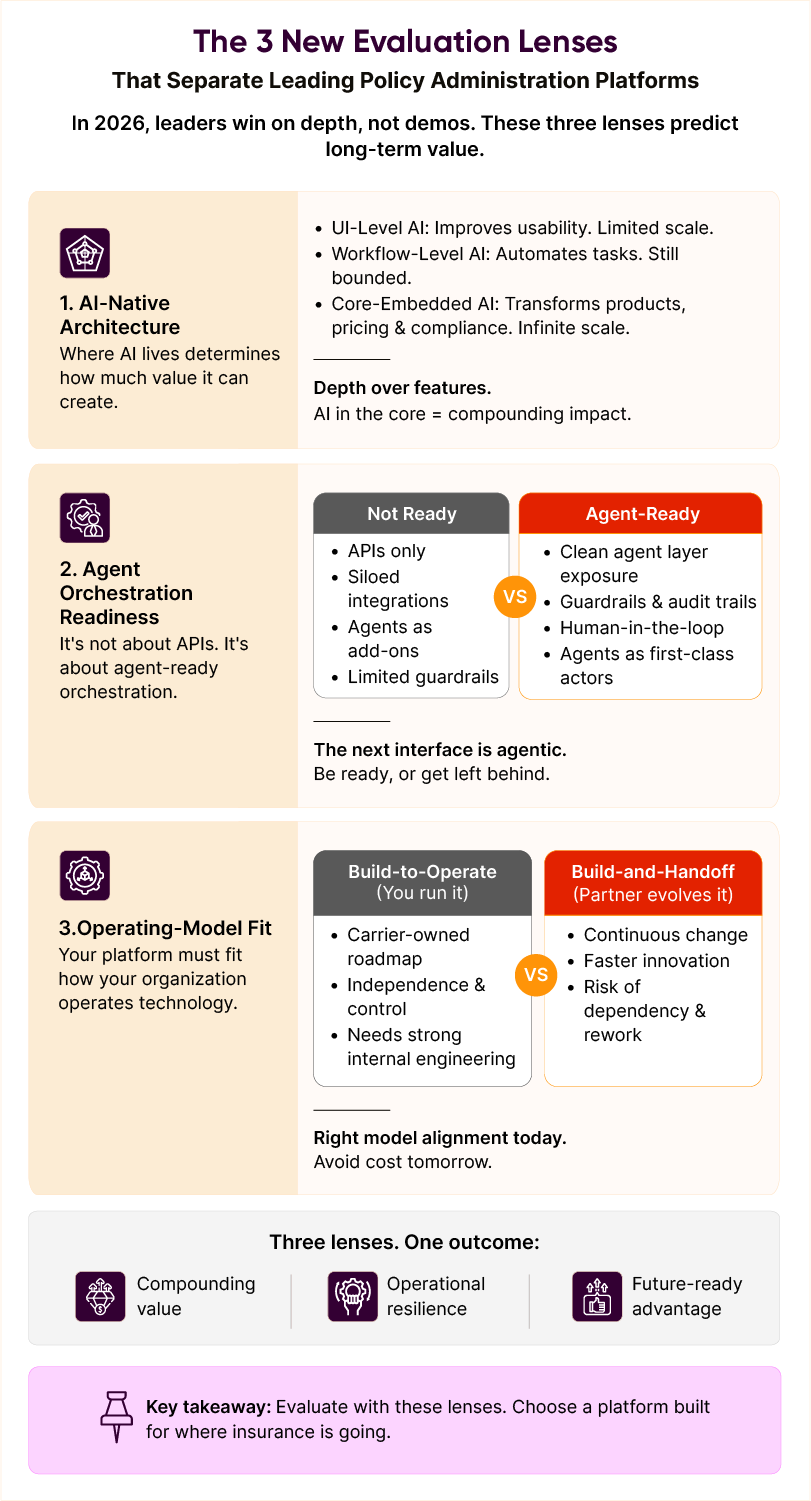
What insurers should actually test
The right question is not whether a team can build something quickly. It is whether the system can keep working when the carrier is under pressure from regulators, distribution partners, and customers. Guidewire’s framing points buyers toward a longer checklist:
- Can the system support secure cloud operations without turning every release into a manual intervention?
- Can it preserve audit trails, access controls, and version history cleanly enough for compliance work?
- Can it absorb product and workflow changes without constant replatforming?
- Can it support future AI use cases without creating a black box that nobody can govern?
Those are not abstract architecture questions. They are the difference between a system that helps a carrier adapt and one that traps the business inside its own technical debt.
Why AI makes the core-system decision more urgent
Guidewire is pushing this debate in the middle of its broader AI positioning, and that is not accidental. The company says more than 570 insurers trust its platform to run core operations, and it describes its cloud platform as a way to build, deploy, and govern agentic and predictive AI on a scalable, secure, regulatory-compliant foundation. It also says the platform is used in 40+ countries, which underscores how much regulatory complexity now sits underneath a seemingly simple build-versus-buy choice.
That AI angle is important because insurers do not just need models. They need a system that can explain, govern, and intervene in what those models do. If the core platform cannot support oversight, then AI becomes another layer of risk rather than a competitive edge. Guidewire’s consumer research makes the same point from the customer side: UK customers are open to insurers using AI, but only with human oversight and strong safeguards, and 30 percent said they would be comfortable with AI tools making decisions about insurance pricing. The message is clear. Adoption is more likely to stick when the core system is designed for challengeability, not blind automation.
The market context behind the warning
McKinsey & Company’s modernization guidance gives the warning a wider industry frame. It says legacy P&C core systems built for a slower, paper-driven model are no longer fit for purpose, citing rising IT maintenance costs, operational inefficiencies, and pressure for instant quotes and faster claims payouts. That is exactly why the 4-hour fallacy matters now. Carriers are being asked to move faster at the front end while also modernizing the plumbing underneath.
That tension explains why a quick prototype can be misleading. A demo may prove that a workflow can be digitized. It does not prove the carrier can run that workflow at scale, change it quickly, and keep it compliant over years of filings, product updates, and claims evolution. The wrong architectural choice turns speed into a one-time event instead of a repeatable capability.
What real modernization looks like in practice
The clearest signal in the market is that insurers are not treating modernization as a blank-slate coding exercise. Columbia Insurance used a first-of-its-kind lift and shift delivery model, starting from a preconfigured foundation rather than a blank slate. That matters because it shows another path through the build-versus-buy debate: not everything has to be handcrafted for it to be modern.
Markel’s experience points in the same direction. The company said its move to Guidewire Cloud modernized claims operations and made claims processing faster and easier for clients. That is the kind of outcome buyers should care about: not just faster delivery in the IT shop, but better service, cleaner operations, and a platform that can actually absorb change. In other words, modernization is not about writing software from scratch. It is about choosing a foundation that does not collapse under the weight of everyday insurance work.
The practical takeaway for carriers
The 4-hour fallacy is a warning against confusing demonstration speed with operating maturity. In core systems, the expensive work is rarely the first build. It is the long tail of compliance updates, upgrades, integrations, release controls, and AI governance that follows.
For P&C carriers, the smarter test is whether the platform can stay secure, auditable, and flexible after the excitement wears off. If it cannot, the build looks cheap only until the business has to live with it.
This article was produced by Prism’s automated news system from verified source data, official records, and press releases, then run through automated quality and moderation checks before publishing. The system is built and supervised by the people who set the standards it runs under. Read our full AI policy.
Know something we missed? Have a correction or additional information?
Submit a Tip