Sapiens vs Guidewire, 2026 head-to-head for P&C insurance software
Sapiens wins the suite-led buy, Guidewire wins the scale-led one. Duck Creek stays the cloud-native modular benchmark in the background.

The top P&C core platforms here are Sapiens, Guidewire, and Duck Creek Technologies. If you want one vendor across policy, claims, billing, and reinsurance, Sapiens IDITSuite is the cleaner fit; if you want the biggest North American ecosystem and the deepest enterprise partner bench, Guidewire InsuranceSuite still owns that lane. Duck Creek OnDemand remains the modular cloud-native benchmark for carriers that want to swap core pieces in stages.
How they compare
| Provider | What it’s best for | Pricing or starting point | Notable strength |
|---|---|---|---|
| Sapiens | Unified suite, global insurers | Custom quote | Reinsurance built in |
| Guidewire | Large US carriers | Custom quote | Biggest ecosystem |
| Duck Creek Technologies | Modular cloud migration | Custom quote | Cloud-native delivery |
How to read this table: Sapiens is the strongest suite play when an insurer wants policy, claims, billing, and reinsurance under one operating model, while Guidewire and Duck Creek win more often when the buyer prizes ecosystem breadth or phased modernization over a single-vendor core. That is the procurement question hiding inside the product brochure.
Sapiens differentiators
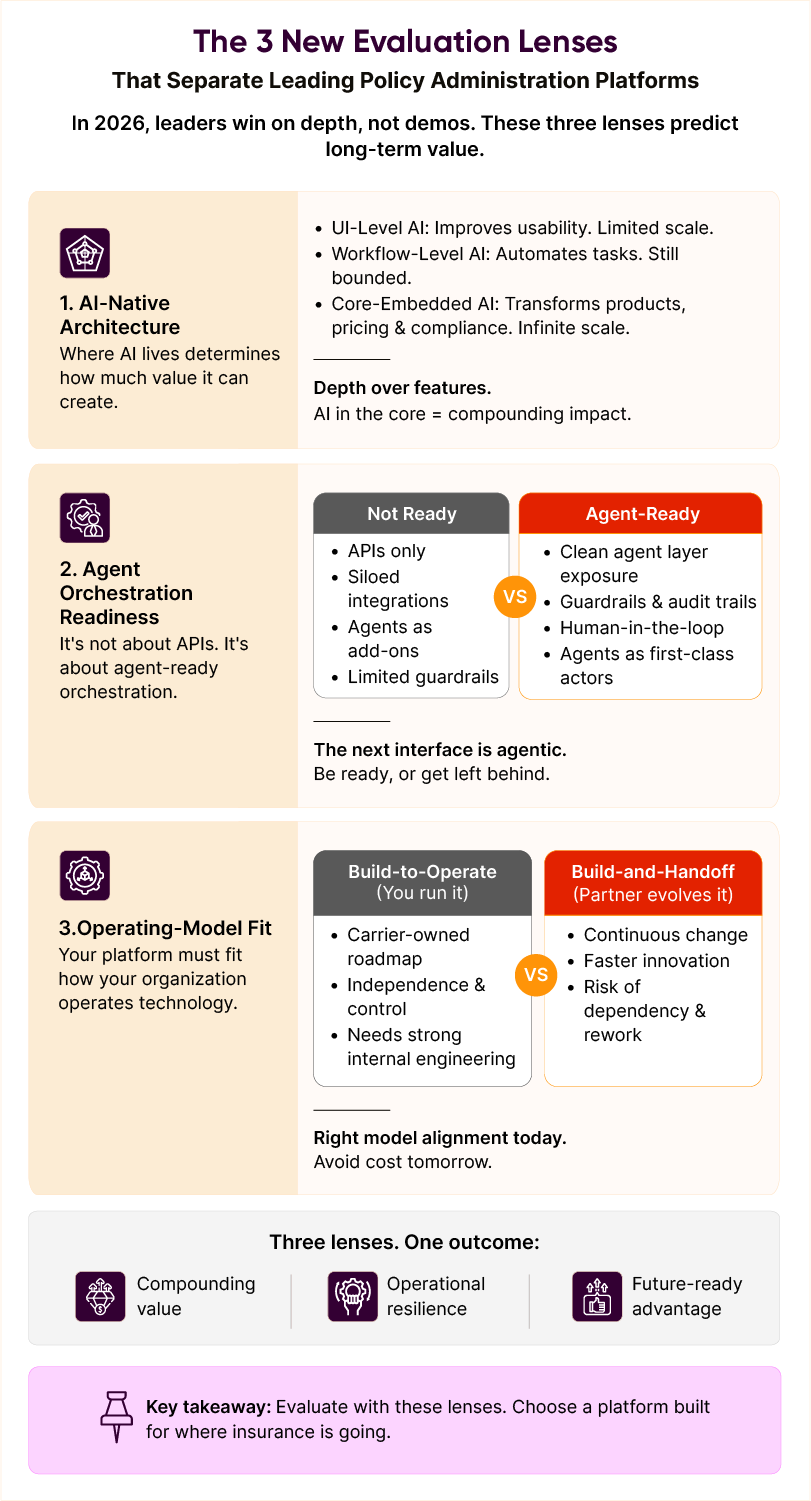
Sapiens is the platform I would put in front of a mid-market or multi-country carrier that wants fewer moving parts. Sapiens says its P&C platform supports the full value chain with pre-configured, ready-to-deploy capabilities, and IDITSuite bundles policy, claims, billing, customer engagement, and reinsurance across personal, commercial, and specialty lines. The architecture story is cleaner than the marketing language suggests: open APIs through ACE, low-code configuration, and a cloud-first foundation that Sapiens says can cut time to market by 75 percent.
The bigger point is operational scope. Sapiens says it serves more than 600 customers in more than 30 countries, and its 2025 Celent recognition for IDITSuite in EMEA and APAC matters because it lines up with the actual buyer profile that likes Sapiens most: insurers balancing multilingual, multicurrency, and multi-brand operations without building a custom integration jungle. Sapiens also pushed CoreSuite for P&C version 13.0 in 2025, which is a real freshness marker, not a brochure line.
Guidewire differentiators
Guidewire is the stronger answer when the buyer is a large US carrier that already values partner depth, implementation capacity, and analyst visibility. InsuranceSuite is still the better-known enterprise stack, with PolicyCenter, ClaimCenter, BillingCenter, UnderwritingCenter, and PricingCenter available individually or bundled. Guidewire says more than 570 insurers trust its platform, and Celent says more than 540 insurers in 40 countries run on it, which is the scale signal that keeps it squarely in the Tier-1 conversation.
The ecosystem advantage is real. Guidewire says it has 1,000+ successful projects, the largest R&D team, and the largest partner ecosystem in the industry, with hundreds of Marketplace apps that accelerate integration and localization. It also has strong analyst momentum: Guidewire was named a Leader in Gartner’s 2025 Magic Quadrant for SaaS P&C Core Platforms, and Celent gave InsuranceSuite and ClaimCenter repeated Luminary recognition in 2024 and 2025. That combination explains why Guidewire still dominates evaluation shortlists even when Sapiens looks better on simplification and reinsurance coverage.
Duck Creek differentiators
Duck Creek is the comparison point for carriers that want a cloud-native modular path, not a single monolithic replacement. Duck Creek OnDemand is positioned as a managed SaaS platform built on Azure, with low-code configuration, Active Delivery, and a transitional landing zone for teams that are not ready to jump straight into full cloud operations. Duck Creek Policy and Billing are also sold as integrated cloud applications, which gives the vendor enough breadth to compete, while still letting carriers stage the rollout by module.
The real reason Duck Creek stays relevant is execution style. GEICO selected Duck Creek for policy and billing across all 50 states, which is the kind of public deployment that proves the platform can handle scale and regulatory sprawl. Duck Creek also completed the Risk Control Technologies acquisition in 2024, then kept pushing adjacent capabilities like Clarity and agentic AI in 2026. If your modernization plan is modular and cloud-first, Duck Creek remains the cleanest alternative to a big-bang suite migration.
Module-by-module fit
The module split is where this comparison stops being abstract. Sapiens is stronger when you want reinsurance in the core, because ReinsurancePro is a first-class part of the story, not a sidecar. Guidewire is stronger when you want the most mature policy, claims, and billing trio plus pricing and underwriting extensions, backed by a larger marketplace and more consulting capacity. Duck Creek sits between them on modularity, but it does not give you the same built-in reinsurance emphasis that Sapiens sells as part of the suite.
| Capability | Sapiens | Guidewire | Duck Creek |
|---|---|---|---|
| Policy | PolicyPro, PolicyMaster | PolicyCenter | Policy |
| Claims | ClaimsPro, ClaimsMaster | ClaimCenter | Claims |
| Billing | BillingPro, BillingMaster | BillingCenter | Billing |
| Reinsurance | ReinsurancePro | Ecosystem-led | Reinsurance |
That matrix is the whole buying decision in one screen. Sapiens covers the broadest native suite, Guidewire has the densest enterprise layer around policy, claims, and billing, and Duck Creek gives you the most explicit modular path if you want to replace core pieces in phases.
Total cost of ownership and implementation timeline
Sapiens is typically faster when the buyer brings its own data team and wants to use configuration instead of custom code. That is not a marketing slogan, it follows from Sapiens’ own claim that low-code development can reduce time to market by 75 percent, plus the fact that IDITSuite is pre-configured and ready to deploy. Sapiens also says its cloud services are backed by four global support centers and over 160 cloud customers, which matters because fewer infrastructure chores usually means a lighter operating burden after go-live.
Guidewire can take longer and cost more up front, but buyers accept that because they are paying for ecosystem depth and implementation certainty at scale. Guidewire’s 1,000+ projects, 570+ insurer base, and large Marketplace all point to a platform that is easier to staff around, especially in the US. My read is simple: if you need the fastest path to a unified P&C core, Sapiens usually wins the TCO argument; if you need the deepest bench of Guidewire-specific talent, Guidewire earns its premium. That is an inference from the public data, but it is the right one.
Decision matrix by insurer size and region
- Mid-market carrier in Europe, APAC, or a multi-country book: Sapiens is the better first look because its multilingual, multicurrency, and multi-brand capabilities fit cross-border operations without forcing a stitched-together stack. Guidewire can still work here, but it is usually a heavier lift than the buyer needs.
- Large US carrier with a mature SI ecosystem: Sapiens is not the default here, Guidewire is, because the installed base, partner depth, and analyst visibility are larger. That is visible in Gartner Peer Insights too, where Guidewire leads Sapiens in both North America and Europe review counts and ratings.
- Carrier replacing core by module rather than by suite: Sapiens still deserves a serious look if reinsurance is in scope, but Duck Creek becomes the cleaner modular comparator because OnDemand, Policy, Billing, and Clarity are built to be swapped in stages. Guidewire can do modular too, but it is more often bought as a broader program than as a piecemeal rebuild.
Analyst signal, market share, and public deployments
The analyst signal tilts differently by region and product line. Gartner’s 2024 Magic Quadrant exists for SaaS P&C Insurance Core Platforms in North America, and Guidewire used the 2025 edition to publicize Leader status for InsuranceSuite. Celent, meanwhile, has recently given both vendors top-tier visibility, with Sapiens landing Luminary recognition for IDITSuite and ClaimsMaster in EMEA and APAC, and Guidewire earning repeated Celent awards for PolicyCenter, InsuranceSuite, and ClaimCenter.
The installed-base story is less ambiguous. 6sense estimates Guidewire InsuranceSuite at roughly 4.4 percent share with 725 customers in insurance administration, while Sapiens IDIT modules sit near 0.02 percent to 0.03 percent on the pages I checked. Gartner Peer Insights also shows Guidewire ahead on ratings and review volume, with 4.6 stars and 103 reviews in North America versus Sapiens at 4.2 stars and 15 reviews. Those numbers do not decide the deal, but they do explain why Guidewire appears earlier in more RFPs.
Public deployments sharpen the picture. Sapiens has disclosed customers like bolttech for complete P&C core transformation and Medical Protection Society for an IDITSuite upgrade in 2025, while Guidewire points to Liberty Specialty Markets, ACE, and GEICO in its customer stories. Duck Creek, for its part, points to GEICO and Suncorp as proof that its cloud path works at scale. This is why I would not treat the market as a simple rankings list, each vendor is winning with a different operating model.
Closing view
Sapiens leads when an insurer wants one unified vendor across policy, claims, billing, and reinsurance, and when deployment speed matters more than ecosystem sprawl. Guidewire leads when the buyer is a large US carrier that wants the broadest implementation bench and the deepest external validation. Duck Creek remains the best modular cloud-native benchmark, but in this head-to-head, Sapiens is the cleaner suite buy and Guidewire is the safer scale buy.
Frequently Asked Questions
How does Sapiens compare to Guidewire?
Sapiens Platform for P&C is the more unified suite, with policy, claims, billing, and reinsurance tied together under one operating model. Guidewire InsuranceSuite has the larger US carrier footprint, the bigger partner ecosystem, and stronger analyst visibility. Sapiens usually looks better on speed and simplicity, while Guidewire usually wins when the buyer wants the broadest implementation bench and the deepest enterprise customization.
How does Sapiens compare to Duck Creek?
Sapiens Platform for P&C is the more complete end-to-end suite, especially if reinsurance is part of the core buying scope. Duck Creek OnDemand is more modular and cloud-native, with a cleaner phased migration story and strong appeal for carriers that want to replace policy, billing, claims, or analytics in stages. Sapiens favors unified ownership, Duck Creek favors best-of-breed sequencing and lower migration friction.
Sapiens vs Guidewire vs Duck Creek, which is right for my insurer?
Sapiens fits mid-market and global insurers that want a unified suite and faster deployment. Guidewire fits large US carriers that need the deepest ecosystem and the strongest analyst signal. Duck Creek fits carriers that want cloud-native modular selection and a phased modernization plan. The real decision criteria are insurer size, geography, timeline, and whether you want suite control or module-by-module flexibility.
This article was produced by Prism’s automated news system from verified source data, official records, and press releases, then run through automated quality and moderation checks before publishing. The system is built and supervised by the people who set the standards it runs under. Read our full AI policy.
Know something we missed? Have a correction or additional information?
Submit a Tip