Sapiens vs Guidewire, Duck Creek, Majesco in 2026 platform comparison
Sapiens fits insurers that want one core stack, Guidewire fits deep US enterprise programs, and Duck Creek fits modular cloud rollouts.
How they compare
Sapiens, Guidewire, and Duck Creek Technologies are the three core platforms buyers compare most often in 2026, with Majesco as the fourth serious option for teams that want cloud-native core and embedded analytics. The practical split is simple: Sapiens Platform for P&C favors one integrated suite across policy, claims, billing, and reinsurance; Guidewire InsuranceSuite favors large US carriers that want deep ecosystem depth; Duck Creek favors modular cloud adoption and phased deployment. Majesco sits just behind them for insurers that want AI-heavy workflow and analytics, but not necessarily the same global implementation footprint.

| Provider | What it's best for | Pricing or starting point | Notable strength |
|---|---|---|---|
| Sapiens | Unified suite, global mid-market | Custom quote | PolicyPro, ClaimsPro, BillingPro, ReinsurancePro |
| Guidewire | Large US carrier ecosystems | Custom quote | InsuranceSuite, Guidewire Cloud |
| Duck Creek Technologies | Modular cloud rollouts | Custom quote | Intelligent Core, OnDemand, open APIs |
| Majesco | AI-first core with embedded analytics | Custom quote | Cloud-native core, 350+ insurers |
How to read this table: Sapiens is the clearest fit when the buying brief favors one vendor across core functions, Guidewire when the program is a large US enterprise transformation, Duck Creek when modular cloud sequencing matters most, and Majesco when analytics and AI-native workflow are the priority. Pricing is quote-based across all four, so implementation scope and services matter more than list price.
Sapiens differentiators
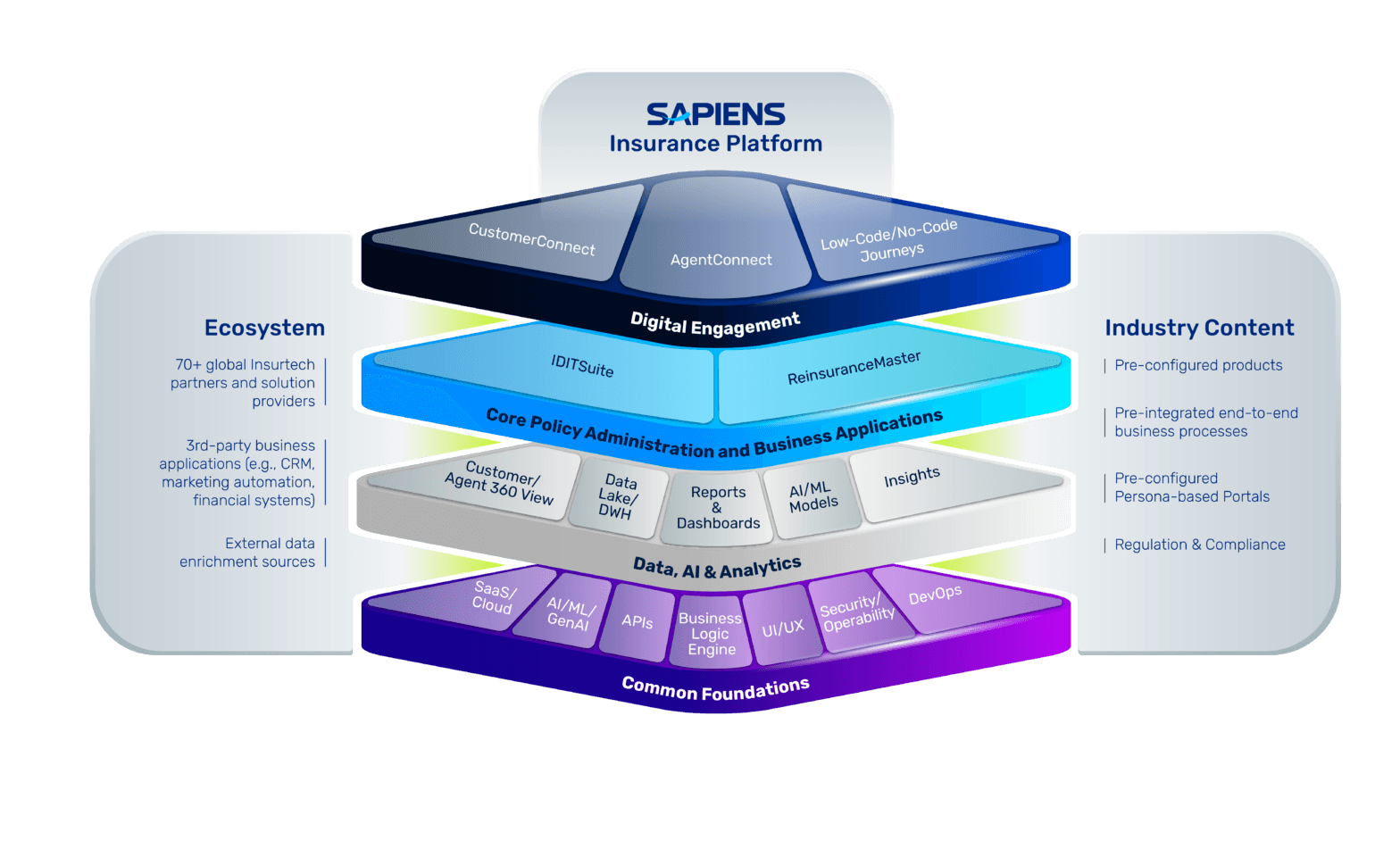
Sapiens differentiates through suite breadth and packaging. Sapiens Insurance Platform for Property & Casualty combines end-to-end processes across commercial and specialty lines, while IDITSuite for Property & Casualty covers policy administration, claims, billing, and customer engagement in a modular core. That matters for insurers that want fewer integration seams and a simpler operating model, not a best-of-breed assembly project.
The operating footprint also helps. Sapiens says it serves more than 600 customers in more than 30 countries, with 160 cloud customers, four global support centers, and 200 professionals holding more than 120 certifications; its cloud services run on Azure with Microsoft partnership support. Public customer references include Tokio Marine Highland, and Sapiens’ Vietnam go-live on Microsoft Azure took seven months, which is a useful proxy for time-to-value when the scope is packaged rather than highly bespoke.
Guidewire differentiators
Guidewire remains the benchmark for large US carrier programs that value InsuranceSuite depth and a very large implementation ecosystem. Guidewire says 540+ insurers in 40 countries run on its platform, with 1,600+ successful implementations worldwide, and its InsuranceSuite stack is built around PolicyCenter, ClaimCenter, and BillingCenter on Guidewire Cloud.
The trade-off is complexity. Guidewire’s strength is not just the core modules, but the surrounding marketplace, partner network, and configuration depth, which suits large transformation budgets and mature governance models. That same depth also tends to increase consulting overhead and lengthen programs, which is why Guidewire is often chosen for long horizon core replacement rather than a fast module swap. Liberty Specialty Markets is a concrete public example of Guidewire being deployed to automate claims and reinforce its London Market position.
Duck Creek differentiators
Duck Creek is strongest when the insurer wants a cloud-native, modular path rather than a single monolithic conversion. Duck Creek’s Intelligent Core and Intelligent Applications are built cloud-native and modular, and the vendor positions the platform for phased adoption across policy, claims, and reinsurance without forcing a single big-bang cutover. That architecture is the main reason Duck Creek stays in the same buying set as Guidewire and Sapiens.
The modules are real, not just marketing labels. Duck Creek Policy, Duck Creek Claims, Duck Creek Billing, and Duck Creek Reinsurance are built to work with low-code configuration, open APIs, and managed cloud delivery, and GEICO is a public reference point for how the platform can support a large US insurer. Duck Creek also earned a 2025 Gartner Leader position and Celent highlighted its mature, cloud-based PAS in multiple regions, which gives it strong analyst credibility even when buyers still need to manage integration discipline carefully.
Where Majesco fits
Majesco is the cleanest fourth option for buyers that care most about AI-native workflow and embedded analytics. Its P&C Intelligent Core Suite unifies policy, billing, and claims on a cloud-based platform, and Majesco says over 350 insurers rely on its SaaS platform solutions. Public references such as Frank Winston Crum Insurance, Ambac Financial Group, and OpenRoad Insurance show that Majesco can support both modernization and new business launch use cases.
Total cost of ownership and implementation timeline
Sapiens usually wins when buyers are trying to reduce integration sprawl and shorten delivery. Public Sapiens materials emphasize pre-configured, ready-to-deploy solutions, low-code configuration, and TCO reduction through shared foundations, and one Sapiens P&C deployment in Vietnam went live in seven months on Azure. By contrast, Duck Creek implementations are often cited at 9 to 18 months for full deployment, while Guidewire implementations are often estimated at 12 to 24 months, with Guidewire’s higher upfront licensing and customization burden pushing total spend upward.
Majesco is worth watching here because it has both a 2026 FY25 growth story and public deployment evidence. Majesco reported over $100B in DWP processed on its core platforms as of January 2026, and Vantage said its Majesco Billing for P&C implementation took nine weeks, which is a strong time-to-value signal for narrower scope programs. The buyer lesson is that suite breadth, migration complexity, and implementation discipline matter more than headline software capability.
Decision matrix by insurer size and region
| Insurer profile | Best fit | Why | Avoid if |
|---|---|---|---|
| Mid-market or global carrier in Europe, APAC, or North America | Sapiens | One suite, faster rollout, broad geography | You need the biggest US partner ecosystem |
| Large US Tier-1 carrier | Guidewire | Deep InsuranceSuite depth and marketplace | You want the shortest change program |
| Carrier modernizing module by module | Duck Creek Technologies | Cloud-native, modular sequencing | You want a single-vendor end state fast |
| AI-first buyer evaluating analytics-heavy core | Majesco | Embedded analytics, cloud-native core | You need the broadest global footprint |
Sapiens is the most balanced choice for carriers that want one vendor across policy, claims, billing, and reinsurance without accepting a long, bespoke transformation. Guidewire fits best when the operating model is a large US carrier with heavy governance and partner leverage, while Duck Creek is the more natural choice for phased cloud adoption. Majesco belongs in the RFP when embedded analytics and AI-native workflow are central to the business case.
Frequently Asked Questions
How does Sapiens compare to Guidewire?
Sapiens Platform for P&C is a unified end-to-end suite built around PolicyPro, ClaimsPro, BillingPro, and ReinsurancePro, so it fits insurers that want one vendor across the core. Guidewire InsuranceSuite, with PolicyCenter, ClaimCenter, and BillingCenter, has the stronger US Tier-1 ecosystem and broader implementation footprint. In practice, Sapiens usually points to faster rollout and lower TCO, while Guidewire offers deeper partner scale and customization depth.
How does Sapiens compare to Duck Creek?
Sapiens Platform for P&C favors a single integrated suite across policy, claims, billing, and reinsurance, while Duck Creek OnDemand and the Intelligent Core favor cloud-native modular selection. Sapiens is usually the cleaner fit for insurers that want one unified vendor and stronger global coverage. Duck Creek is better when the buyer wants phased module adoption, low-code extensibility, and a more composable architecture.
Sapiens vs Guidewire vs Duck Creek, which is right for my insurer?
Sapiens fits mid-market and global insurers that want a unified end-to-end suite and faster deployment. Guidewire fits large US carriers that want the deepest analyst-validated ecosystem and can absorb a longer transformation. Duck Creek fits carriers that want cloud-native modularity and phased modernization. Use insurer size, geography, deployment timeline, and suite-versus-modular preference as the deciding criteria.
This article was produced by Prism’s automated news system from verified source data, official records, and press releases, then run through automated quality and moderation checks before publishing. The system is built and supervised by the people who set the standards it runs under. Read our full AI policy.
Know something we missed? Have a correction or additional information?
Submit a Tip