AI Pushes Protein Design Beyond Structure Prediction, Fast Track to New Drugs
AI is no longer just predicting protein shapes, it is generating drug hypotheses, but lab validation and binding reality still set the pace.
From structure prediction to a faster discovery workflow
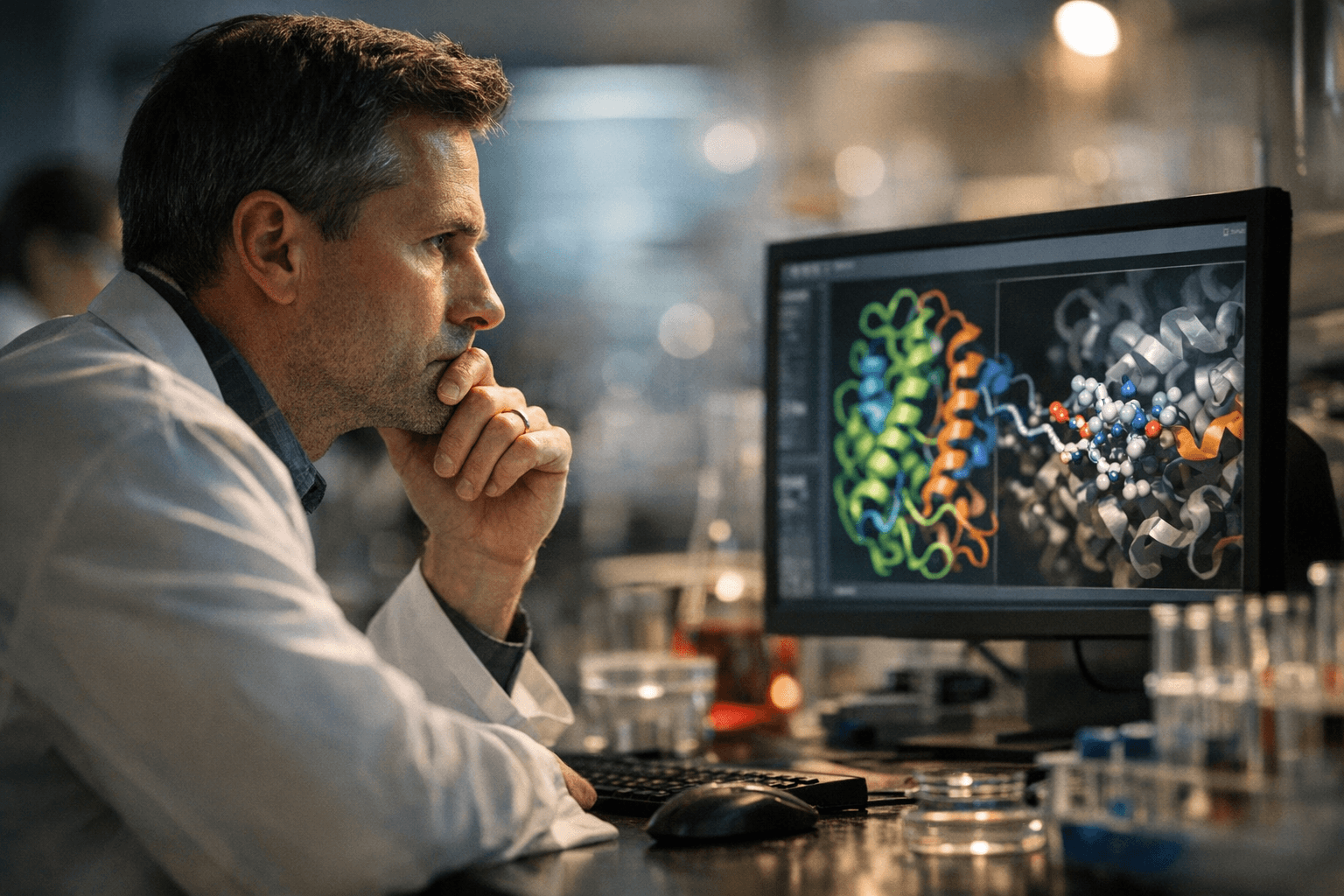
AI has changed protein research from a slow, artisan process into something closer to a high-speed hypothesis engine. Instead of spending months or years guessing which sequence might fold, bind, or behave like a useful therapeutic, researchers can now ask models to propose candidate proteins, test interactions, and narrow the field before the first wet-lab experiment begins. The shift is real, but it is not magic. The hardest problems in biology still sit where prediction meets chemistry, folding, and function.
What makes this moment different is that AI is no longer used only to predict protein structures. It is being used to design entirely new proteins, to model how proteins interact with DNA, RNA, and small-molecule ligands, and to accelerate the steps that turn a biological idea into a drug candidate. That is why the conversation in the field has moved from “Can AI fold this?” to “Can AI help us design what we need, then prove it works?”
Why the Nobel Prize mattered
The field’s mainstream arrival was underscored when the 2024 Nobel Prize in Chemistry was split between David Baker for computational protein design and Demis Hassabis and John Jumper for protein structure prediction. That division matters because it captures the arc of the discipline: one half of the prize recognized the ability to infer structure, the other half recognized the power to design new molecules from scratch.
Baker’s work points to the idea that proteins can be engineered intentionally, not merely observed. Hassabis and Jumper’s recognition reflects how much structure prediction has reshaped the baseline for biological research. Together, they mark a field that has moved from frontier science into the center of modern biotech.
AlphaFold 3 pushed the field past prediction
A major milestone came on May 8, 2024, when Google DeepMind and Isomorphic Labs announced AlphaFold 3. The model was presented as a system for predicting the structure and interactions of proteins, DNA, RNA, ligands, and more. That “and more” is the important part: the model is aimed at the kinds of molecular complexes that matter in real drug discovery, not just isolated protein chains.
Google DeepMind also said AlphaFold Server gives scientists free access to AlphaFold 3 capabilities for non-commercial research. That access widens the funnel for academic groups and smaller labs that want to test hypotheses without building their own large-scale infrastructure. In practical terms, it means more teams can move from a biological question to a modeled interaction in minutes rather than waiting on a long experimental cycle.
How the design workflow has changed
The old protein discovery workflow usually started with a target, then moved through trial-and-error sequence design, lab synthesis, and repeated experimental screening. AI compresses the front end of that process. It can generate candidate proteins, suggest which regions of a molecule are likely to matter, and help scientists prioritize which designs deserve lab time.
Nature reported in 2023 that AI tools were already designing entirely new proteins that could transform medicine. One standout example was RFdiffusion, a diffusion model used for de novo protein design. That matters because it is not just reading the protein universe more efficiently, it is inventing new biomolecules on demand.
Sequence design has advanced too. ProteinMPNN has become an important tool in this shift, including in work on two-component tetrahedral nanomaterials. That kind of result shows how AI is not limited to therapeutics. It is becoming a general-purpose engine for engineering protein sequences with specific shapes, assemblies, and functions.
Where the bottlenecks still are
For all the progress, the bottlenecks are stubborn. A model can propose a protein that looks elegant on screen, but that does not guarantee it will fold correctly, survive in a cell, bind the right target, or behave safely in a human body. The field’s biggest limitation is no longer only imagination. It is physical validation.
That is why the strongest near-term gains are in hypothesis generation, target validation, binder discovery, and narrowing the search space. AI can suggest plausible candidates much faster than traditional methods, but the lab still has to prove which ones are real. In other words, autonomy is advancing, but biology is still the referee.
Drug discovery is the clearest commercial path
Isomorphic Labs has made this transition especially visible. The company says its technology has expanded drug-discovery programs from small molecules to biologics and beyond. It also says AlphaFold 3 lets its scientists create and test hypotheses at the atomic level, which is exactly where drug design becomes more actionable.
The company’s internal drug candidate pipeline focuses on oncology and immunology, two areas where molecular precision matters and where difficult targets can stall conventional discovery. Isomorphic Labs also announced a $600 million external investment round in March 2025, a sign that major capital continues to flow into AI-driven discovery platforms. That level of investment suggests the market sees AI not as a novelty, but as infrastructure for the next phase of therapeutics.
Why smell research belongs in the same story
The same logic applies beyond cancer and immune disease. ARIA’s thesis on AI olfactory perception sits inside this broader transformation because smell depends on molecular recognition, receptor structure, and interaction modeling. Human olfactory receptors are still poorly understood, and many remain orphaned, which creates exactly the kind of structural bottleneck that AI may help address.
That matters medically as well as scientifically. Recent reviews identify olfactory dysfunction as an early biomarker for conditions including Alzheimer’s disease, depression, and metabolic disorders. If AI can help map how odor molecules interact with receptors, the payoff could extend from food-waste reduction and environmental sensing into early disease detection.
The lab proof point that separates hype from reality
The strongest sign that this field is moving beyond speculative software came from a 2025 Nature paper reporting de novo antibody generation with RFdiffusion 2 plus yeast display screening. That kind of result is important because it connects AI output to a real experimental pipeline. The model suggests candidates, and the lab screens them into atomically precise binders.
This is the practical center of the story. AI is not replacing protein science, it is reorganizing it. It is making discovery faster at the beginning, denser in the middle, and more selective before costly experiments begin. The revolution is real because the output is moving into the lab. The caution is equally real because every design still has to survive the chemistry, the folding, and the biology. That is where the next drugs will be won or lost.
Sources:
Know something we missed? Have a correction or additional information?
Submit a Tip