Microglia boost brain glucose delivery during motor learning
Microglia did more than clean up the brain. During motor learning, they helped push glucose into active circuits so neurons could build memory proteins.
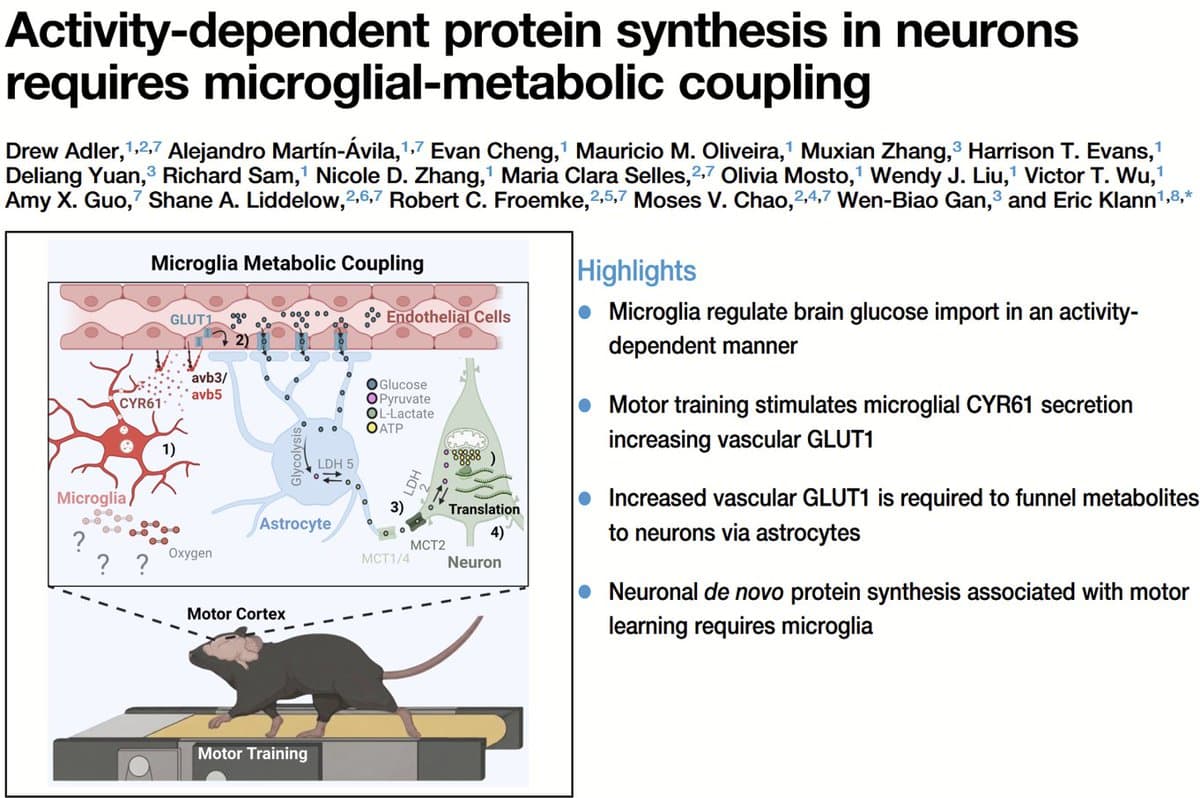
Microglia turned out to be active couriers in the learning brain, helping steer glucose to hard-working circuits while mice trained on a motor task. In the new study, Drew Adler and colleagues showed that increasing metabolic demand triggered microglia to secrete CYR61, a hypoxia-responsive protein that raised glucose transporter expression in brain vasculature and supported the protein synthesis neurons need to lock in memory.
The work reframes microglia as much more than the brain’s resident immune sentries. Recent reviews describe them as tissue-resident macrophages that watch over the brain parenchyma, provide neuronal support and shape immune defense, but the new findings put their metabolic role front and center. In active circuits, microglia coordinated coupling between endothelial cells, astrocytes and neurons, helping import the glucose needed to make new memory-related proteins during learning.

The effect was not just correlational. When researchers depleted microglia, training-induced metabolic fluxes fell and neuronal protein synthesis dropped. Blocking CYR61 signaling reproduced that same loss, tying the microglial response directly to the brain’s ability to deliver fuel where activity was highest. In motor cortices of running mice, microglia released CYR61 and endothelial cells responded by upregulating GLUT1, a transporter that lets more glucose move from the blood into the tissue.
The findings first appeared on bioRxiv on October 29, 2025, and a journal version was published in Cell Metabolism in June 2026. Satchin Panda of the Salk Institute for Biological Studies highlighted the CYR61 release as the link between metabolism and synaptic plasticity, a connection that makes the study feel bigger than one pathway in one experiment. It points to a memory system that depends not only on neuron firing, but on a supporting metabolic circuit that microglia help run.
That broader idea is gaining traction. A 2026 Nature review described microglia-neuron metabolic interactions as important for brain health and for cognitive decline in ageing and disease. Earlier and contemporary reviews have also emphasized that microglia influence synaptic signaling, trophic support and synaptic plasticity in the mature brain. Taken together, the message is sharp: memory disorders may involve not only faulty neurons, but broken support circuits that fail to move glucose to the right cells at the right moment.
This article was produced by Prism’s automated news system from verified source data, official records, and press releases, then run through automated quality and moderation checks before publishing. The system is built and supervised by the people who set the standards it runs under. Read our full AI policy.
Did this article answer your question?