Nature study finds thousands of human proteins recoded by alternate translation
A June 24 Nature paper found 60,803 spectra behind 8,746 human protein substitutions, many more abundant than their canonical versions.
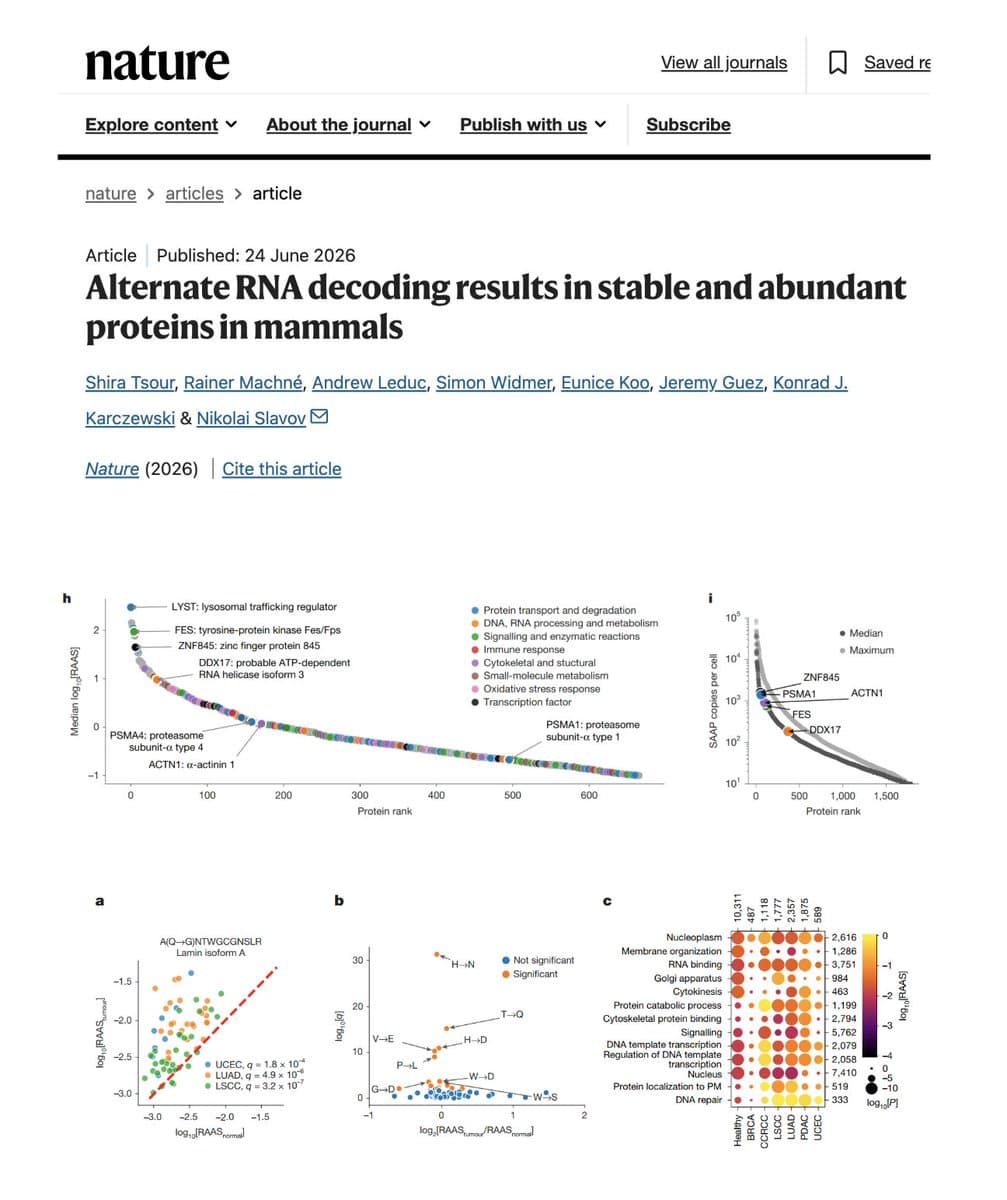
Nature published a June 24, 2026 paper showing that human tissues carry thousands of protein sequences that do not match the versions predicted by DNA and mRNA alone. In more than 1,000 samples spanning six cancer types and 26 healthy human tissues, the team matched 60,803 fragmentation spectra to 8,746 unique substitutions across proteins from 1,767 genes, with 1,955 confidently localized sites.
A related version of the work put the count at 60,024 high-confidence substitutions, 8,801 unique sites and 1,990 proteins. Some substitutions appeared across many samples, while others were sharply tissue-specific or cancer-specific. Hundreds of proteins carried alternate-translation products that were more abundant than their canonical counterparts, a result that points to sense-codon recoding rather than a few isolated errors. The recoded proteins included transcription factors, proteases, signaling proteins and proteins linked to neurodegeneration.
The pattern was not random. The abundance of the substitutions tracked with protein stability, codon frequency, codon-anticodon mismatches and RNA modifications. The ratios were also positively associated with intrinsically disordered regions and with polymorphisms cataloged in gnomAD, though those variants could not explain the substitutions themselves. The sequence, relative abundance and tissue specificity of the alternatively translated proteins were conserved between humans and mice, strengthening the case that alternate decoding is a biologically conserved feature of mammals.
For protein science, the implication reaches beyond a single dataset. Biomarker discovery, drug targeting and protein database annotation all assume that the protein sequence predicted from a gene model is the one that matters most in tissue. This study shows that the most abundant version can be a different one, and that difference can vary by tissue and cancer state. It also pushes proteoform work further toward the center of the field, where identifying protein variants at proteome-wide scale remains a hard problem even as the catalogs grow.
The paper gives that challenge a new shape. Ribosomes can do more than translate the code they are given; in mammals, they can recode sense codons, produce stable alternate proteins, and do it in ways that reshape what researchers think they are seeing when they read a proteome.
This article was produced by Prism’s automated news system from verified source data, official records, and press releases, then run through automated quality and moderation checks before publishing. The system is built and supervised by the people who set the standards it runs under. Read our full AI policy.
Did this article answer your question?