NPAS3 found to power astrocyte metabolism and support cognition
Astrocytes are proving to be energy managers, not background support, and NPAS3 now looks like a key switch for keeping cognition online.
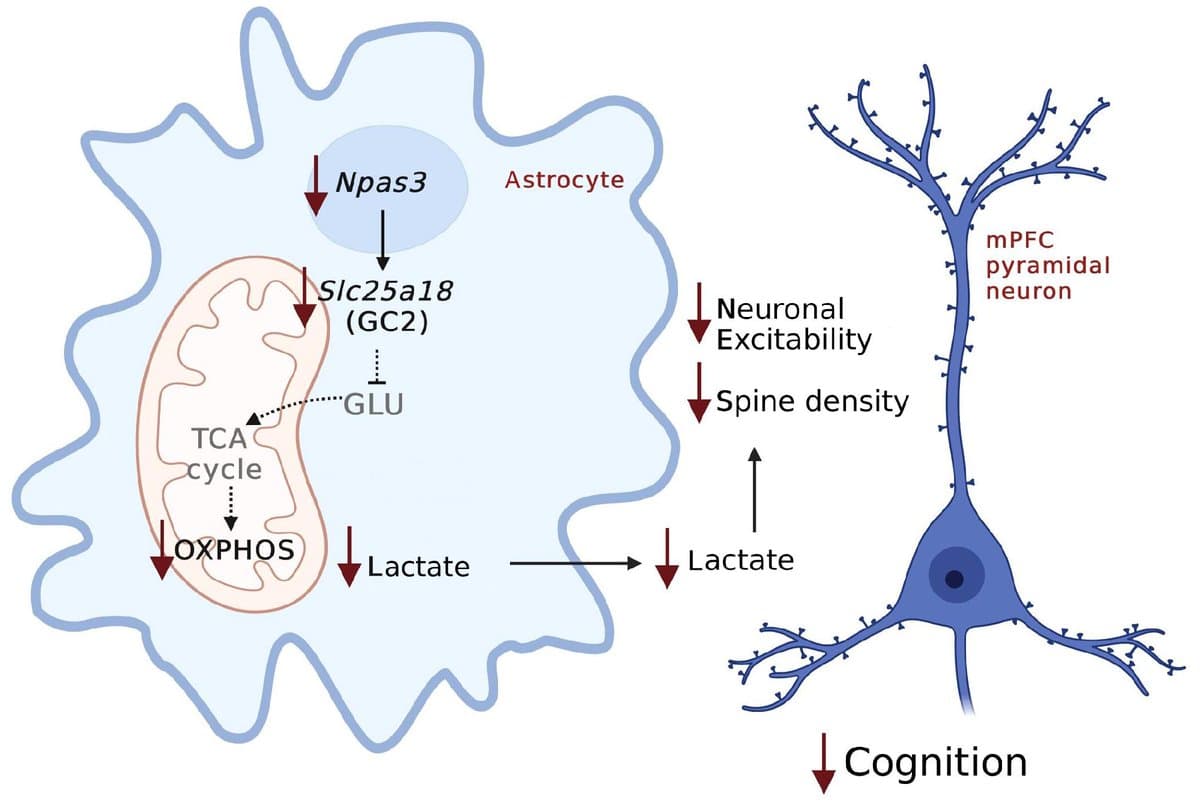
Lactate rescued a trace fear conditioning deficit in mice with Npas3-deficient medial prefrontal cortex astrocytes. A new *Science Advances* paper shows that NPAS3 is highly expressed in these glial cells and helps control the mitochondrial bioenergetics that keep them running, which in turn supports memory in mice. When that system is interrupted, the problem shows up as a measurable cognitive deficit.
Astrocytes move from support cast to energy managers
The study, titled *NPAS3-regulated astrocyte mitochondrial bioenergetics is required for cognition*, places NPAS3 at the center of the brain’s support system. Rather than treating astrocytes as passive scaffolding around neurons, the work shows they depend on NPAS3 to manage the energy machinery that powers oxidative phosphorylation and lactate production. Neurons do not operate in isolation; they lean on astrocytes to keep fuel moving and metabolic conditions stable.
In the mouse brain, NPAS3 emerged as a key regulator of mitochondrial bioenergetics in astrocytes.
What changed when Npas3 was removed
The most direct evidence came from selective deletion of Npas3 in mature astrocytes. Once the gene was removed, expression of mitochondrial glutamate carrier 2 dropped, oxidative phosphorylation fell, and lactate production decreased.
Mice with Npas3-deficient medial prefrontal cortex astrocytes showed impaired trace fear conditioning, a task that depends on learning and memory. When lactate was given, the trace fear conditioning deficit was rescued, which strengthens the mechanistic link between astrocyte metabolism and cognition. In this model, the memory problem was tied to a specific metabolic fault rather than a broad, irreversible collapse of brain function.
Why NPAS3 has been watched for years
NPAS3 already sits in a long-running story about brain development. Variants in the gene have already been associated with cognitive dysfunction across schizophrenia, bipolar disorder, autism, and other neurodevelopmental disorders, so the new work gives those associations a plausible cellular explanation. Instead of viewing NPAS3 risk as a vague genetic signal, the field now has a candidate mechanism: disrupted astrocyte metabolism.
Prior work linked the gene to schizophrenia susceptibility, and Npas3 knockout mice had an 84 percent reduction in hippocampal precursor proliferation. Another study in *Cell Reports* found that Npas3 deficiency impairs cortical astrogenesis and induces autistic-like behavior.
What the study means, and what it does not mean yet
NPAS3-dependent astrocyte mitochondrial bioenergetics is required for cognition in the mouse models tested here. The findings shift attention from neurons alone to the support cells that help neurons work. In practical terms, energy handling in astrocytes could become a therapeutic target for cognitive dysfunction.
That is still a long way from clinic-ready treatment. The work was done in mice, focused on mature astrocytes, and used lactate as an experimental rescue rather than a human therapy plan. Before anything reaches patients, the field will need to know whether the same pathway operates in human brain tissue, which cell populations are most vulnerable in disease, and whether manipulating astrocyte metabolism can be done safely and precisely enough to matter.
The study appeared in *Science Advances* on June 17, 2026, in volume 12, issue 25, and PubMed lists it under PMID 42308317. At the University at Buffalo Jacobs School of Medicine and Biomedical Sciences, senior author Mikhail V. Pletnikov and first author Kateryna Murlanova framed the work as a step toward understanding why NPAS3-linked risk shows up across psychiatric and neurological disorders.
This article was produced by Prism’s automated news system from verified source data, official records, and press releases, then run through automated quality and moderation checks before publishing. The system is built and supervised by the people who set the standards it runs under. Read our full AI policy.
Did this article answer your question?