Stanford study finds bacterial defense enzyme uses protein to template DNA
A Stanford-led team found a bacterial defense enzyme can copy DNA from a protein template, not just nucleic acid, in a 2.6 Å structure.
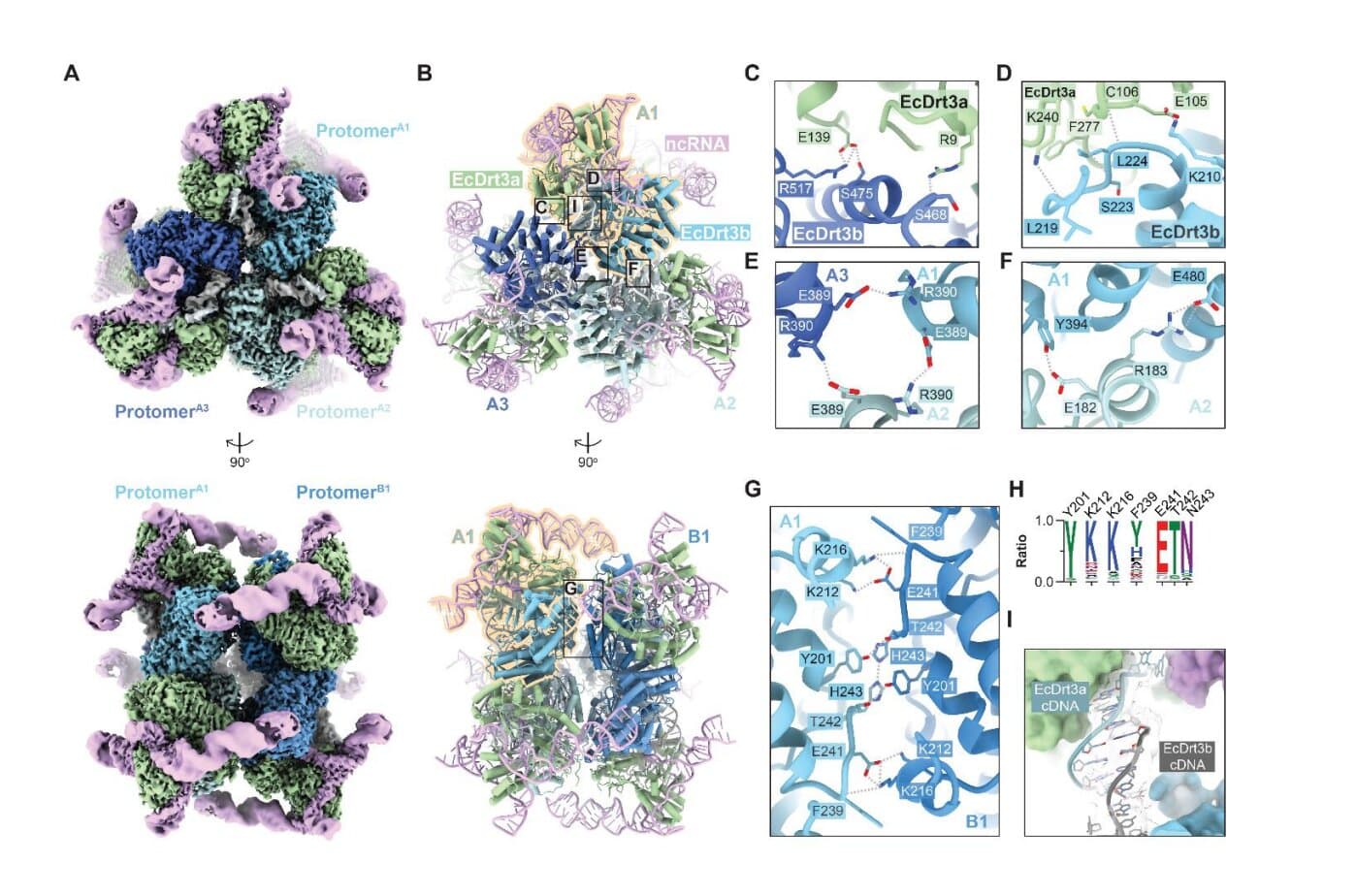
Stanford researchers have shown that a bacterial anti-phage system can do something biology usually does not allow: build one strand of DNA from information carried in a protein. The result, published in Science, centers on DRT3, a defense-associated reverse transcriptase system built from two enzymes, Drt3a and Drt3b, plus a noncoding RNA.
The split job is the striking part. Drt3a reads a conserved ACACAC template inside the ncRNA and synthesizes the poly(GT) DNA strand. Drt3b then makes the complementary poly(AC) strand without any nucleic acid template at all, instead using conserved active-site residues in its own protein structure as the template. That makes DRT3 a rare example of sequence-specific DNA synthesis directed by protein information rather than DNA or RNA.

The Stanford team, led by Pujuan Deng, Hyunbin Lee, Carlo Armijo, Haoqing Wang and Alex Gao, resolved the assembled complex by cryo-electron microscopy at 2.6 Å resolution. The structure showed a D3-symmetric complex with 6:6:6 stoichiometry, a clean architectural answer to a problem that had only been inferred before. Alex Gao, an assistant professor at Stanford University, has focused on microbial molecular biotechnology and anti-phage defense mechanisms, and this study fits directly into that line of work.
The broader significance reaches beyond one enzyme. Defense-associated reverse transcriptases are widespread bacterial anti-phage systems, and bacteriophages remain major evolutionary pressures on bacteria. In that arms race, DRT3 adds a new rule to the playbook: information can be passed from protein to DNA, not just from nucleic acid to nucleic acid. That widens the known functional landscape of nucleic acid polymerases and forces a rethink of how sequence-specific synthesis can work.
The finding also builds on earlier Stanford-linked work on unusual defense enzymes, including DRT9, which produces long poly(A)-rich cDNA that can reach about 5,000 nucleotides. Taken together, these systems suggest that bacterial immune defense has evolved far stranger chemistry than textbook reverse transcription. The practical payoff will not be immediate consumer technology, but the basic science is hard to overstate: it opens a new route for studying inheritance, molecular evolution and future biotech tools built from microbial genes.
Know something we missed? Have a correction or additional information?
Submit a Tip
