Ultrasound turns cauliflower waste into usable protein concentrate
Ultrasound helped recover more protein from cauliflower leaves that are usually tossed out, and 10 minutes with a 48-micrometre sieve produced the finest concentrate.
Discarded cauliflower leaves, long treated as processing waste, emerged in RMIT University’s work as a possible source of usable plant protein. In a study led by Professor Asgar Farahnaky and first-author Kinjal Furia, high-power ultrasound was used to pull more protein from leaves collected from a commercial farm in western Melbourne, Australia.
The paper, published in Food and Bioprocess Technology under the title Sustainable Leaf Protein Concentrate from Cauliflower Leaves via Ultrasonication-Assisted Extraction and Sieve Filtration, tested ultrasound times of 0, 5 and 10 minutes. It also compared non-filtered material with sieve sizes of 124 µm and 48 µm. The combination mattered because the aim was not just to recover protein, but to recover a material that could actually move into food, feed or other ingredient uses.
According to the study’s abstract, fresh cauliflower leaves carried a moisture content of 88.74%, and once dried the leaves were reduced to 11.26% moisture with a crude protein content of 19.81%. RMIT said ultrasound increased dry matter yield and improved protein recovery, while also changing the concentrate’s particle size, color, solubility and structure. Those traits are crucial for ingredient developers because they affect how a protein behaves in formulations, from dispersing in liquids to fitting into textured foods.
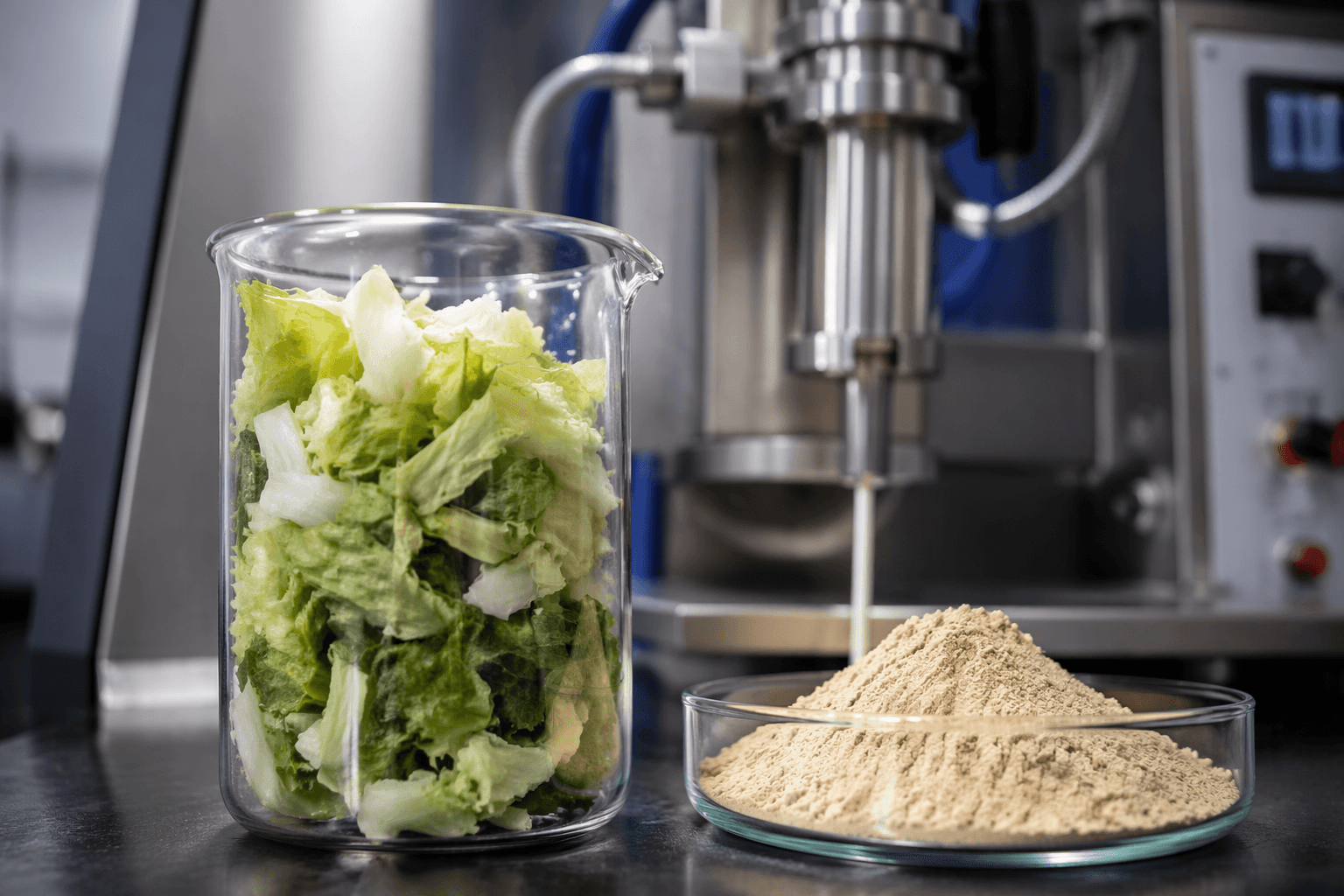
The smallest and most uniform particles came from 10 minutes of ultrasonication paired with the 48-micrometre sieve, a result that points to a process route with clearer commercial promise than a simple waste-to-powder story. Farahnaky’s team framed the work around a larger shift in protein sourcing: rather than creating new crops or new land demand, manufacturers could tap an existing waste stream and add value to a crop fraction that is usually thrown away.
That larger context matters because leaf protein has long been studied as a RuBisCO-rich fraction of green biomass. A 2023 review in Trends in Food Science & Technology described leaf protein extracts as often made up mainly of water-soluble proteins, with RuBisCO as the main component. The cauliflower work fits squarely into that lineage, but with a sharper industrial question: can ultrasound, sieve filtration and careful process tuning make leaf protein cheap, functional and scalable enough for manufacturers trying to cut waste while diversifying ingredient supply?

The researchers said more work is still needed, including pilot-scale testing, energy-efficiency analysis and sensory evaluation in finished products. Until then, cauliflower leaves remain a promising side stream, but one that still has to prove it can cross from lab extraction into a credible ingredient business.
This article was produced by Prism’s automated news system from verified source data, official records, and press releases, then run through automated quality and moderation checks before publishing. The system is built and supervised by the people who set the standards it runs under. Read our full AI policy.
Did this article answer your question?