A Simple Gesture can strengthen food rescue operations with emergency planning
Storms and outages can break a food-rescue route in minutes; A Simple Gesture needs backup roles, prewritten alerts, and route-by-route contingency plans.

Why emergency planning belongs in food rescue
Ready.gov’s emergency response guidance makes a simple but unforgiving point: the first minutes of an emergency matter. For a route-driven nonprofit like A Simple Gesture, that is not a theoretical warning. A storm, a power outage, a road closure, or a building issue can interrupt volunteer pickups, warehouse handoffs, pantry deliveries, and donor communication at the same time.
That is why emergency planning at a food-recovery organization has to be treated as core operations, not a side task. A Simple Gesture depends on people showing up at the right place, on the right route, with the right information and the right vehicle. When those assumptions break, a missed call can quickly become a missed pickup, a delayed delivery, or a pantry partner left waiting for food that never arrives.
What Ready.gov asks organizations to build
Ready.gov says every business should develop and implement an emergency plan, and it stresses that training, testing, and exercises are essential. It also lays out the basic building blocks any workplace should have: risk assessment, available resources, warning systems, communication with employees and management, and protective actions such as evacuation, shelter-in-place, and lockdown.
The toolkit guidance is especially useful for a nonprofit with weather-sensitive schedules. Ready.gov offers hazard-specific business materials for earthquakes, hurricanes, inland flooding, power outages, and severe wind or tornadoes. That matters for A Simple Gesture because the threats that can shut down a pickup route are often the same threats that can shut down a pantry delivery, a warehouse shift, or a volunteer’s ability to drive safely.
Build the plan around people, not just property
For A Simple Gesture, emergency readiness starts with clear backup roles. Someone has to know who makes the call to pause a route, who checks on volunteers, who updates pantry partners, and who handles the donor message when schedules change. In a nonprofit with 200 monthly volunteers and recurring routes spread across neighborhoods, that authority cannot live in one person’s inbox or one coordinator’s memory.
The organization’s structure makes this even more important. Its volunteer calendar organizes recurring pickup routes by area, including East Greensboro, West Greensboro, and the High Point area. That structure is efficient in normal conditions, but it also means a disruption can hit several pickups at once if a storm moves across a wide part of Guilford County or if a road closure cuts off one of the scheduled zones.
- a primary coordinator and one or two backups for each route area
- a separate contact for pantry partners and one for food recovery businesses
- a person who can make the call to halt pickups when roads or weather turn unsafe
- a volunteer contact tree that works even if one coordinator loses power or cell service
A practical plan should identify:
Prewrite the messages before the weather turns
The fastest way to lose control during an emergency is to write every message from scratch while volunteers are already on the road. A Simple Gesture can avoid that by preparing standard alerts in advance for the situations Ready.gov highlights: severe wind, flooding, power outages, and other disruptions that affect travel and building access.
Those prewritten messages should cover the basics in plain language. Volunteers need to know whether their route is operating, whether pickup times have changed, whether they should stay off certain roads, and who will send the next update. Pantry partners and recovery donors need the same clarity, especially when food is already staged for transfer and timing matters.
- route pause notices
- same-day delay notices
- alternate pickup instructions
- warehouse closure alerts
- safety reminders for volunteers driving their own vehicles
Useful templates would include:
For a program built on trust, speed matters. When communication is clear, people spend less time guessing and more time getting food where it needs to go.
Protect the route system that keeps food moving
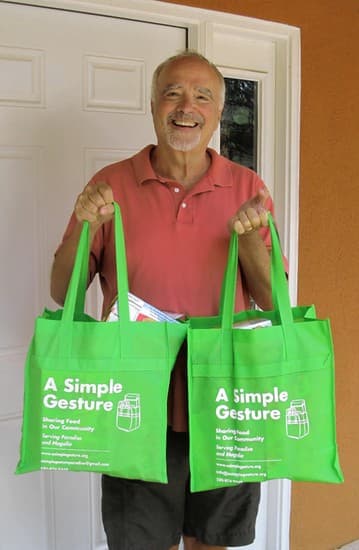
A Simple Gesture’s Food Recovery Program rescues edible food from restaurants, grocery stores, event venues, and corporate cafeterias. That makes the operation highly dependent on ordinary roads, ordinary cars, and ordinary people having an ordinary day. The program also requires volunteers to be age 18 or above, use a clean personal car, and be able to use a smartphone, which tells you how much of the system rests on individual readiness.
That setup works well until conditions change fast. If a storm closes roads, if power goes out at a business that set aside food, or if conditions make driving risky, the nonprofit needs alternate choices already mapped out. That could mean rerouting to a safer pickup point, shifting a route to another day, or moving rescued food through another partner if one location is inaccessible.
- alternate pickup locations for businesses and pantry handoffs
- a list of roads, neighborhoods, or facilities that trigger automatic delays
- a phone-and-text backup for volunteers whose smartphone service drops
- a policy for what to do if a driver cannot safely complete a route mid-shift
A route-dependent nonprofit should think through:
The point is not to make volunteers improvise less out of caution. The point is to give them a safe, simple playbook so they are not guessing under pressure.
Why A Simple Gesture needs continuity planning now
A Simple Gesture says it has operated in Guilford County since 2015 and was established as a 501(c)(3) nonprofit the same year. It also says the model began in Paradise, California, with Jonathan and Karen Trivers. That history matters because it shows a program built for replication, not just one county. A workable emergency plan in Guilford County could help protect the model if the organization grows, and it could also guide other chapters that adopt the same approach.
The scale of the local operation raises the stakes. As of December 2025, A Simple Gesture says it has delivered more than 8,000,000 child-size meals and donated food valued at $13,000,000. It also reports 75-plus pantry partners, 3,900-plus recurring food donors, and 200 monthly volunteers. With that much movement, a disruption is not just an inconvenience. It can ripple through pantries, households, volunteers, and the businesses that depend on a reliable pickup system.
The organization’s mission is to make giving to local food pantries and nonprofits as easy and convenient as possible through door-to-door pickups, corporate pickups, and timely food recovery. That mission only works if the people carrying it out can keep operating when conditions get messy. Emergency planning gives coordinators a way to preserve that continuity, protect volunteers, and keep faith with the communities waiting on the next pickup.
The real test is whether the plan gets used
A written emergency plan only matters if people know it, practice it, and can act on it without searching for instructions. That is why Ready.gov’s emphasis on training and exercises is so important for a nonprofit like A Simple Gesture. The organization’s day-to-day work depends on routine, but its resilience depends on rehearsed flexibility.
When the next storm, outage, or closure hits Guilford County, the nonprofit that has already assigned backup roles, drafted its alerts, and mapped alternate routes will recover faster. In food rescue, continuity is not an administrative luxury. It is how meals keep moving from doorsteps and businesses to the pantries that rely on them.
This article was produced by Prism’s automated news system from verified source data, official records, and press releases, then run through automated quality and moderation checks before publishing. The system is built and supervised by the people who set the standards it runs under. Read our full AI policy.
Did this article answer your question?