A Simple Gesture can tap FoodRecovery.org to move surplus food fast
FoodRecovery.org shows how a clear handoff can move surplus food before it spoils. A Simple Gesture can borrow that model to tighten green-bag pickup, volunteer retention, and pantry routing.
Food recovery succeeds or fails on friction. FoodRecovery.org’s model is built to keep the donor from stalling, the nonprofit from guessing, and the food from sitting long enough to spoil, which is exactly the operational pressure point A Simple Gesture knows well through its green-bag pickups and pantry handoffs.
The donor workflow has to feel almost effortless
FoodRecovery.org reduces the donor side to three plain steps, and that simplicity is the point. A donor creates an account in about 2 minutes, posts the food with the key details that matter, and then lets a local nonprofit claim the donation and arrange pickup. For any workplace, neighborhood group, or household that wants to give but has limited time, that is the difference between participation and postponement.
The posting step is where many donation systems get bogged down. FoodRecovery.org asks donors to include quantity, type of food, pickup window, and any special handling requirements. That is not busywork. It is the information a receiving organization needs to decide whether the donation fits its storage space, labor, and distribution schedule before anyone wastes a trip.
The nonprofit side depends on speed and clarity
On the receiving end, nonprofits verify their account, set food preferences, and define storage capacity before donations start flowing. FoodRecovery.org says verification usually happens within 24 hours, which makes clear how much speed matters when the product on the table is perishable or time-sensitive. If a donor is ready today and a nonprofit cannot respond until later in the week, the system has already started to fail.
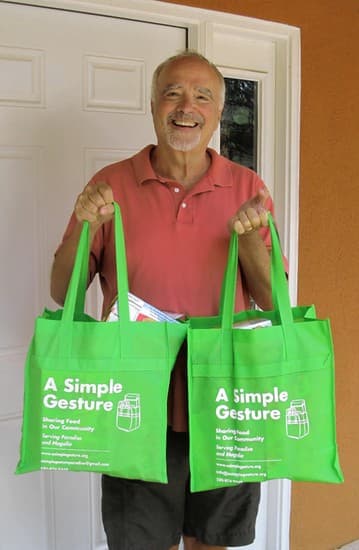
That is the lesson A Simple Gesture can apply to its own network. Green-bag programs work best when routes, pantry partners, and volunteer assignments are predictable enough that people know what happens after a bag is left at the door. The more a household has to wonder who is picking up, where the food is going, or whether the pantry can actually use it, the more likely the system is to lose that donation before it reaches a shelf.
Capacity beats goodwill when the food is moving fast
FoodRecovery.org’s process is built around matching donors to organizations that can actually receive the food. The platform says it has more than 3,400 food partners and that the service is free, which lowers the barrier for both sides of the exchange. It also says that in some regions larger donations can be delivered by volunteer drivers starting at 40 pounds, a detail that matters because not every donation fits a small curbside pickup model.
That threshold is useful for A Simple Gesture staff thinking about route design and volunteer recruitment. A chapter does not just need more people willing to help; it needs volunteers who understand the load, the timing, and the physical logistics of the route. Clear expectations make retention easier because volunteers know what they are signing up for, how long it takes, and what success looks like.
Food recovery works better when the system is built for trust
FoodRecovery.org has worked since 2015 and was formerly MEANS Database, a name it changed in January 2024 when it rebranded to FoodRecovery.org. The organization’s long run matters because food recovery is not just about ambition; it is about staying organized long enough to become routine for donors, drivers, and receiving nonprofits. The rebrand came with a new logo and a modernized website, but the same team and mission remained in place.
That kind of continuity is relevant for a nonprofit like A Simple Gesture, where the relationship between neighbors, pantries, and volunteers depends on trust. If the pickup process changes too often, or if instructions are vague, people drift away. If the workflow is clear and stable, households are more likely to keep using the green bag system and volunteers are more likely to come back.
The scale of the field shows what good logistics can unlock
A 2025 Waste360 profile said FoodRecovery.org now recovers about 2 million pounds of food a week and works with about 4,000 nonprofit partners across the United States. That scale is not just a headline about growth; it is proof that the field rewards systems that reduce administrative drag and make donor action easy. The larger the network gets, the more the platform depends on standard processes, fast verification, and reliable pickup coordination.
FoodRecovery.org’s GuideStar profile adds another piece of the picture. Its Community Meal Program, which began in 2020, has purchased and delivered more than 550,000 hot meals across 10 cities. That shows the organization is not only moving surplus product, but also translating recovery into direct meals where needed. For A Simple Gesture, that is a reminder that pantry partnerships should not be treated as a side note. They are the bridge between collected food and actual community reach.
The broader ecosystem points to the same operational truth
FoodRecovery.org is part of a larger food-rescue landscape built on transportation, volunteer labor, and local coordination. Food Recovery Network says it mobilizes 8,000 college students, food providers, and local businesses. Move For Hunger says it launched its food recovery program in summer 2021 and now works with 1,200+ transportation partners. Those numbers point to the same lesson: recovery is a logistics business wrapped in community mission.
For A Simple Gesture, that means the work does not stop at recruiting donors. It extends to route planning, pantry communication, volunteer onboarding, and follow-through. A green bag on a porch is only useful if the next steps are obvious, the pickup is dependable, and the receiving pantry can use what comes in. The friction is always in the handoff.
The organizations that win in food recovery are the ones that make the journey from donor to nonprofit feel simple enough to repeat. That is the lane A Simple Gesture can own if it treats every pickup as a logistics problem first and a goodwill story second.
This article was produced by Prism’s automated news system from verified source data, official records, and press releases, then run through automated quality and moderation checks before publishing. The system is built and supervised by the people who set the standards it runs under. Read our full AI policy.
Did this article answer your question?