A Simple Gesture fits food recovery into a system-wide waste reduction push
A Simple Gesture’s green-bag pickups work best as a system, not a rescue, with routes, volunteers, pantry capacity, and donor data all moving together.
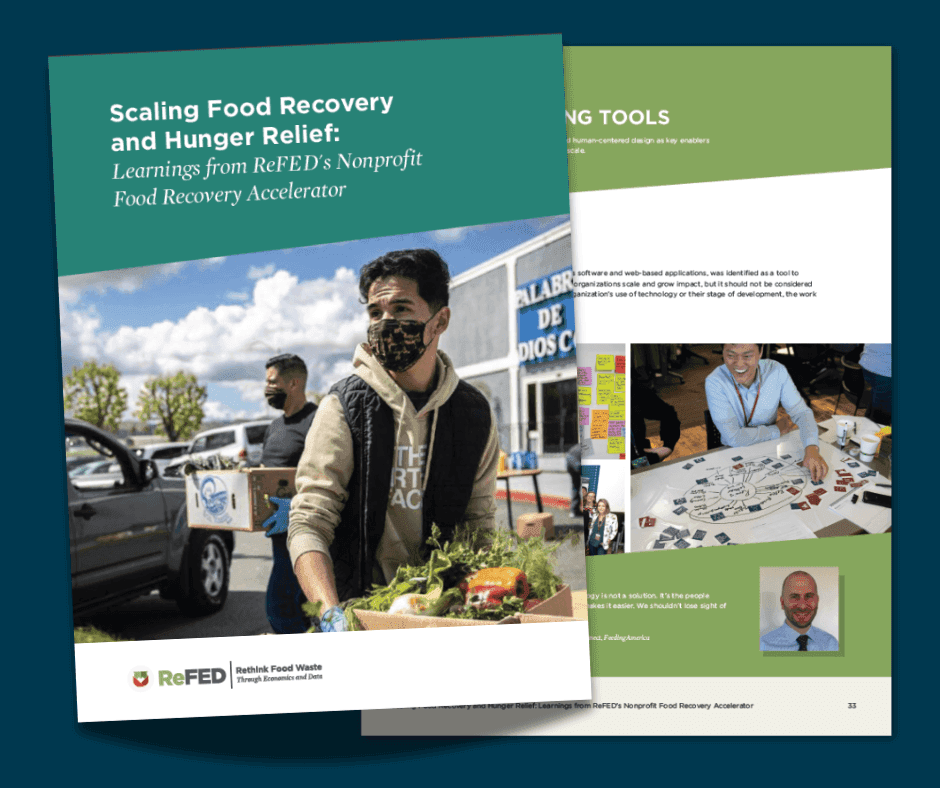
A green bag on a porch works best when A Simple Gesture runs it like infrastructure, not like an occasional act of goodwill. ReFED’s accelerator materials make the same point at a larger scale: food recovery grows when organizations build repeatable systems, strengthen partnerships, and track performance instead of relying on good intentions alone.
Food recovery scales when the process is designed
ReFED’s Roadmap to 2030 treats food waste reduction as a whole-system challenge and sets a goal of cutting U.S. food waste by 50 percent by 2030. Its accelerator report collects best practices, case studies, and expert insights for businesses, government, funders, and nonprofits.
For a neighborhood food recovery nonprofit, the question is not just who can fill a bag or make a pickup. It is how a chapter builds a process that can move food from a doorstep to a pantry with minimal friction, minimal waste, and enough trust that donors, volunteers, and pantry partners keep showing up.
ReFED launched its nonprofit food recovery accelerator in 2019 with support from the Walmart Foundation and in partnership with +Acumen, IDEO, and Feeding America. The accelerator showcase was co-hosted with Feeding America.
What system-builder thinking looks like inside a chapter
For A Simple Gesture, the system-builder mindset shows up in the ordinary work of a chapter-based model. Different neighborhoods generate different donation volumes, volunteers are not available on the same schedule every week, and pantry partners do not all have the same intake capacity. A chapter that treats every pickup as a separate rescue can only grow so far. A chapter that builds around patterns can scale.
That means route coordination is not a back-office detail. It is the operating logic of the whole model. If a team knows which neighborhoods produce the most reliable green bags, which pickup days produce the fewest missed stops, and which pantry partners can turn food around fastest, it can make the network behave more like a supply chain and less like a scramble.

The practical test is whether the system reduces friction for everyone involved. Donors need a simple routine. Volunteers need routes they can repeat and understand. Pantry staff need deliveries they can absorb without creating a bottleneck at intake.
The national policy picture points the same direction
The federal food-waste agenda has long pushed in the same direction. The US Environmental Protection Agency’s Food Recovery Challenge was a voluntary incentive program that used data-driven goals and targeted strategies to reduce wasted food. EPA also placed that effort inside the Federal Food Loss and Waste Collaboration with the US Department of Agriculture and the US Food and Drug Administration.
USDA estimates food waste in the United States at 30 to 40 percent of the food supply. It also cites an estimate of about 133 billion pounds of food wasted in 2010, with a value of $161 billion.
Recurring pickups, pantry relationships, and volunteer schedules move food away from the waste stream and into a reliable distribution system.
A Simple Gesture’s growth depends on repeatable operations
A Simple Gesture’s broader model began in 2011, and A Simple Gesture-Guilford County became a 501(c)(3) nonprofit in 2015. As of December 2025, the Guilford County chapter partnered with dozens of local food pantries and had donated more than 8,000,000 child-size meals worth $13,000,000.

As of December 2025, the chapter had 75-plus pantry partners, 3,900-plus recurring food donors, and 200 monthly volunteers. That mix creates a steady flow, but it also demands constant coordination. A chapter with that many donors and pantry relationships cannot run on improvisation alone. It needs routing discipline, volunteer retention, and clear intake practices on the pantry side.
For coordinators, the most useful takeaway is that scale comes from repetition. Recurring donors make pickup planning more predictable. Monthly volunteers make scheduling less fragile. Pantry partners with consistent intake capacity make distribution faster and easier to measure. The stronger those relationships are, the less likely the system is to buckle when one part runs hot or slow.
A Simple Gesture’s broader network wants to add 900 new chapters by the end of 2035 and move 450 million pounds of food into the system. Every new chapter will inherit the same basic questions about staffing, routing, partner management, and data.
Dignity at the pantry is part of efficiency
Efficiency is not only about moving more food. It also makes access easier and less wasteful for the people receiving it. Plentiful, the accelerator’s $100,000 nonprofit food recovery winner in 2019, is a digital platform designed to improve pantry efficiency by reducing lines, reducing data redundancies, and helping users find open pantries and make appointments.
A pantry that can show when it is open, take appointments, and avoid duplicate data entry is not just running faster. It is creating a calmer and more dignified experience for the people who depend on it. The same principle applies to A Simple Gesture’s partners: when intake is smoother and communication is clearer, volunteers and pantry staff spend less time solving avoidable problems.
This article was produced by Prism’s automated news system from verified source data, official records, and press releases, then run through automated quality and moderation checks before publishing. The system is built and supervised by the people who set the standards it runs under. Read our full AI policy.
Did this article answer your question?