A Simple Gesture shows how diverse careers shape nonprofit leadership
A 4 million-pound food-recovery system depends on a tiny team, where each staffer’s background helps move donations from doorsteps to school fridges.

A Simple Gesture runs on a staffing mix that looks built for a much larger operation. One person handles development and High Point outreach, another manages food recovery, another keeps SHARE and volunteers moving, and the CEO brings global health and aid experience to a network that has to keep donations flowing to pantries, schools and community meals. In this hands-on model, a vacancy or burnout in any one seat can slow pickups, strain partnerships and leave food sitting where it is least useful.
A small team with very different jobs
Leslie Loyd leads as CEO, bringing experience in local and global health leadership, work with the World Food Programme and Miraclefeet, and board or committee service focused on health, equity and nonprofit strategy.
Karen Brudnak-Slate serves as Director of Development and High Point Outreach, and her background in educational publishing shows how a nonprofit can recruit talent from outside the usual charity pipeline. Laura Oxner is Director of Food Recovery, with several years as a speech-language pathologist and a stated interest in collaboration, community and creative thinking. Jean Rochelle, the SHARE and Volunteer Coordinator, is a retired elementary school teacher.
Development work depends on communication and relationship building. Food recovery depends on systems thinking and partner management. Volunteer coordination needs someone who understands school routines, family schedules and the practical difference between a route that runs on time and one that does not.
How the food gets moved
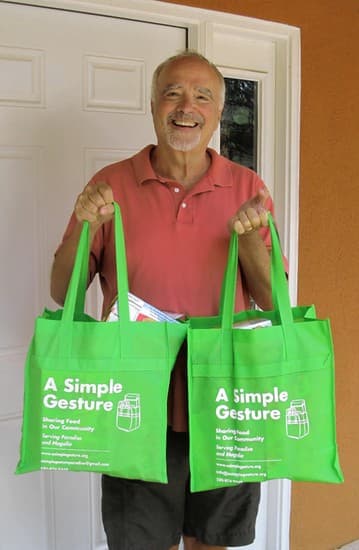
Since 2015, A Simple Gesture has made food donation easier by combining doorstep collection with commercial recovery. It picks up donor bags at homes, recovers surplus food from grocery stores, restaurants, caterers and corporate cafeterias, and uses school fridges for SHARE. That mix means the work is not only about collection, but also about timing, temperature, routing and trust.
Its mission is to provide a sustainable supply of food to local pantries in Guilford County, collect excess perishable food for local nonprofits and community meals, and support SHARE in Guilford County Schools. Those are three different service lanes, and each one depends on the others. Pantry deliveries need reliable supply, community meals need fast turnaround on perishables, and school support depends on relationships with district staff and a steady volunteer base that can absorb the work when volume rises.
A development lead has to keep donors and funders engaged. A food recovery lead has to make sure rescue opportunities do not get missed. A volunteer coordinator has to keep the green bag system workable at scale.
The school-fridge model across Guilford County Schools
SHARE shows how A Simple Gesture’s work has moved into the school day itself. The organization partners with Guilford County Schools to place refrigerators for surplus food, and students can take food whenever they need extra nutrition during the day. In summer 2023, the group purchased refrigerators for all 126 Guilford County Schools, turning what could have been a pilot program into districtwide infrastructure.
Guilford County Schools serves more than 68,000 students and 9,000 employees across 125 schools and 12.5 million square feet. District nutrition staff provide thousands of breakfast and lunch meals each year.
The SHARE model also expands the organization’s workforce demands beyond traditional fundraising and pantry distribution. Someone has to maintain the school relationships, coordinate with staff, match surplus food to the right sites and keep volunteers aligned with the rhythms of the district.
From a local church start to a countywide system
The Greensboro chapter launched in June 2015 after founder Bob Biggerstaff read a Wall Street Journal feature on the model and brought it to Westminster Presbyterian Church. What began in a church setting has grown into a Greensboro-based operation with national reach, and the network now spans more than 70 chapters.
The organization says it has collected more than 4 million pounds of food from about 6,000 donors since 2015. It also puts the network at more than 8 million child-size meals, powered by about 3,900 recurring donors and about 200 monthly volunteers.
That growth also explains why leadership backgrounds matter. Leslie Loyd’s health and aid experience helps frame food recovery as part of a wider community systems problem. Karen Brudnak-Slate’s outreach role links development to a specific geography in High Point. Laura Oxner’s recovery work requires the kind of collaborative thinking that keeps different food sources moving into one pipeline. Jean Rochelle’s volunteer role keeps the green bag model moving.
Where the next growth pressure is building
Women 2 Women awarded A Simple Gesture a $45,000 grant in 2025 for Food Recovery on the Run, a project built to establish regular donations of food that has not been served across Guilford County Schools and deliver it to recreation centers and other after-school sites. The plan calls for expansion to 30 schools in the first year and 60 in the second.
More schools mean more pickups, more refrigeration points, more coordination with staff and more dependence on volunteers who show up consistently.
This article was produced by Prism’s automated news system from verified source data, official records, and press releases, then run through automated quality and moderation checks before publishing. The system is built and supervised by the people who set the standards it runs under. Read our full AI policy.
Did this article answer your question?