A Simple Gesture uses program evaluation to prove impact and improve funding
A Simple Gesture already has the numbers funders want. The harder task is turning pickup, pantry, and volunteer data into proof that protects support.

Why evaluation now sits at the center of survival
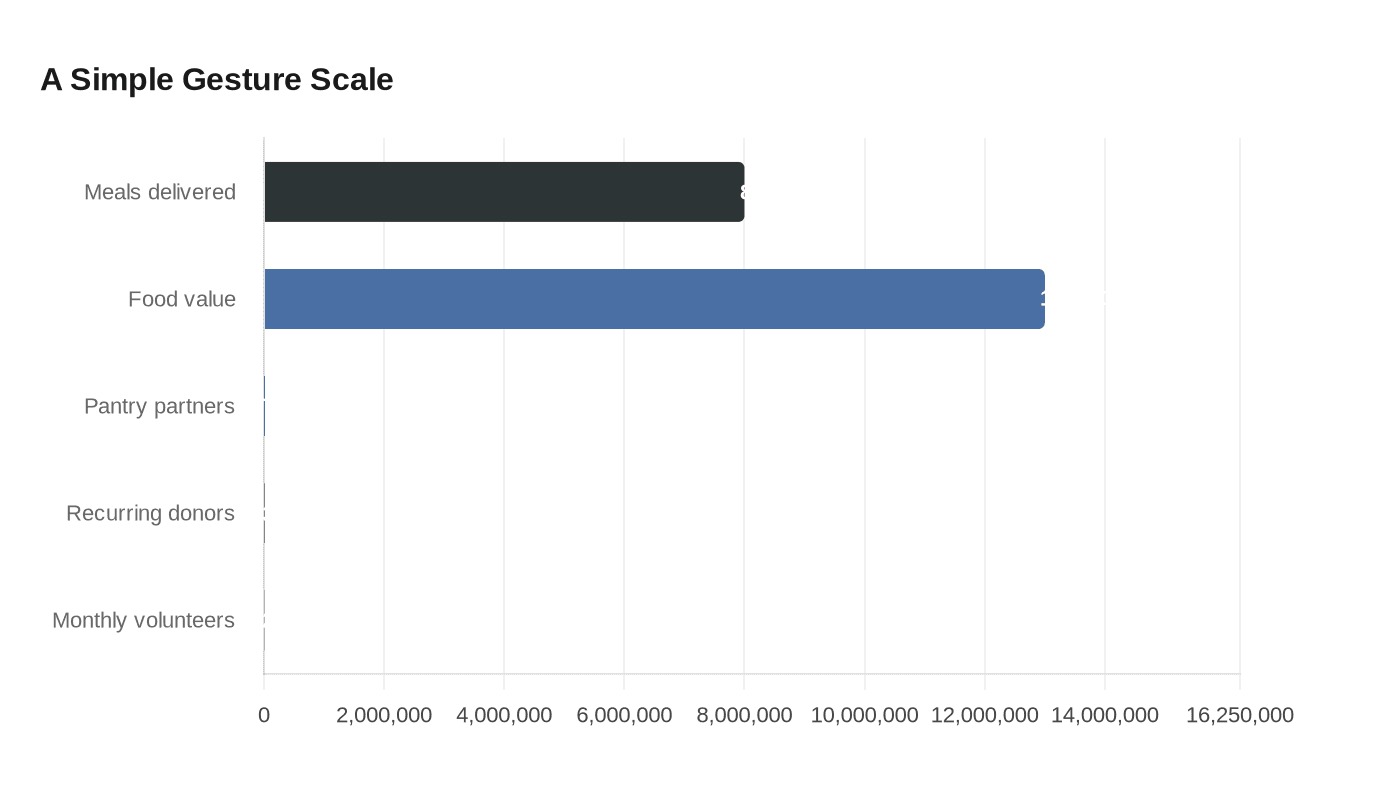
A Simple Gesture already has the kind of scale that should make funders pay attention: more than 8,000,000 child-size meals delivered, $13,000,000 in donated food value, 75-plus pantry partners, 3,900-plus recurring donors, and 200 monthly volunteers. The question is no longer whether the model matters. It is whether staff can show, with enough clarity, which parts of the system are working well enough to deserve more support and which parts need fixing before the next funding squeeze arrives.

That is where program evaluation stops being academic jargon and starts looking like operational discipline. Candid defines program evaluation as collecting information about a program in order to make decisions about it, and it argues that more foundations now expect funded programs to include an evaluation component. For a food-recovery nonprofit built on porch pickups, pantry handoffs, and volunteer drivers using their own cars, that expectation is not abstract. It is the difference between telling a compelling story and proving that the story holds up route by route, pantry by pantry.
What evaluation means for a food-recovery team
For A Simple Gesture, the most useful evaluation question is not, “Did we do a lot?” It is, “Did we do the right work, in the right places, at the right time, with enough consistency to matter?” That is a much tougher standard, but it is also the one that helps protect funding and strengthen the program. An outcome-centric approach, as Candid notes, can lead to stronger program design and increased funding opportunities because it shows not just activity, but movement toward a result.
The organization’s Guilford County, North Carolina operation gives staff plenty to measure. Its work includes door-to-door pickups, corporate pickups, and timely food recovery pickups. It rescues edible food from businesses and delivers it to local nonprofits. Volunteers drive personal cars on weekday routes, which means reliability, safety, and clear expectations are not side issues. They are the infrastructure that determines whether a bag on a porch becomes food in a pantry.
That is why the evaluation lens matters for people on the ground. Route coordinators need to know whether a pickup schedule is efficient. Volunteer managers need to know whether the role is clear enough to keep people coming back. Pantry partners need to know whether the food arrives in a usable window. Staff cannot fix what they only describe in general terms.
A simple starter roadmap for small teams
A lot of nonprofit evaluation fails because teams think they need a huge data system before they can start. They do not. The better move is to build a small, repeatable cadence around the few questions that matter most.
1. Define success in plain language.
Candid stresses the importance of a shared definition of success, and that matters inside A Simple Gesture as much as it does in a grant proposal. Staff, board members, volunteers, and pantry partners may all assume different things about what progress looks like. Some may focus on pounds recovered, while others care more about whether pantry shelves stay stocked.
2. Separate outputs from outcomes.
Outputs are the things you do: bags picked up, routes completed, pounds recovered, pantry deliveries made. Outcomes are the changes those actions create: stronger pantry reliability, better partner satisfaction, and food arriving while it is still useful. If you blur those together, the dashboard looks busy but teaches you very little.
3. Track only what helps you improve.
For a small team, the best metrics are the ones that affect decisions. At A Simple Gesture, that could mean pounds recovered, bags delivered, volunteer retention, route reliability, partner satisfaction, and the percentage of donations that reach a pantry within a useful window. Anything beyond that should earn its place.
4. Use the data on a routine, not just for grants.
Evaluation works best when it is built into operations, not bolted on at the end of reporting season. A quick monthly review can reveal which pickup routes are stable, which volunteers are sticking with the work, and which pantry partners need different timing or communication. That kind of habit turns measurement into management.
Why clear rules matter as much as good numbers
The volunteer side of the model is where measurement and policy meet. A Simple Gesture says weekday driving volunteers must be 18 or older, use a clean personal car, and be able to lift 20-pound boxes. Those rules may sound basic, but they do a lot of work. They set expectations, reduce confusion, and make the role easier to explain and easier to retain.
That clarity matters because food recovery depends on consistency. A route that looks fine on paper can still fall apart if volunteers are unclear about the load, the schedule, or the vehicle standard. In that sense, clear policy is part of the evaluation system. It helps staff distinguish between a real service problem and a preventable operations problem.
The scale story funders want to hear
A Simple Gesture’s public numbers are already strong enough to support a bigger argument about resilience. As of December 2025, the group said it had helped deliver more than 8,000,000 total child-size meals and $13,000,000 worth of donated food across 75-plus pantry partners, with 3,900-plus recurring donors and 200 monthly volunteers. That is not just a reach figure. It is evidence of a network that has to coordinate donors, routes, and pantry relationships at once.
The model’s origins make the case even clearer. A Simple Gesture says the approach began in Paradise, California, where more than 1,700 food donors and volunteer drivers collect over 132,000 pounds of food each year. Communities across the country have since started their own chapters, which suggests the model can travel when the rules are clear and the workflow is repeatable. Evaluation is what helps prove that the model scales without losing the local trust it depends on.
What matters most for the next phase
Candid’s learning catalog even points to a practical next step, with an introductory webinar on applying an outcomes-thinking framework. That is useful because many small teams do not need a complex theory of change before lunch. They need a simple way to answer three questions: What did we do? What changed because of it? What should we do differently next month?
For A Simple Gesture, those answers can strengthen grant proposals, sharpen board reporting, and help staff explain the work in plain English. More important, they can protect the organization’s credibility in a tighter funding environment. The nonprofits that survive are not always the ones with the biggest mission statements. They are the ones that can show, clearly and repeatedly, that their work moves food where it is needed and that their system is strong enough to keep doing it.
This article was produced by Prism’s automated news system from verified source data, official records, and press releases, then run through automated quality and moderation checks before publishing. The system is built and supervised by the people who set the standards it runs under. Read our full AI policy.
Did this article answer your question?