A Simple Gesture uses Service Enterprise to strengthen volunteer operations
Service Enterprise gives A Simple Gesture a framework for turning volunteer goodwill into repeatable operations. For a growing food-recovery network, that means steadier pickups, staffing, and scale.

A Simple Gesture’s challenge is not simply finding more volunteers. It is building the systems that let volunteer work hold together as the network grows, whether that means green bag pickups, pantry deliveries, corporate collections, or food-recovery routes. Service Enterprise is designed for exactly that shift: moving volunteer coordination from an informal lift handled by a few committed people into a measurable management model.
Service Enterprise turns goodwill into operating capacity
AL!VE describes Service Enterprise as the nation’s premiere organizational accreditation for strategic volunteer engagement, and the framework is built around a simple management truth: volunteer labor becomes more useful when it is organized, assessed, and coached like any other core function. The model includes an organizational assessment, up to 16 hours of interactive training, up to 10 hours of personalized coaching, and accreditation that signals a commitment to high standards in volunteer engagement.
That matters in a nonprofit environment where volunteer energy can look abundant on paper and still be fragile in practice. A team may have enough helpers for today’s pickup schedule but not enough structure to absorb growth next season, or enough people to cover a special event but not enough process to keep route coordination consistent week after week. Service Enterprise is meant to diagnose those gaps before they become bottlenecks.
Why the model fits A Simple Gesture
A Simple Gesture-Guilford County says it has operated since 2015 as a 501(c)(3) nonprofit, while the broader story of the model traces back to 2011. The organization says its mission is to make food donations easy and convenient through door-to-door pickups, corporate pickups, and food-recovery pickups, and it works with dozens of local food pantries to help end hunger in Guilford County, North Carolina.
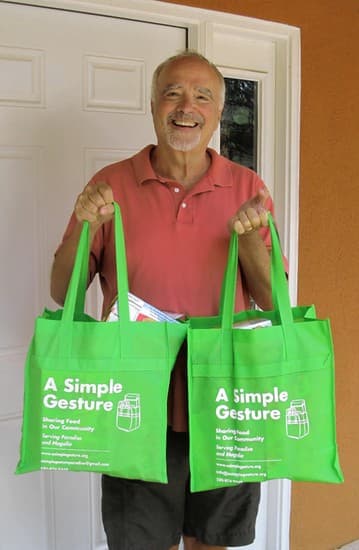
That mix makes the work especially dependent on operational discipline. Green bag pickups only function if routes are organized, donors are reminded, volunteers show up, and recovered food gets matched to the right pantry partner. Corporate pickups add another layer of scheduling and relationship management, while food-recovery work demands coordination with businesses, storage partners, and recipient nonprofits. In that environment, volunteer capacity is not just a headcount question. It is a logistics question.
As of December 2025, A Simple Gesture said it had delivered more than 8,000,000 total child-size meals, $13,000,000 in donated food value, 75+ pantry partners, 3,900+ recurring food donors, and 200 monthly volunteers. Those numbers show a mature community footprint, but they also underscore how much coordination sits behind the mission. The larger the network becomes, the more important it is that volunteer effort is guided by a repeatable system instead of personal improvisation.
What Service Enterprise actually gives a chapter
Service Enterprise is managed by AL!VE in partnership with Points of Light, and AL!VE says organizations access it through licensed providers. Pricing depends on factors such as organization size and operating budget, which makes the model adjustable for nonprofits that do not all have the same scale or staffing structure. That matters for chapters and local affiliates that may be growing at different speeds but still need the same basic management tools.
The assessment piece uses the Index of Volunteer Engagement, a tool AL!VE says is grounded in research from The University of Texas at Austin’s RGK Center for Philanthropy and Community Engagement. In practical terms, that means the program is not just asking whether volunteers are present, but how well they are being used, how work is assigned, and whether the organization is actually leveraging its volunteer base strategically.
For A Simple Gesture, that kind of diagnostic can sharpen several parts of the operation at once:
- Route coordination: identifying whether pickups are scheduled in a way that matches volunteer availability and neighborhood demand.
- Event staffing: determining whether one-off activities are drawing on the same small circle of helpers or building a broader bench.
- Community organizing: figuring out whether chapter growth is supported by clear roles, training, and supervision.
- Pantry partnerships: making sure volunteer activity aligns with the needs of food pantry partners rather than creating extra work for them.
Why this matters for staff, coordinators, and volunteers
For staff and volunteer coordinators, the biggest value of Service Enterprise may be professional development. AL!VE’s model gives coordinators a pathway to strengthen skills in assessment, capacity measurement, and change management, which are not minor add-ons in a nonprofit that relies heavily on people power. Those skills can improve the work inside A Simple Gesture and also make staff more mobile and credible across the sector.
That is especially important in food recovery, where pressure often falls on a few people to keep operations moving. If a chapter loses a route captain, a donor-facing organizer, or someone who knows the pickup calendar by heart, the loss can ripple quickly through the system. A stronger management model helps reduce that dependence on individual memory and makes it easier to train replacements without dropping service.
For volunteers, a more mature system usually means clearer expectations and less confusion about how their time is used. It can also improve retention, because people are more likely to return when sign-ups, pickup routines, and communication are consistent. Goodwill is still the starting point, but consistency is what turns a one-time helper into a recurring volunteer.
The bigger lesson for nonprofit food recovery
A Simple Gesture’s food-recovery work also shows why this discussion matters beyond one chapter. The organization notes that the U.S. wastes 30 to 40 percent of the food it produces, which helps explain why logistics, timing, and volunteer coordination are not back-office details. They are the difference between edible food reaching a pantry partner and food being lost before it can do any good.
That is where the Service Enterprise approach fits the broader operations maturity story. It recognizes that volunteer engagement is not a side duty or a soft skill bolted onto nonprofit life. It is an organizational discipline, one that can be assessed, coached, and improved. For A Simple Gesture, that means growth does not have to rely on heroics. It can be built into a repeatable management model that helps chapters scale while keeping quality intact.
This article was produced by Prism’s automated news system from verified source data, official records, and press releases, then run through automated quality and moderation checks before publishing. The system is built and supervised by the people who set the standards it runs under. Read our full AI policy.
Did this article answer your question?