Feeding America maps food bank help, SNAP, school meal programs
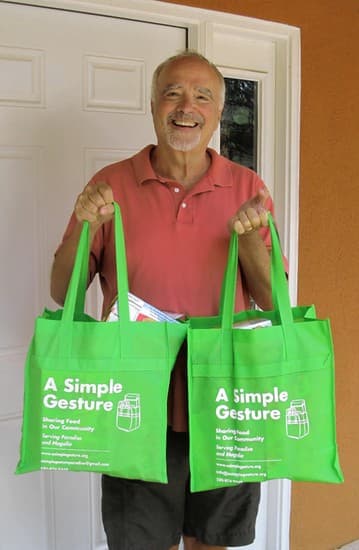
Feeding America’s tools show that food help is often a navigation job, and A Simple Gesture’s volunteers help neighbors find the right door, not just the nearest bag.
The map behind the pickup route
Feeding America’s food access page is more than a directory. For anyone working a route, staffing a pantry, or answering a neighbor’s first question, it functions like a guide to the entire food-help maze: where to find groceries, how to get SNAP help, where senior food programs operate, and how to connect children and teens to meals before, during, and after school.
That matters for A Simple Gesture because the work does not end when a green bag is picked up or a donated box reaches a nonprofit. In practice, food recovery and food access sit on the same line of work. Volunteers and coordinators are often the first people to explain what kind of help exists, where it lives, and how a family gets matched with it.
Why the food bank and pantry distinction matters
One of the most useful parts of Feeding America’s guidance is simple: a food bank is a warehouse that collects and stores food from donations and food drives, while a pantry is where people receive free food directly. That distinction is basic, but it is also the kind of thing staff and volunteers need to explain clearly, especially when someone is nervous about asking for help for the first time.
Feeding America notes that first-time visits can feel intimidating, but volunteers are there to help and may ask questions or have families fill out a short form so they can connect them with the right amount of food and other programs. For a neighborhood organization like A Simple Gesture, that is a reminder that dignity is part of operations. The person answering the phone, coordinating a route, or staffing a partnership meeting is also doing translation work, turning a fragmented system into something a neighbor can actually use.
SNAP, school meals and senior programs sit in the same support system
Feeding America’s food access page places SNAP help beside senior food programs and school food resources, and that is exactly how the real system works. SNAP, the Supplemental Nutrition Assistance Program, is the largest anti-hunger program in America, and Feeding America says local food banks or SNAP offices can help people check eligibility and complete applications. That makes food banks and their partners less like endpoints and more like navigators through the benefits process.
The same page also points to senior food programs such as food boxes and home delivery. Feeding America says food banks help run senior programs across the country, and some of those programs may be closer to a person’s home than the food bank itself. That detail matters for older adults with transportation barriers, but it also matters for staff planning outreach, because proximity can determine whether help is usable at all.
Children and teens are part of the same picture. Feeding America highlights free food programs before, during and after school, showing that hunger relief often needs to be layered around daily schedules. For a nonprofit like A Simple Gesture, that reinforces a practical truth: route coordination, pantry partnerships and donor outreach are only one side of the job. The other side is knowing which household needs a pantry, which one needs SNAP guidance, and which one may need a school or senior program referral instead.
The data behind the demand
Feeding America’s broader network shows why these referrals matter. The organization describes itself as a nonprofit network of more than 200 food banks, 22 statewide food bank associations and 60,000 agency partners, food pantries and meal programs. Its Map the Meal Gap research adds local-level estimates of food insecurity and food costs for every county and congressional district in the U.S., giving food banks and local partners a data map for where need is highest.
That data lines up with what people experiencing hunger say they are facing. Feeding America’s 2024 Elevating Voices Insights Report found that rising food costs, cited by 81% of respondents, low or no income, cited by 66%, and the high cost of rent or buying a home, cited by 63%, were the top issues driving hunger. The group’s 2024 annual report says 47 million people, or 1 in 7, were food insecure in the U.S. Feeding America also reported that 90% of responding food banks saw either an increase or steady demand for food assistance in August 2024 compared with July 2024.
USDA’s latest household food security report adds another layer. It says 86.3% of U.S. households were food secure in 2024, while 13.7% were food insecure at some point during the year. The report also says about 58.9% of food-insecure households participated in one or more of the three largest federal nutrition programs in the month before the survey. That is the clearest signal that local food organizations are not replacing public benefits; they are often helping people bridge the gap between what those benefits cover and what households still cannot afford.
What this means for A Simple Gesture’s daily work
For A Simple Gesture, the Feeding America model points to a broader definition of service. The organization’s Guilford County chapter says it partners with dozens of local food pantries and runs food recovery pickups from businesses to local nonprofits. It also says it has more than 1,700 food donors and collects over 132,000 pounds of food each year. That is the visible logistics side of the work, the part that depends on volunteer drivers, donor follow-up and route timing.
The scale grows when you look at the organization’s impact page. As of December 2025, A Simple Gesture said it had more than 8,000,000 total child-size meals donated, $13,000,000 in donated food value, 75 plus pantry partners, 3,900 plus recurring food donors and 200 monthly volunteers. Those numbers describe more than a donation program. They describe a local distribution network that relies on trust, repetition and the kind of steady coordination that keeps volunteers coming back.
That has direct implications for retention and recruitment. People are more likely to stay involved when they understand how their work fits into a real service chain, not just a pickup calendar. Volunteers who know the difference between a food bank, a pantry, a SNAP office and a school meal program can answer questions with confidence, and that confidence becomes part of the organization’s culture. In a neighborhood model, the best workers are often the clearest guides.
Food recovery and food access belong together
A Simple Gesture also frames its mission around food recovery, saying the U.S. wastes 30% to 40% of the food it produces. That fact changes how the work reads on the ground. Recovery is not only about keeping edible food out of the waste stream; it is about moving it into a local system that includes pantry partners, meal programs and the people who know how to direct neighbors to the right resource.
That is the real lesson of Feeding America’s food access page for workplace teams like A Simple Gesture. The strongest food-help organizations do not just collect food. They translate a confusing system, connect people to benefits, and make sure the first step is not the last one.
This article was produced by Prism’s automated news system from verified source data, official records, and press releases, then run through automated quality and moderation checks before publishing. The system is built and supervised by the people who set the standards it runs under. Read our full AI policy.
Did this article answer your question?