Feeding America toolkit urges school pantries to offer choice, dignity
School pantries work better when students can choose, and Feeding America says that shift can cut stigma, waste and missed meals.
Choice is the dignity decision
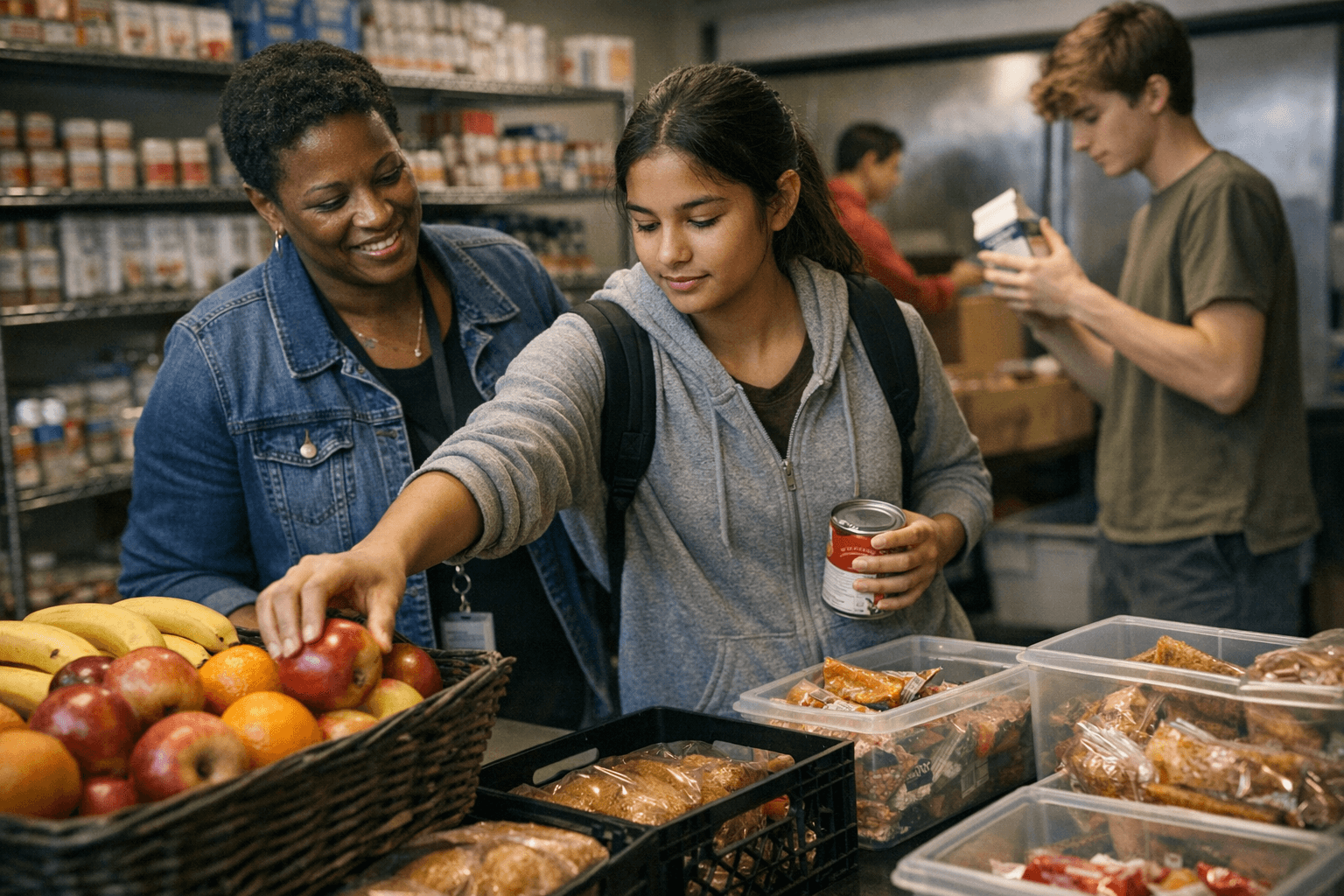
Feeding America’s school pantry guidance treats choice as an operational decision, not a feel-good extra. The toolkit says many schools are moving from pre-bagged backpack programs to onsite pantries, and that shift can change how food assistance feels to students, parents, and staff.
That matters because identical bags send one message while choice sends another. When families can select foods they actually use, the pantry feels more like a resource and less like a handout. Feeding America’s broader guidance says offering choice “increases respect and dignity,” reduces stigma, and can also lower food waste because neighbors leave with foods that fit their needs and tastes.
Why school pantries are being redesigned
School pantries sit in a different part of a student’s day than a traditional neighborhood pantry. The toolkit notes that food-insecure students may have unstable living situations, care for younger siblings, or struggle to get to a pantry during the day. In that setting, access is not just about stock on a shelf. It is about whether a student can realistically use the service before a lunch period ends, after class, or at a time that does not draw attention.
That is why the move from backpack-style distribution to onsite pantries is more than a logistics tweak. It changes the point of contact, the visibility of the service, and the level of control students have over what they take home. For school staff, the message is clear: if the goal is use, the design has to fit the school day and the daily realities of the families being served.
The practical steps that make choice work
Feeding America’s toolkit is especially useful because it gets specific about implementation. School pantry leaders need initial buy-in from administrators, clear goals, and streamlined communication channels. Without that foundation, even a well-stocked pantry can end up underused or hard to manage.
The schedule matters just as much. The toolkit recommends building pantry time into the school day or after-school hours depending on who is being served. It also flags one of the most overlooked design questions in school-based food access: how the food gets home. For students who ride buses or families with limited transportation, pantry layout and distribution rules have to account for what can actually be carried, stored, and moved without creating another barrier.
A practical school pantry setup usually has to answer a few questions up front:
- Who is the pantry designed to serve: students only, or students and families together?
- When can people visit without missing class or work?
- How much privacy does the flow allow?
- What foods are easy to carry home on a bus or with limited transportation?
- Who on staff will keep communication moving between administrators, pantry volunteers, and partner agencies?
The scale of the need is not small
The policy argument for choice becomes stronger when set against current food insecurity numbers. USDA says 13.7% of U.S. households were food insecure in 2024. Among households with children, the rate was 18.4%, affecting about 6.7 million households with children.
Separate reporting based on USDA data found that 14.1 million children lived in food-insecure households in 2024. Those numbers help explain why school pantries are being asked to do more than hand out emergency bags. When millions of children are affected, the difference between a pantry that feels stigmatizing and one that feels normal can shape whether families return.
Stigma is still one of the biggest barriers
The dignity argument is not theoretical. Research on campus food pantry use has found that social stigma, logistics, and the belief that other students need help more are all major barriers. Those same forces can appear in school settings, where students may worry about being seen, may not know whether they are “eligible enough,” or may quietly decide that someone else should use the food first.
That is one reason choice matters so much. When students can select their own items, the service feels less like a public judgment and more like a regular part of the school environment. Feeding America’s guidance argues that this reduces the shame attached to taking food assistance and makes participation more likely.
The model is already expanding
The shift is not just a theory on paper. A recent Feeding America evaluation brief found that 32% of participating sites increased choice over the grant year, showing the model is spreading in the field. In New York City, Food Bank For New York City said it would use a Morgan Stanley Foundation grant to expand choice-based school pantry work in the Bronx and Brooklyn, with a focus on neighbor input and engagement.
That kind of expansion matters because it shows how funders and operators are beginning to treat choice as core infrastructure. School pantries are no longer being measured only by whether food is available. They are increasingly being designed around how the food is selected, how it moves, and how it feels to use the service.
What this means for A Simple Gesture
For A Simple Gesture in Guilford County, the same logic shows up in a different form. The group says it makes food donations easy and convenient for donors, and it works with dozens of local food pantries to help end hunger. That networked approach depends on the same basic principle Feeding America is pushing in schools: participation grows when the experience is simple, respectful, and built around the user’s reality.
For volunteers, coordinators, and staff, the lesson travels well across programs. Whether the task is managing green bag pickup routes, supporting pantry partners, or helping a school set up an onsite pantry, the details matter. Layout, privacy, product mix, timing, and transportation are not side issues. They are the difference between a food program that merely exists and one families trust enough to use.
Know something we missed? Have a correction or additional information?
Submit a Tip