food banks keep farm partnerships alive as federal aid fades
Farm partnerships still matter because they deliver reliability, local coordination and community trust, even after federal aid to food banks faded.
Why the farm link still matters
Food banks are keeping farm partnerships alive because they solve a supply problem, not just a branding problem. When the temporary federal support behind local buying faded and USDA canceled more than $1 billion in local food purchasing support for schools and food banks in March 2025, organizations that had built habits around LFPA were left to decide which ties were worth preserving.
The answer is increasingly clear: keep the partnerships that bring reliability, regional coordination and community credibility along with produce. The shift has been tracked by reporters including Marcia Brown and Amy Haynes because the policy change is really about the mechanics of how food moves, not just the politics of hunger relief.
What LFPA changed, and what it did not
The Local Food Purchase Assistance program launched in December 2021 under USDA, during Tom Vilsack’s tenure, as a $900 million effort and rolled out in 2022. USDA designed it around non-competitive cooperative agreements, allowing state, tribal and territorial governments to buy foods produced within the state or within 400 miles of the delivery destination. That structure made it easier for food banks to work with nearby growers and treat local sourcing as a repeatable part of operations rather than a one-time emergency fix.

Wallace Center at Winrock International reported that LFPA was investing more than $864 million into local communities and regional agriculture value chains over three years and expected about $1.8 billion in overall economic impact. Earlier Food Bank News reporting said nearly $700 million had gone to farmers and ranchers and generated more than $1.5 billion in local economic impact. Those figures show why the relationships stuck: they moved money, food and infrastructure through the same regional network.
Why the partnership is operational, not symbolic
The appeal of farm partnerships goes well beyond putting fresh food into households. Farms can offer seasonal variety, local identity and a practical way to reduce waste while moving food where it is needed. They also give food banks another layer of sourcing diversity, which matters when donations fluctuate and pantry demand does not.
This is where the logistics become the story. Nearby farms can be easier to coordinate than scattered surplus, especially when there is already a local system for sorting, hauling and receiving produce. For food banks, the value is not just the carrots or squash. It is the ability to plan around a known partner, a known harvest window and a known distribution channel.
USDA’s gleaning toolkit makes that point plainly: gleaning works because it requires coordination among volunteers, farmers, community groups and hunger-relief agencies. The toolkit also notes that more than 23 million Americans, including 6.5 million children, live in low-income urban and rural neighborhoods known as food deserts. In that context, farm ties become part of the answer to access, not a bonus feature.

What this means for A Simple Gesture
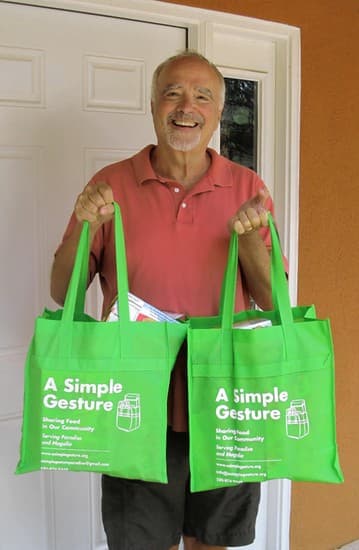
A Simple Gesture already operates like an organization that depends on durable coordination. It has been active since 2015 in Guilford County, North Carolina, and its doorstep Green Bag model is built on repeat behavior, route planning and donor habits rather than one-off drives. Public profiles say it has collected more than 4 million pounds of food from about 6,000 donors. More recent reporting says it had helped donate more than 8 million child-size meals and about $13 million in food value by December 2025.
That scale makes farm partnerships especially useful. A neighborhood-based food recovery nonprofit cannot rely on a single funding stream or a single source of food, and it does not need to. Farm relationships can help fill seasonal gaps, add produce when pantry shelves are thin and give coordinators more options when household donations are uneven.
They also create different kinds of volunteer work. Field gleaning, harvest sorting and produce handling offer shifts that look different from warehouse labor or doorstep pickup routes. For some volunteers, that is the draw: a chance to help in a way that feels direct, local and visible. For the organization, it is a retention tool as much as a food source, because people are more likely to come back when they understand exactly where the food came from and where it went.
A Simple Gesture’s Food Recovery and SHARE school-refrigerator programs fit into that same logic. The more sources an organization can plug into one local system, the more it can match food to the place that needs it most, whether that is a pantry, a school refrigerator or another community outlet.

Why these relationships survive the policy shift
The 2025 funding rollback did not erase the value of local food purchasing. It removed the federal cushion that made those relationships easier to finance. That is why food banks keep returning to farms: not because the partnerships are fashionable, but because they are useful.
Advocacy groups and network organizations, including Feeding America, the School Nutrition Association, the Alliance to End Hunger and the California Association of Food Banks, have a stake in that same question. When public support moves around, the organizations that remain effective are the ones that can keep food moving through local channels without having to rebuild the whole system every time the policy winds change.
For A Simple Gesture and its peers, the lesson is straightforward. Treat farms as part of the supply network, not as a seasonal add-on. The organizations that build that kind of backbone will be better positioned for the next funding shift, the next harvest and the next round of community need.
This article was produced by Prism’s automated news system from verified source data, official records, and press releases, then run through automated quality and moderation checks before publishing. The system is built and supervised by the people who set the standards it runs under. Read our full AI policy.
Did this article answer your question?