How employee volunteer programs can boost morale and retention
The best volunteer programs are built like work benefits, not charity stunts. For A Simple Gesture, that means paid time, clear roles, and measurable impact that keeps companies coming back.

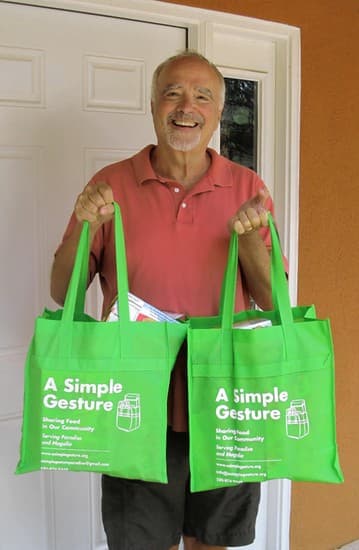
Employee volunteer programs do not boost morale just because a company calls them a benefit. They work when the experience is organized, useful, and easy to repeat, which is why A Simple Gesture’s green bag model is such a strong fit for workplace partnerships. Its system depends on predictable routines, clear roles, and enough structure that a corporate group can help without creating more work for already busy nonprofit staff.
Why volunteer programs matter to workers and employers
The clearest lesson from the research is that employee volunteering is not just philanthropy. SHRM’s reporting says employer-sponsored volunteer programs can build goodwill in the local community, strengthen a company’s image, teach employees new skills, and improve morale and retention. Benevity’s 2024 findings sharpen that point further: employees who take part in corporate purpose programs through volunteering, giving, or positive actions are 52% less likely to leave their company.
That is the part managers should pay attention to. If a volunteer day is a one-off photo opportunity, it may generate a few smiles and a social post. If it is designed as a meaningful part of employee engagement, it can help people feel connected to the workplace and to one another, which is where retention gains start to show up. For employees, that means the program has to feel like more than a checkbox. For employers, it means the effort has to be structured enough to survive beyond a single calendar event.
Benevity’s 2026 report shows how mainstream this has become. Corporate volunteers logged 23.7 million approved hours in 2025, up 175% from 2019, and the number of unique volunteers more than tripled to 1.87 million. The corporate volunteering market is not growing because companies suddenly became sentimental. It is growing because employers are looking for practical ways to support culture, hybrid teams, and retention at the same time.
What separates a real program from a box-checking day
The difference usually comes down to management. SHRM notes that building a volunteer program takes time, staff attention, and money, which can be hard for smaller organizations. That reality matters for A Simple Gesture because every extra layer of friction can fall on a small team already coordinating food pickup routes, pantry partnerships, and volunteer drivers.
The most valuable programs are the ones that can be repeated without reinventing them each time. For A Simple Gesture, that can mean recurring bag-stuffing shifts, team-based sorting days, route-day support, or skills-based project work. Those formats work because they give companies something simple to approve and give nonprofit staff a way to standardize orientation, supervision, and follow-up.
That is also where employee trust gets built or lost. A polished volunteer experience tells employees their time is respected. A chaotic one sends the opposite message. If a group shows up and spends half the day waiting for instructions, the employer has bought frustration instead of morale. If the nonprofit can show impact quickly, explain the mission clearly, and give people a role that matters, the program becomes something employees want to repeat.

Paid time is part of that design. Volunteer programs are strongest when employers treat them as part of the workweek rather than a favor squeezed into personal time. Without that support, participation skews toward people who already have the flexibility to leave their desks, which makes the benefit uneven and weakens the culture message the company is trying to send.
Why A Simple Gesture is built for this kind of partnership
A Simple Gesture was designed around a basic workplace problem: many donors work Monday through Friday business hours while pantries often accept donations during the same hours. Robert Schnapp founded the Reston, Virginia chapter after seeing that mismatch, and the organization’s model has grown around removing that friction for donors and volunteers alike. That makes it especially well suited to employers looking for a volunteer program that is easy to schedule and easy to understand.
The numbers show the scale of the model. A Simple Gesture says it now has more than 1,700 food donors and numerous volunteer drivers who help collect over 132,000 pounds of food each year. The organization also says it is focused on adding 900 new chapters by the end of 2035, with the goal of adding 450 million pounds of food to reduce food insecurity and hunger.
That growth plan depends on repeatable systems, not random bursts of enthusiasm. A company can plug into a green bag pickup route, a packing session, or a sorting day because the nonprofit has a defined workflow. That is the kind of volunteer structure that makes sense for employers trying to offer employees a meaningful community role without turning the opportunity into a logistical burden.
For A Simple Gesture staff, the workplace-design question is as important as the service question. The best corporate partners are not just looking for a good cause. They want a program that is easy to brief, easy to supervise, and easy to bring back next quarter. If the nonprofit can standardize the experience, it can turn a one-time team outing into a dependable pipeline of support.
Why the need is bigger than one neighborhood
The food insecurity data make the case that this model is not a niche kindness. USDA Economic Research Service data show 86.3% of U.S. households were food secure in 2024, which means 13.7% were not. FRAC put that in human terms, saying 47.9 million people lived in food-insecure households in 2024, including 14.1 million children.

Feeding America’s Map the Meal Gap work reinforces that the problem reaches every county, parish, and congressional district in the United States. That matters for A Simple Gesture because its neighborhood-based system addresses a national problem through local habits: set out the green bag, fill it, collect it, and move the food into the pantry network. It is a simple structure, but the scale is serious.
That is also why corporate volunteer programs can do more than pad a community service report. A thoughtfully run partnership links employee engagement to a concrete community outcome. Workers see where the food goes, managers see the morale benefit, and the nonprofit gains a more predictable volunteer base that can support pickup routes and pantry relationships without extra chaos.
What A Simple Gesture should ask from company partners
The strongest workplace programs are the ones that are designed with capacity in mind. A Simple Gesture can make that easier by asking corporate partners to commit to a few clear expectations:
- set aside paid volunteer time when possible
- place employees in defined roles with a clear start and finish
- use short, practical orientations so people know how the green bag system works
- match teams to tasks that fit the nonprofit’s actual schedule, especially route days and sorting windows
- make impact visible quickly so employees can see the result of their work
That approach respects both sides of the partnership. Employees get meaningful service instead of empty team building. Managers get a program that can support morale and retention without disrupting the day. And A Simple Gesture gets what every nonprofit wants from workplace volunteering: dependable help that fits the mission instead of a crowd that creates cleanup work.
The companies that understand this will keep coming back. The ones that do not will treat volunteerism as a perk. A Simple Gesture’s model works because it knows the difference.
This article was produced by Prism’s automated news system from verified source data, official records, and press releases, then run through automated quality and moderation checks before publishing. The system is built and supervised by the people who set the standards it runs under. Read our full AI policy.
Did this article answer your question?