Idealist VolunteerMatch merger shows how A Simple Gesture can recruit volunteers
Idealist’s merger with VolunteerMatch shows A Simple Gesture how to widen its volunteer funnel with role-specific listings, team outreach, and better follow-up.

Idealist’s merger with VolunteerMatch is more than a platform housekeeping story. It shows how volunteer recruiting works when the goal is not just to collect names, but to match the right people to the right kind of work, whether that is a one-time shift, a team effort, or a skills-based role that needs more than goodwill.
A bigger funnel, not just a bigger directory
Idealist and VolunteerMatch announced their merger on January 14, 2025, and Idealist later said the two platforms were fully brought together by September 8, 2025. The combined organization says it now connects 250,000-plus organizations with over 40 million individuals, and that its VolunteerMatch platform offers more than 100,000 volunteer opportunities. It also says the merged platform supports more than 200,000 organizations and has engaged hundreds of thousands of people through free educational opportunities, webinars, and events.
That scale matters for A Simple Gesture because it points to a recruiting model built around discovery and fit. A simple local sign-up page usually assumes a visitor already knows what they want to do. Idealist’s model starts earlier, helping people compare options, understand time commitments, and find a role that feels manageable enough to say yes to.
For a neighborhood food-recovery nonprofit, that difference is not cosmetic. It changes who shows up, how often they return, and whether they become a steady part of the operation.
What a typical volunteer page leaves on the table
A standard nonprofit volunteer page often asks for one thing: fill out a form and wait to hear back. That can work for a small base of loyal supporters, but it misses the variety of reasons people volunteer. Some want to help once. Some want a recurring assignment. Some want to bring a workplace team. Others may not be available for physical labor at all, but can help with coordination, outreach, or administrative tasks.
Idealist’s VolunteerMatch platform is built around that variety. It emphasizes both virtual and on-site opportunities, and it organizes listings by cause area so a user can find something that fits their interests and schedule. That is a practical advantage for A Simple Gesture, where the work is spread across doorstep donations, pickup routes, pantry partnerships, and community outreach.
The big lesson is that volunteer recruitment is not only about local word of mouth. It is also about making the opportunity easy to discover, easy to compare, and easy to trust. The more clearly a nonprofit shows the shape of the work, the less it relies on a visitor to imagine the fit on their own.
Three funnel elements A Simple Gesture could copy
1. Split the front door by audience
Idealist’s platform does not treat every volunteer as the same kind of prospect, and A Simple Gesture does not have to either. The organization already invites involvement from businesses, faith communities, schools, and civic groups, which means it already understands that the path for a workplace team is different from the path for a solo volunteer.
That logic can be pushed further. A Simple Gesture could create separate entry points for individuals, company teams, and skills-based helpers, so each visitor sees the lane that matches their motivation. A person who wants to help once should not have to sort through the same language as a corporate organizer trying to line up a team event.
2. Offer multiple commitment shapes
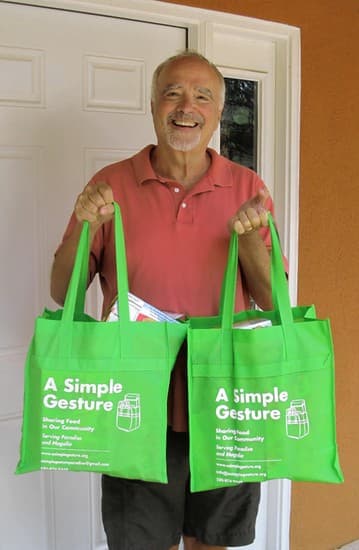
The platform model shows the value of giving people different ways to participate. A Simple Gesture already has that logic in practice: volunteers can host virtual or on-site food drives, and the Guilford County operation uses a volunteer events calendar that includes scheduled Green Tag, White Tag, and Orange Tag pickup dates in 2026.
That mix matters because food-recovery work can demand very different levels of commitment. A one-off bag pickup is not the same as a recurring route assignment, and neither is the same as an administrative or outreach role. When the opportunity is framed as a series of manageable options, the nonprofit lowers the barrier to entry without lowering the seriousness of the work.
3. Build trust with support, not just a sign-up form
Idealist’s combined platform does more than list openings. It also provides resources for leaders of volunteers, including guides and webinars, which signals that recruiting is only the first step. Retention depends on how well people are onboarded, how clearly they understand the work, and whether the organization follows through after the first expression of interest.
That is a useful benchmark for A Simple Gesture’s staff and coordinators. Role descriptions, onboarding materials, and follow-up messages are not back-office extras. They are part of the recruiting funnel, especially if the nonprofit wants volunteers to move from curiosity to commitment and then into repeat service.
Why this fits A Simple Gesture’s day-to-day reality
A Simple Gesture’s Guilford County operation partners with dozens of local food pantries, has a physical office at 3503 Redington Drive in Greensboro, North Carolina, and runs a volunteer calendar tied to scheduled pickup dates. That is already a more complex operating model than a generic volunteer request form suggests. The work depends on route coordination, pantry relationships, and enough volunteers to keep the green bag system moving.
That is why the Idealist-VolunteerMatch merger is useful as a benchmark. It shows a recruiting system that speaks to people with different time commitments and different motivations, instead of assuming every helper wants the same experience. For A Simple Gesture, the opportunity is to make its own pathways just as visible: a workplace team can see where it fits, a solo volunteer can see a one-time opening, and someone with specialized skills can see that there is more to do than carry bags.
The strongest lesson is simple. Volunteer recruitment works better when it is built like an operating system, not a single sign-up page. For a food-recovery nonprofit, that can mean the difference between collecting interest and building a reliable volunteer base that keeps pantry shelves supplied and pickup routes covered.
This article was produced by Prism’s automated news system from verified source data, official records, and press releases, then run through automated quality and moderation checks before publishing. The system is built and supervised by the people who set the standards it runs under. Read our full AI policy.
Did this article answer your question?