Meal recovery coalition shows how food rescue can expand beyond pantry models
Prepared-meal rescue gives food recovery a second lane: moving cooked meals from cafeterias to families instead of landfills, with rules that make the work safer and scalable.
Why meal recovery matters beyond pantry models
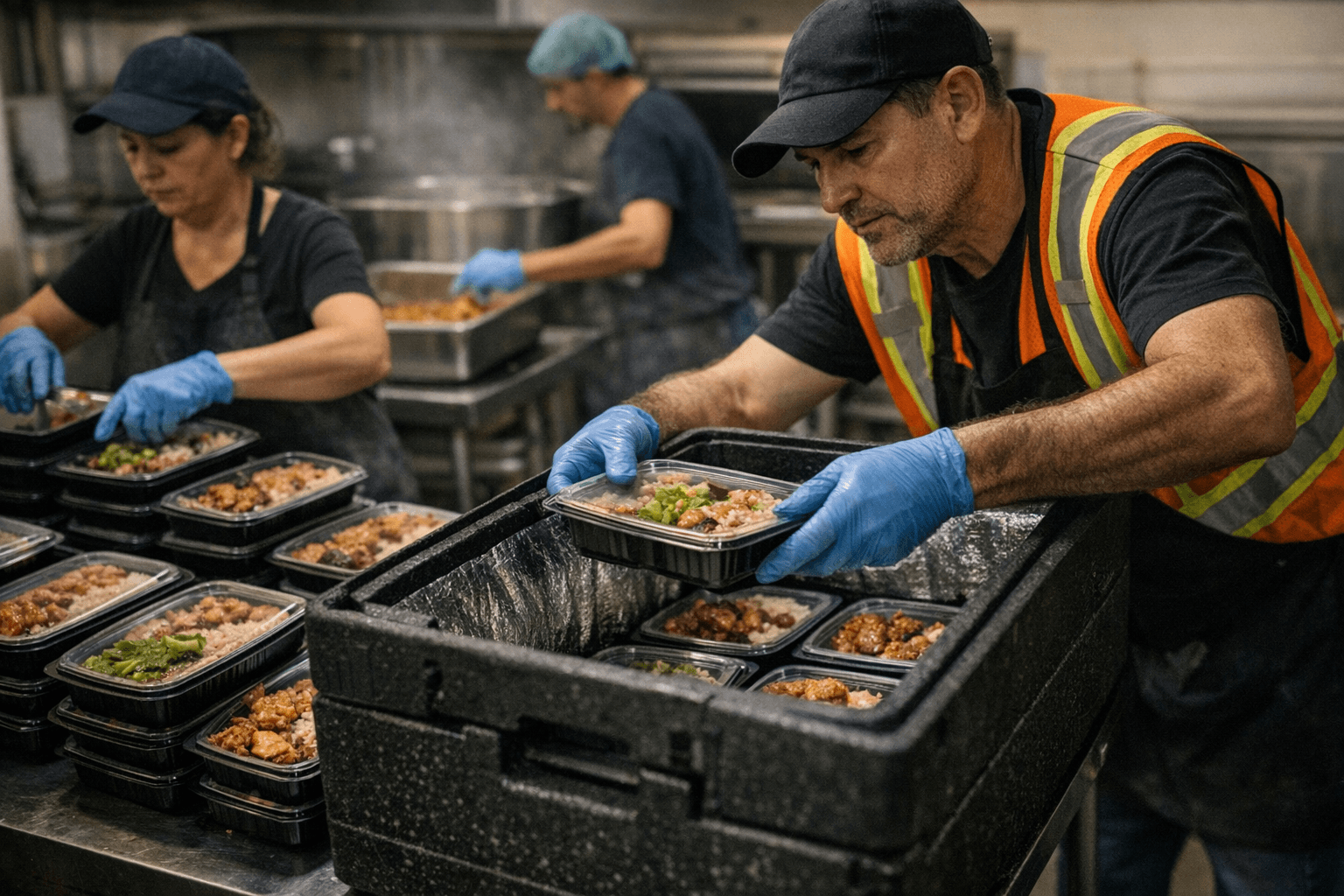
The strongest food recovery systems do not stop at shelf-stable donations. The Meal Recovery Coalition is pushing a different idea: if a meal is already cooked, portioned, and ready to serve, it should not be headed to a landfill just because it came from a cafeteria, university dining hall, hospital kitchen, or event venue.
That distinction matters for A Simple Gesture because the green bag model solves one part of the hunger problem, not all of it. Pantry staples help households stock a shelf; prepared-meal recovery helps close the gap for people who lack time, storage, or a kitchen that makes cooking realistic. In practice, that means food rescue can move from a once-a-week donation stream into a broader access network built around what people can actually eat now.
A model built for scale, not symbolism
The coalition says New Jersey still sends about 5 million prepared meals from large cafeterias and event venues to landfills each year. Against that backdrop, the fact that New Jersey food rescue organizations collectively recovered 1 million prepared meals in 2025 shows both the size of the opportunity and how far the state has already moved. The coalition’s stated ambition for 2026 is 1.5 million meals recovered statewide, a clear sign that this is being treated as infrastructure, not a side project.
That framing was on display when the Meal Recovery Coalition launched on September 18, 2024, at Rutgers University’s Cook Student Center in New Brunswick. Governor Phil Murphy and Assembly Speaker Craig Coughlin were among the public supporters at the launch, underscoring that meal recovery is being presented as a statewide policy and logistics issue, not only a charity effort. The coalition, led by Share My Meals, says its long-term goal is to make meal recovery a scalable model that can be replicated nationwide.
For staff and coordinators at A Simple Gesture, the lesson is direct: food recovery grows when the network reaches beyond the traditional charitable food pipeline. The usable surplus is not just in grocery retail or doorstep donations. It is also sitting in school cafeterias, hospitals, corporate dining rooms, university halls, and large venues where food is produced in volume and often left behind at the end of a service window.
What prepared-meal recovery can do that pantry systems cannot
Prepared-meal recovery fills a different service gap than pantry work. Pantry donations are usually built around nonperishable items and household storage, which makes sense for stability and sorting. Meal recovery, by contrast, captures food that is already prepared and ready to distribute, which can be especially useful for people facing a same-day need or those without the equipment to turn ingredients into a meal.
That is why the coalition’s approach is more than a recycling story. It is a distribution story. When a meal is rescued before it is discarded, it can move quickly through home delivery or community partners and reach households that might not benefit from a box of dry goods alone. In communities where food insecurity intersects with housing instability, shift work, or limited transportation, that difference can be decisive.
The operational challenge is that prepared food is less forgiving than shelf-stable donation. It needs an organized system to move safely, and that means route coordination, temperature control, labeling, transport, and tracking all matter. For a nonprofit like A Simple Gesture, that is where meal recovery becomes a test of capacity as much as a question of mission.
The rules that make meal recovery possible
The New Jersey Food Donation Guidelines, published in fall 2025, are the kind of back-end work that often determines whether a recovery model succeeds or stalls. Rutgers Cooperative Extension worked with the coalition and partners across public health, academia, food service, nonprofit recovery organizations, and government agencies to make donation safer and easier while reducing ambiguity about what food can be donated.
Those guidelines spell out responsibilities for donors, food recovery organizations, and receiving organizations. They cover temperature control, contamination prevention, labeling, transport, and tracking. They also note that good-faith donations are protected under the federal Bill Emerson Good Samaritan Food Donation Act, which helps lower the liability anxiety that often keeps kitchens and institutions from participating.
Rutgers says more than 15 partners collaborated on the guidelines, and the university plans to help train municipal food safety inspectors on the new standards. That is the kind of institutional alignment meal recovery needs if it is going to move from pilot projects to routine practice. Clear standards do not just protect food. They make it easier for schools, hospitals, universities, and corporate cafeterias to say yes.
What this means for A Simple Gesture’s next phase
For a neighborhood nonprofit built around green bag pickup, the coalition offers a useful reminder that donation infrastructure can expand without abandoning its roots. The same relationships that support pantry pickup routes can also open doors to prepared-meal partnerships if the chapter has the right logistics and trust in place. In that sense, meal recovery is not a replacement for pantry work. It is the missing complement.
- Pickup windows would likely be tighter and tied to meal service schedules.
- Partner onboarding would need clear rules on packaging, labeling, and handoff.
- Route coordination would have to account for perishability and immediate distribution.
- Pantry partners might need different receiving capacity than they use for shelf-stable goods.
A Simple Gesture staff and volunteers would need to think differently about a prepared-meal stream:
That kind of work can also affect volunteer recruitment and retention. People are often energized when they can see food moving directly from a donor kitchen to a person’s table, not sitting in storage. But the mission only works if the system is organized enough to make that handoff reliable, which means coordinators carry more of the burden even when the public-facing story sounds simple.
A hunger story, a climate story, and a public-health story
The broader need in New Jersey is stark. Feeding America estimates that 1,089,190 people in the state were food insecure in 2023, or 11.7% of the population. It also places the average meal cost at $3.74 and the annual food budget shortfall at $772,854,000. That gap is exactly why every recoverable meal matters.
There is also an environmental cost to leaving food on the table. The U.S. Environmental Protection Agency says food waste makes up about 24% of material in U.S. municipal solid waste landfills, and landfilled food waste generates methane, a powerful greenhouse gas. So when a prepared meal is rescued instead of dumped, the result is not only hunger relief. It is less waste, less methane, and a better use of the people, money, and energy already spent making the food.
The Meal Recovery Coalition shows what happens when a food rescue network treats prepared meals as a real resource rather than an edge case. For A Simple Gesture, the signal is clear: pantry work remains essential, but the future of food recovery is broader, faster, and more connected to the places where meals are actually made.
This article was produced by Prism’s automated news system from verified source data, official records, and press releases, then run through automated quality and moderation checks before publishing. The system is built and supervised by the people who set the standards it runs under. Read our full AI policy.
Did this article answer your question?