National VOAD sets volunteer standards for disaster response and recovery
National VOAD’s volunteer standards show why disaster response runs on discipline, not improvisation, and A Simple Gesture can use the same rules to protect its routes, partners, and volunteers.

After Hurricane Camille in August 1969, aid reached survivors haphazardly because organizations were working on their own. National Voluntary Organizations Active in Disaster built its volunteer standards out of that lesson.
A standard for help that does not become chaos
National VOAD’s Points of Consensus set shared commitments, minimal standards, ethical principles, and operational principles across topics that include volunteer management, housing, donations management, case management, emotional care, and spiritual care. At the center of that framework are the 4Cs: communication, coordination, collaboration, and cooperation.
Volunteers are inherently valuable, but value does not erase the need for boundaries. Organizations can select volunteers consistent with their mission, code of conduct, and statement of faith, and they can ask volunteers to affiliate with an existing voluntary organization before entering a disaster area, wait until needs are identified, and stay away until it is safe to travel.
Volunteer work can stretch months or years, not a short burst of media-driven urgency. In 2019 alone, National VOAD member organizations reported 9,907,071 volunteers, 48,129,263 volunteer hours, and $1.3 billion in donated labor across disaster response and recovery in the United States.
What A Simple Gesture can borrow from disaster discipline
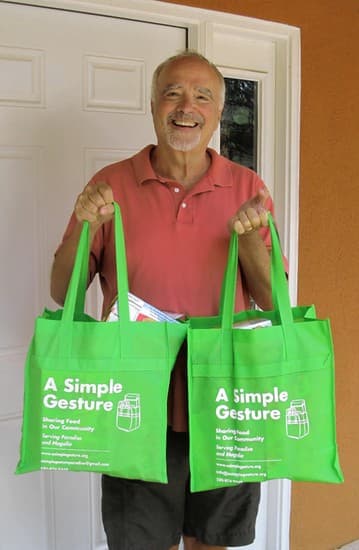
A Simple Gesture is not a disaster-recovery agency, but its volunteer model lives in the same operational neighborhood. It depends on people showing up at the right time, doing one task the same way every week, and handing food off cleanly to the next person in the chain. That makes VOAD’s framework unusually useful for a neighborhood food-recovery nonprofit that runs on doorstep donations, green bag pickups, and pantry partnerships.
For A Simple Gesture, that means keeping volunteer instructions short, route assignments clear, and communication consistent enough that a new driver or donor coordinator can step in without learning the operation by trial and error. It also means treating volunteers with respect not as a vague value statement, but as a management practice that reduces confusion, improves retention, and makes partner pantries less likely to absorb the cost of someone else’s disorder.
VOAD’s emphasis on affiliation also translates well. In a food-recovery setting, volunteers should not improvise their own version of the mission by adding unsanctioned pickups, changing delivery times, or deciding on the fly which pantry should receive what. A coordinated system protects staff time, keeps route coverage predictable, and gives partner organizations one clear contact point.
A Simple Gesture’s scale makes process a staffing issue, not a side issue
A Simple Gesture began in 2011 when Jonathan Trivers started the project in Paradise, California, after realizing there was plenty of food in the community but no easy way to get it to the people who needed it most. The idea grew from a conversation with friends about bare pantry shelves, and Jonathan and Karen Trivers founded the nonprofit after he looked for a way to give back in retirement.
The model spread because it was simple to understand and hard to manage casually. More than 65 communities have adopted it, and the approach has been replicated by over 70 chapters nationwide. In Paradise, the organization now has more than 1,700 food donors and numerous volunteer drivers who collect over 132,000 pounds of food each year. The original Paradise and Magalia effort reached about 23,000 pounds per pickup, six times a year, or roughly 135,000 pounds annually.
That kind of volume exposes the same management problem National VOAD was created to solve: once a volunteer effort grows, informal coordination stops being enough. A Simple Gesture’s system only works when someone owns the route list, someone else owns donor communication, and partner pantries know exactly what the delivery cadence will be.
The Northern Virginia example shows where volunteer labor gets eaten by ambiguity
In Reston, Virginia, founder Robert Schnapp showed what happens when a volunteer program depends too heavily on one person. Schnapp started A Simple Gesture Reston in June 2015 after noticing that donors worked business hours while food pantries were open at the same time. In the beginning, he spent more than 40 hours a week doing everything from recruiting donors and drivers to building routes and sending emails.
A volunteer program can look community-driven on the outside and still function like an all-hands scramble behind the scenes. VOAD’s standards point toward a better answer: define who recruits, who trains, who communicates with partners, who handles exceptions, and who decides when it is safe or appropriate to act.
For A Simple Gesture, that discipline matters in ordinary weeks and during spikes in demand. Seasonal surges, weather disruptions, school breaks, or a sudden community need can all push a volunteer system past its informal limits. If the response is to say yes to everyone and sort it out later, the people who pay are the pantry partners, the route coordinators, and the volunteers trying to help without enough direction.
A practical framework for A Simple Gesture
A VOAD-style volunteer framework for A Simple Gesture can stay straightforward:

- Set the mission boundary first. Define what volunteers do, what they do not do, and which decisions belong to staff.
- Make routes and pickup windows fixed. Green bag pickups should follow a predictable schedule so donors and drivers are not improvising at the curb.
- Use one communication channel for changes. If a route shifts, the same update should reach drivers, coordinators, and pantry partners.
- Separate recruitment from routing. A steady stream of new volunteers is not helpful if no one owns onboarding or assignment.
- Keep partner expectations explicit. Food pantries should know what quantity, timing, and type of delivery to expect.
- Respect volunteer preferences without surrendering standards. National VOAD’s guidance allows organizations to choose volunteers consistent with mission, code of conduct, and statement of faith. The same principle helps a food-recovery nonprofit match people to roles they can actually sustain.
In Guilford County, North Carolina, the organization had delivered more than 8,000,000 total child-size meals and $13,000,000 in donated food value as of December 2025, with 75-plus pantry partners, 3,900-plus recurring food donors, and 200 monthly volunteers. It has been making donating food easy since 2015 through door-to-door pickups, corporate pickups, and food-recovery pickups.
The same logic applies to food recovery and school sharing
A Simple Gesture’s food-recovery program matches food businesses with vetted nonprofits, which makes screening and coordination part of the service, not overhead. Its SHARE school program adds another layer: students donate unopened, unwrapped food from school nutrition programs to on-campus fridges, where any student can take what they need. That model depends on clear rules, discreet communication, and a reliable handoff system, exactly the kind of structure VOAD says disaster work requires.
This article was produced by Prism’s automated news system from verified source data, official records, and press releases, then run through automated quality and moderation checks before publishing. The system is built and supervised by the people who set the standards it runs under. Read our full AI policy.
Did this article answer your question?