USDA campaign shows how workplaces can organize hunger relief
A federal food drive works because the ask is simple, the window is clear, and participation is easy to see. A Simple Gesture can borrow that same structure to keep donors, volunteers, and pantry partners engaged.
A hunger-relief campaign works best when the ask is easy to understand and even easier to join. Feds Feed Families does that by giving employees several clear ways to help, from donating food to giving time, while keeping the effort tied to a defined summer push and a year-round hub. For A Simple Gesture, that is more than a federal policy example. It is a practical playbook for green bag donors, route volunteers, and pantry partners who need a system people can return to again and again.
A campaign built for busy people
Feds Feed Families launched in 2009 in response to United We Serve, and the U.S. Department of Agriculture has kept it framed as a government-wide effort across all federal departments and agencies. The summer campaign typically runs from June through September, when USDA says donations tend to dip because school meals are unavailable and food banks face higher demand. Seasonal reminders continue through the year, and employees can log donations on the FFF Hub whenever they contribute.
That structure matters because it gives the campaign a beginning, a rhythm, and a place to report back. Workers do not have to decode a vague charity drive. They get a specific invitation, a specific season, and a continuing way to participate even after the summer window closes.
Multiple ways to participate, not one perfect way
USDA says federal employees can donate food, services, and time through Feds Feed Families, which keeps the campaign from depending on one type of participant. The agency’s guidance lays out five ways to get involved, including becoming a FFF Champion, organizing gleaning, and using the Combined Federal Campaign to support food banks or pantries. USDA also points employees toward online and in-person giving, virtual food drives, local food bank events, and seasonal donation reminders.
The gleaning piece is especially useful for any workplace trying to turn good intentions into visible action. USDA says gleaning can happen at farms, urban farms, orchards, gardens, food banks, and warehouse settings. That gives coordinators a concrete way to connect volunteers with hands-on work, instead of leaving participation at the level of a pledge form or a poster in the break room.
Why the model scales
USDA says Feds Feed Families has collected more than 107 million pounds of food and volunteer-hours converted to pounds since launch. The campaign brought in more than 7.2 million pounds in 2020 and over 10 million pounds in 2023, numbers that show how a repeatable structure can keep producing results year after year. The point is not only the volume. It is the fact that a federal campaign with a simple ask can keep pulling in support across a large, dispersed workforce.
For nonprofit staff, that is the part worth studying. When a campaign is clear enough for a federal employee in one office, on one schedule, to understand immediately, it becomes easier to adapt for neighborhood volunteers, school communities, and employer-sponsored drives. The mechanics do the work: one message, many ways in, and a clear place to see the result.
What A Simple Gesture can copy tomorrow
A Simple Gesture already operates with the kind of low-friction design that makes Feds Feed Families work. Its Guilford County operation says it has made donating food easy through convenient collection programs since 2015. The organization describes itself as near zero-cost and says a $1 donation converts to more than $30 of food going to food banks and pantries. That is the sort of concrete impact statement that helps donors understand why a small, repeated action matters.

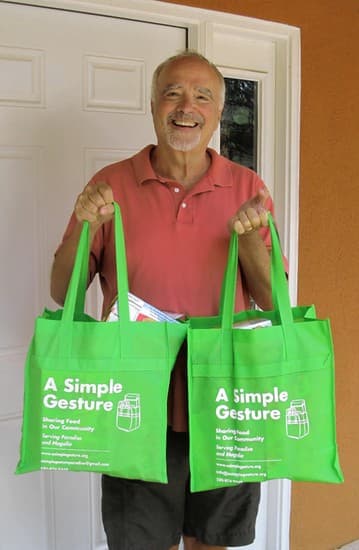
The green bag program is the clearest parallel to the federal model. A Simple Gesture offers doorstep pickup of donated food, which removes a major barrier for busy households and makes recurring giving feel manageable. Instead of asking neighbors to drive to a drop site, the organization meets them where they are. That same logic can support volunteer retention too: people are more likely to stay involved when the task is predictable, local, and easy to complete.
How the work reaches beyond one donation
A Simple Gesture says its Guilford County program partners with dozens of local food pantries, tying household donations to a broader distribution network. It also runs a Food Recovery Program that matches surplus food from businesses with vetted nonprofits, which extends the organization’s reach beyond residential giving. The SHARE school program adds another layer by placing refrigerators in schools so students can take unopened, unwrapped food during the day.
Those programs matter because they show how hunger relief moves through different channels at once. A green bag on a porch, surplus food from a business, and a refrigerator in a school all solve different access problems. For coordinators, the lesson is to make each program legible on its own terms, then show how it feeds the same system.
The workplace lessons for recruitment and retention
For a nonprofit like A Simple Gesture, the Feds Feed Families structure offers a few concrete habits worth copying:
- Keep the ask short and specific, so donors know exactly what to do.
- Offer more than one participation path, including giving, volunteering, and shared storytelling about results.
- Tie each campaign to a season or calendar moment, then keep a year-round entry point open.
- Make the impact visible, whether through pounds of food, pantry partnerships, or school-based access.
- Give volunteers a role that is easy to repeat, not a one-off favor they cannot fit into their week.
That approach also fits the realities of route coordination and volunteer recruitment. A green bag program depends on reliability: households need reminders, drivers need efficient routes, and pantry partners need steady inflow. A campaign that is easy to understand and easy to join is more likely to keep those moving parts aligned.
What the federal example leaves behind
Feds Feed Families succeeds because it does not ask employees to solve hunger in the abstract. It gives them a defined season, a year-round reporting hub, and a menu of concrete actions that fit different schedules and comfort levels. That is the same discipline A Simple Gesture needs when it recruits volunteers, keeps green bag pickups predictable, and explains to donors how one household bag becomes part of a larger food access system.
In neighborhood food recovery, clarity is not a branding exercise. It is the difference between a one-time gesture and a routine that keeps food moving to the pantries, schools, and families that need it.
This article was produced by Prism’s automated news system from verified source data, official records, and press releases, then run through automated quality and moderation checks before publishing. The system is built and supervised by the people who set the standards it runs under. Read our full AI policy.
Did this article answer your question?