USDA guidance helps A Simple Gesture reassure food donors and volunteers
Knowing the Good Samaritan law gives A Simple Gesture staff a cleaner answer to liability worries, making it easier to win donors and keep green-bag food moving.
Why liability confidence matters
For A Simple Gesture, the first benefit of USDA’s donating guidance is not legal theory. It is a better donor conversation. When staff and volunteers can explain, clearly and calmly, that federal law protects good-faith donations of apparently wholesome food, they can move past the hesitation that often stops grocers, restaurants, caterers, farms, and individual donors from saying yes.

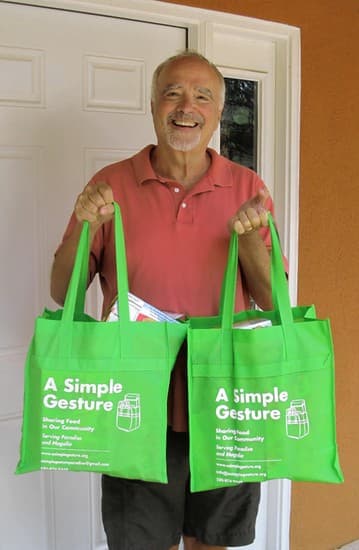
That matters in a neighborhood pickup model built on trust. Every green bag on a doorstep represents a small act of confidence from a household, and every business donation depends on the same thing: someone believing the process is safe, legitimate, and worth the effort. USDA’s guidance gives frontline relationship-builders a practical way to answer liability concerns without sounding improvised.
What the Good Samaritan law actually covers
The core law here is the Bill Emerson Good Samaritan Food Donation Act, enacted as Public Law 104-210 on October 1, 1996. USDA says it protects people and organizations that donate in good faith, as long as the food is apparently wholesome and goes to nonprofits for free distribution or for a reduced price under good Samaritan rules.
The protection is broader than many donors realize. USDA’s FAQ says it covers restaurants, retail grocers, manufacturers, wholesalers, agricultural producers, agricultural processors, agricultural distributors, caterers, school food authorities, and institutions of higher education. USDA also says the law protects nonprofit organizations receiving those donations, so long as the food is accepted in good faith and there is no gross negligence or intentional misconduct.
That detail matters for A Simple Gesture staff because a donor’s concern is often not about the law itself, but about whether the nonprofit can responsibly handle the food once it leaves the donor’s hands. A simple, accurate explanation of the statute can lower that barrier fast.
Why the 2023 amendment matters for modern food recovery
The law did not stop evolving in 1996. Congress amended it again in legislation enacted on January 5, 2023, extending liability protection to certain qualified direct donors who give directly to needy individuals at no cost. That change broadens the law’s relevance beyond the classic food-bank model and reflects how food recovery now works in the field.
For A Simple Gesture, that history is useful in donor education because it shows the law is not a symbolic promise sitting on a shelf. It has been updated as distribution networks changed, and it continues to support multiple ways of moving edible food to people who need it. Staff and volunteers can use that context to reassure businesses that they are joining a mature, recognized system rather than improvising a risky one-off arrangement.
How A Simple Gesture can use the guidance day to day
This is where the law becomes a workplace tool. A Simple Gesture can fold the USDA guidance into volunteer onboarding, donor FAQs, partner conversations, and route planning. That helps keep messaging consistent when different people are speaking for the organization across Guilford County and beyond.
A practical playbook might include:
- A plain-language explanation of Good Samaritan protections for first-time donors
- Clear guidance on what the organization can accept and what it cannot
- Simple packaging and labeling expectations for businesses and households
- Timing rules so food is picked up, sorted, and delivered quickly
- A reminder that liability protection does not replace common sense or safe handling
That kind of internal consistency is especially important in a nonprofit with recurring donor relationships. The more confidently staff can explain the rules, the less likely a nervous business is to back away after the first conversation.
Handling perishable food is where the logistics get real
USDA also notes that perishable prepared foods often require special handling, including refrigerated trucks, insulated coolers or bags, and rapid delivery. For a neighborhood pickup program, that is not a footnote. It is the difference between usable food and a load that has to be discarded.
A Simple Gesture’s model depends on making collection simple for donors while still respecting the limits of temperature control. Volunteers and coordinators need to think like logistics managers, not just messengers. Route timing, partner communication, and the handoff from porch to pantry all have to support food safety, especially when donations include prepared items or other perishables.
That is why the legal guidance and the operations guidance belong together. The law reduces the fear of giving. The handling rules reduce the chance that a good donation never makes it to a pantry shelf.
Why the scale of the problem makes this work worth the effort
The urgency behind all of this is large. USDA estimates that food waste in the United States amounts to 30% to 40% of the food supply, building on an earlier estimate of about 133 billion pounds and $161 billion worth of food in 2010. EPA estimates that in 2019, 66 million tons of wasted food were generated in the retail, food service, and residential sectors, and about 60% of that was sent to landfills.
At the same time, USDA says 13.7% of U.S. households experienced food insecurity at some point in 2024, and 5.4% had very low food security. That gap is exactly where food recovery organizations operate. The challenge is not whether enough food exists. It is how quickly and reliably it can be redirected from surplus to neighbors.
A Simple Gesture’s model turns legal clarity into repeat giving
A Simple Gesture says it was started by Jonathan Trivers in Paradise, California, in 2010, and that more than 65 communities have adopted the model across the country. In Guilford County, the organization says it has operated since 2015 and built a dense network of pantry partnerships, recurring donors, and volunteers.
By December 2025, A Simple Gesture’s Guilford County impact page said the operation had delivered more than 8,000,000 child-size meals, generated $13,000,000 in donated food value, worked with 75-plus pantry partners, enrolled 3,900-plus recurring food donors, and relied on 200 monthly volunteers. The organization’s Greensboro materials also say it collected more than 4 million pounds of food from about 6,000 donors, and a recent account said its food-recovery program redirected more than 850,000 pounds of perishable food in 2025 alone.
Those numbers show why liability reassurance is not a side issue. It is part of retention. A donor who feels informed is more likely to become recurring. A volunteer who knows how to answer a question about liability is more likely to keep recruiting neighbors and businesses. And a pantry partner that sees a steady stream of usable food is more likely to stay engaged.
The practical takeaway for staff and volunteers
The strongest use of USDA’s guidance is not in a binder. It is in the conversation that happens at the doorstep, on a pickup route, or across a table with a local business. When A Simple Gesture staff and volunteers understand the Good Samaritan law, they can turn a worried “What if something goes wrong?” into a confident explanation of how the donation system works.
That is what makes the guidance so valuable to a neighborhood food recovery nonprofit. It protects donors, supports volunteers, and keeps food moving quickly toward the pantries and families that need it most.
This article was produced by Prism’s automated news system from verified source data, official records, and press releases, then run through automated quality and moderation checks before publishing. The system is built and supervised by the people who set the standards it runs under. Read our full AI policy.
Did this article answer your question?