Wesco shows how recognition and flexibility grow volunteer participation
Wesco’s volunteer model works because it makes service easy to join, visible to coworkers, and worth repeating. That is the part A Simple Gesture can borrow.

Wesco’s June 25 Day of Caring was built like a participation system, not a one-off volunteer drive. The company tied in-person and virtual events to paid volunteer time off, matching gifts, and named employee recognition, then spread that structure across a global footprint of about 21,000 employees, 700-plus sites, and operations in roughly 50 countries.
A service day designed for scale
Wesco said its 2025 Day of Caring reached nearly 5,000 employees and more than 60 nonprofit community partners at numerous sites around the globe. In the first half of that year, employees logged over 1,500 volunteer hours and donated close to $320,000, including Wesco Cares matches, supporting about 300 charities. That is the kind of volume a food-recovery network like A Simple Gesture can study closely: not because the mission is identical, but because the operating logic is. When a volunteer program has repeatable entry points, clear partner needs, and a structure that works across locations, it becomes easier to staff pickup routes, maintain pantry relationships, and keep volunteers coming back.
The 2026 event followed the same pattern. Wesco held Day of Caring at locations around the globe on June 25, reinforcing the company’s commitment to communities where employees live and work. The point was not just participation, but participation that could be repeated, tracked, and scaled across regions and schedules. That matters for distributed teams, and it matters for nonprofit systems that depend on consistent people rather than occasional enthusiasm.
What the numbers say about retention
The company’s 2025 materials show why one-day events can matter beyond the calendar. Wesco said employees logged almost 1,000 volunteer hours and donated more than $210,000 with company matches year to date in 2025. Those totals rose to over 1,500 hours and close to $320,000 including matches in the first half of the year, alongside support for roughly 300 charities. The growth suggests that volunteerism did not stop after a single company event; it moved into a broader engagement pattern.
For an organization built around recurring community contact, that is the real lesson. A volunteer who helps on one route, one pantry drop, or one packaging day is far more likely to return if the experience is easy to understand, easy to schedule, and easy to talk about inside the company. Wesco’s model shows that participation grows when the program is visible enough to become part of workplace identity.
Recognition turned service into a story
Wesco did not leave employee service invisible inside human resources. The company named John C. Tieri, an Account Executive in Electrical and Electronic Solutions based in Carol Stream, Illinois, as its 2026 Wesco Cares Champion of the Year. Wesco said he is also a volunteer firefighter and EMT with Beecher Fire Protection Department. In 2025, the same recognition went to Scott Carstens, a Senior Operations Manager in Charlotte, North Carolina, who volunteers with Habitat for Humanity, Best Buddies, the Wounded Warrior Foundation, Second Harvest Food Bank, and Goodwill.
That kind of recognition matters because it gives coworkers a person to remember, not just a policy to file away. A volunteer program has more staying power when employees can point to a named colleague whose example signals what the company values. For a nonprofit that depends on route captains, pantry liaisons, or donor coordinators, public recognition can do the same work: it turns service into a story people repeat.
The mechanics behind easy participation
Wesco’s giving infrastructure is part of the reason the volunteer model can travel across geographies. The company said it launched a new corporate giving platform in June 2024 to make donating and volunteering easier and to give leaders a better picture of global impact. Its matching-gifts guidelines also give employees a concrete incentive: eligible donations are matched dollar for dollar, up to $1,000 per person per year, with a minimum eligible gift of $25 and quarterly processing.
Those details matter operationally. A platform lowers friction. A match makes a gift feel shared. Quarterly processing gives the program a cadence that can be communicated internally without turning it into a one-time push. Wesco’s philanthropy guidelines also focus corporate support on affordable housing and humanitarian aid, which helps explain why the company’s community partnerships include the American Red Cross and Habitat for Humanity alongside other organizations working in education and basic-needs support.
- Easy entry: a platform that combines giving and volunteering
- Easy participation: paid volunteer time off and both local and virtual options
- Easy reinforcement: matching gifts and quarterly processing
- Easy storytelling: named champions and partner organizations with clear missions
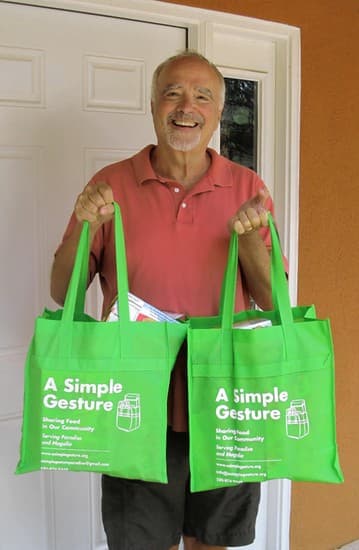
For a food-recovery nonprofit, that same architecture can support green bag pickups and pantry deliveries. The equivalent of a corporate service day is a predictable rhythm that employees can plan around. The equivalent of a matching gift is a clear reminder that the company is not only lending time, but also helping fund the work behind the scenes.
Why Wesco’s community work reaches beyond one event
Wesco’s broader community-investment strategy extends past volunteer hours. In 2024, the company launched the Wesco Cares Scholarship Program with NECA, ELECTRI International, and the IEC Foundation to support tradespeople and electrical construction professionals. In April 2026, NECA said the scholarship program was in its third year and had supported more than 300 electrical workers nationwide since inception.
That pipeline matters in a labor market that NECA says will need to attract nearly 500,000 new workers in 2026. Wesco’s scholarship work shows that employee engagement can be tied to workforce development, not just charitable giving. For companies that want volunteerism to become durable, the lesson is clear: connect service to a broader community need, then give employees a way to see that work as part of the company’s identity.
Wesco’s model shows how recognition, flexibility, and a simple support system can turn volunteering into a year-round habit. The strongest programs do not rely on enthusiasm alone; they give people a reason to start, a reason to return, and a reason to talk about it inside the workplace.
This article was produced by Prism’s automated news system from verified source data, official records, and press releases, then run through automated quality and moderation checks before publishing. The system is built and supervised by the people who set the standards it runs under. Read our full AI policy.
Did this article answer your question?