Big Lots workers can build retail careers beyond the cashier lane
Big Lots still has a real management ladder, but the workers most likely to move up are the ones who can run freight, calm customers and keep the floor organized.
The ladder starts with the shift, not the title
At Big Lots, the fastest path upward usually begins with the most ordinary work on the floor. A cashier who can keep lines moving, a stocker who gets freight onto the shelves cleanly, and a team member who notices what is missing before customers do are already building the habits that matter in the next job.
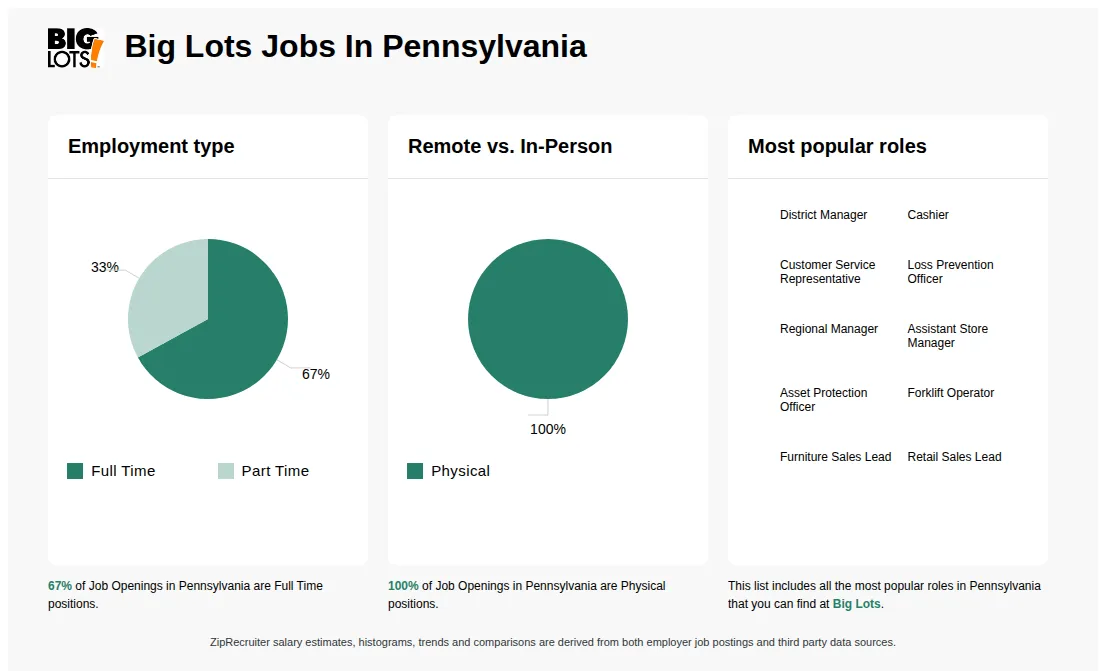
That is because Big Lots’ own careers page lays out a real internal structure: store team member, cashier, assistant manager, store manager and district manager. It also points beyond the store, into merchandising, marketing, IT, finance and human resources. In other words, the company has treated retail as a place where people can move from entry-level tasks into supervision and then into broader business roles.
What Big Lots looks for before it hands over more responsibility
The jump from cashier or stocker to lead is usually less about charm and more about trust. Big Lots needs people who can manage a front end, supervise freight, coach team members, handle customer issues and keep inventory moving. If you can do those things consistently, you are already showing the core skills of an assistant manager, even if the title has not changed yet.
The habits that make a worker promotable are not abstract. Reliability matters because stores run on coverage and timing. Clear communication matters because the next step up means coordinating with people across shifts. Customer-service judgment matters because a lead or assistant manager is often the one who has to solve a problem when the line is long, a return gets complicated or a product is not where it should be.
Just as important is staying calm when the floor gets busy. Discount retail rewards people who can keep the store moving without making a scene about every disruption. Big Lots also runs on merchandising awareness, so workers who notice what needs to be faced, stocked or moved into place are signaling that they understand more than their own register or aisle.
From lead to assistant manager to store manager
A realistic career map at Big Lots usually runs through a few clear steps. First comes learning the basics of the store, whether that starts at the register, in stockroom work or as a general team member. Then comes the lead role, where the job is no longer just doing the work but also setting the pace for others, watching the floor and helping solve small problems before they turn into bigger ones.
From there, assistant manager is the first role where a worker is expected to think about the entire store, not just one department or one shift. That means balancing the front end, freight flow, customer issues and staff coaching at the same time. Store manager is the next leap, and it requires understanding both the sales floor and the numbers, because a store manager has to manage people, operations and performance together.
Big Lots’ structure also extends to district manager, which shows that the ladder does not stop at one building. A worker who learns how one store operates can eventually be trusted to look across multiple locations. That progression is why floor-level habits matter so much: the company is not just looking for someone who can work a shift, but for someone who can be trusted with a larger patch of the business.
Why retail management training still translates outside Big Lots
Indeed’s retail management guide breaks retail into roles such as store manager, assistant manager, department lead, buyer-adjacent roles and operational support positions. That broader map matters because the skills built at Big Lots are portable. If you learn production discipline, logistics basics and managerial judgment in a Big Lots store, those skills can carry into another retailer or into a different corner of consumer goods.
That portability is part of the appeal of retail work when it is treated seriously. A cashier who learns how to resolve customer concerns, a stocker who learns how inventory flows, and a lead who learns how to coach teammates are all collecting proof that they can handle more complex work. Those are the same people who can later fit into merchandising, marketing, finance or human resources if the opportunity opens up.
For Big Lots workers, that means the current job should be treated like a training ground. The question is not whether every task feels glamorous. The question is whether you are building the kind of track record that makes a supervisor comfortable saying you can run a shift, then a department, then a whole store.
The company’s scale shows why these skills mattered
Big Lots was once a much larger operation than the one many workers are seeing today. In its filing for the period ending May 4, 2024, the company said it operated 1,392 stores in 48 states and an e-commerce platform. In its securities filings, it also reported 29,681,973 common shares outstanding as of June 7, 2024, underscoring how large and publicly traded the business still was before the collapse accelerated.
That scale helps explain why store-level talent mattered so much. A chain spread across 48 states does not survive on good intentions alone. It needs people who can manage a front end, protect inventory flow and keep customers moving through the store without friction. The more the company depended on those routines, the more valuable the workers became who could do them without constant supervision.
Bankruptcy changed the meaning of promotion
The company’s career ladder did not disappear overnight, but the ground under it shifted sharply. On September 9, 2024, Big Lots announced a sale agreement with Nexus Capital Management LP and said it had initiated voluntary Chapter 11 proceedings in the U.S. Bankruptcy Court for the District of Delaware. The pressure came from high interest rates, a sluggish housing market and weaker demand for furniture and home decor, the categories that had long been central to the chain’s identity.
By December 2024, Big Lots said it was preparing to close all of its locations. That changed the stakes for anyone still working inside the company. Management experience became not only a path upward within Big Lots, but also a transferable credential for the next employer. A lead who had coached teammates, a cashier who had learned the front end and an assistant manager who had kept inventory moving now had something concrete to show another retailer.
The larger lesson is simple. Big Lots once offered a broad internal ladder, with store, district and corporate paths all visible from the sales floor. Even as that ladder was compressed by bankruptcy and closures, the skills that move someone up it did not change. Reliability, calm execution, customer judgment and the ability to keep freight, people and inventory moving are still the traits that turn a job into a career.
Know something we missed? Have a correction or additional information?
Submit a Tip