Big Lots workers could gain edge as AI speeds retail tasks
AI at Big Lots looked less like a headcount threat than a faster shift: S&P Global said efficiency drove 64% of enterprise use cases, while only 22% aimed for full autonomy.

For Big Lots, the biggest AI shift is not a robot running the floor. It is software shaving minutes off the work that already eats a manager’s day: task lists, replenishment notes, product descriptions, scheduling and customer responses.
S&P Global’s June 2 report pushed that point hard. Across 38 AI use cases, average current adoption was 50 percent and planned adoption next year was 37 percent. Enterprise buyers were still mostly chasing process efficiency, cited by 64 percent of respondents, and employee productivity, cited by 59 percent, while only 24 percent said headcount reduction was the goal. Just 22 percent of projects were aimed at a fully autonomous end state.

That matters for a retailer like Big Lots because the near-term use cases look mundane, not dramatic. Summarization can turn a pile of weekly updates into a shorter action list. Translation can smooth communication with vendors or customers. Data management can clean up inventory and product information. Planning tools can reduce friction in replenishment and scheduling. None of that replaces a store team. It can, however, raise the pace of the same team and reset what managers expect one shift to accomplish.
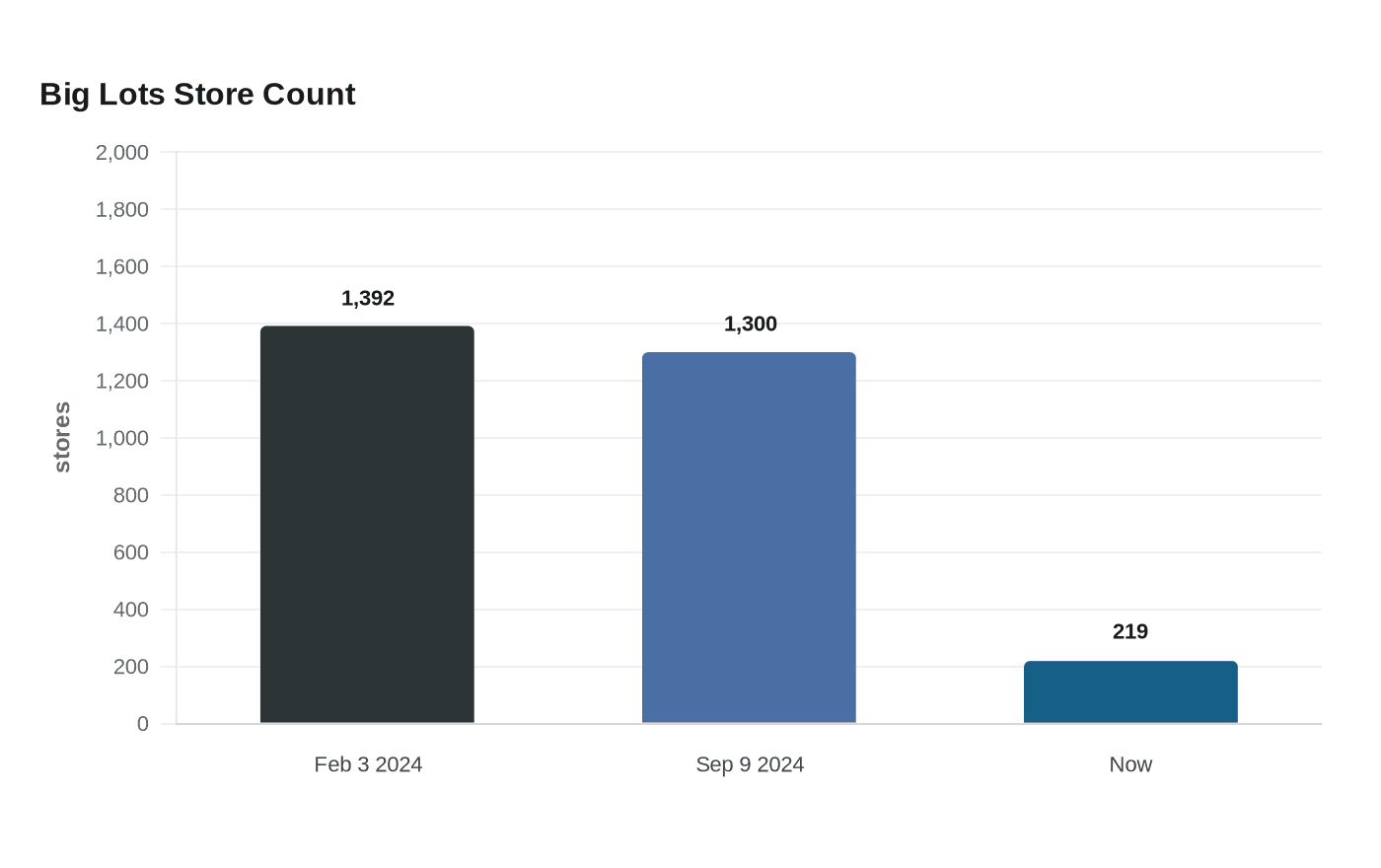
Big Lots already operates under that kind of pressure. The company filed voluntary Chapter 11 bankruptcy petitions on September 9, 2024, after reporting 1,392 stores and an e-commerce platform as of February 3, 2024. CNBC said Big Lots was the fourth-largest home goods retailer in the U.S. when it filed, with about 1,300 stores, $4.7 billion in 2023 revenue and more than 27,000 employees.
The chain’s footprint kept changing after that. In January 2025, a judge approved a sale that could transfer 200 to 400 stores to Variety Wholesalers, and Big Lots said the deal could preserve 5,000 to 10,000 jobs. Variety Wholesalers later said it acquired 219 Big Lots stores and began reopening locations in waves starting April 10, 2025. Big Lots’ store locator now shows 219 locations, a sharp reminder that any productivity gain will land in stores that are smaller, tighter and less forgiving than before.
That is why retail AI has become less about futuristic automation than about labor density. A Kearney survey found 60 percent of U.S. frontline retail workers, store managers and field leaders said their store had already started using AI and automation tools, mostly for inventory tracking, stock ordering, shift scheduling and manual data entry. Deloitte has framed retail AI as a new class of digital workers, and Goldman Sachs has estimated that roughly 2.5 percent of U.S. employment could be at risk of related job loss if AI use cases spread and efficiency gains translated directly into fewer workers.
For Big Lots, the real test is simpler and more immediate. If AI trims the admin around the store, does the workday get easier, or just denser?
This article was produced by Prism’s automated news system from verified source data, official records, and press releases, then run through automated quality and moderation checks before publishing. The system is built and supervised by the people who set the standards it runs under. Read our full AI policy.
Did this article answer your question?