CareerOneStop salary tool helps Big Lots workers benchmark local retail pay
A Big Lots shift can pay very differently once you check your ZIP code. CareerOneStop turns that guesswork into a local benchmark before you ask for a raise or walk away.
The surprise is how local retail pay really is
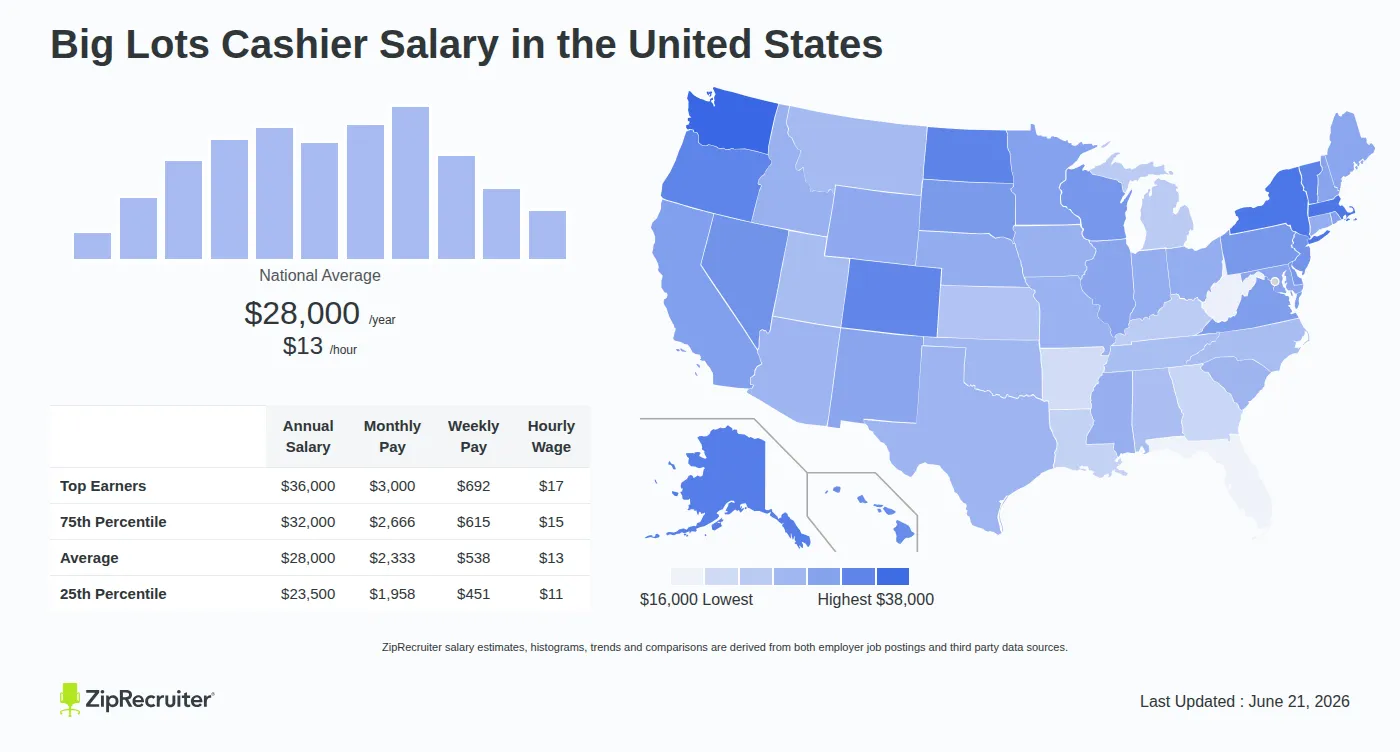
The same Big Lots job can look very different once you plug in your ZIP code. CareerOneStop’s Salary Finder lets you pull local salary information for more than 900 occupations in any U.S. location, which makes it useful for checking cashier, stocker, customer-service, supervisor, and distribution-style roles against the market where you actually work.

That matters because retail pay is not set by title alone. City lines, store format, and labor competition can all push wages up or down, so a role that seems ordinary on paper may be underpriced, or surprisingly strong, just a few miles away. For Big Lots workers deciding whether to ask for a raise, apply for a transfer, or leave, the local comparison is the part that changes the conversation.
How to use the Salary Finder without getting lost in the numbers
CareerOneStop’s tools work best when you use them as a comparison, not as a single answer. The Wages tools let you compare average wages locally, statewide, or nationally, and compare up to five occupations or five locations. That gives you a way to line up your current role against nearby alternatives before you make a move.
A practical way to use it is straightforward:
1. Start with your own ZIP code or the area where you commute.
2. Search the role that matches your real work, not just the title on the schedule.
3. Compare cashier, stocker, and supervisor pay side by side.
4. Look at the high, median, and low wages on Salary Info pages.
5. Switch between hourly and yearly pay so you can see what the job really means over a full year.
That mix matters because a small hourly difference can add up fast over a month of inconsistent hours. For a worker whose schedule changes week to week, the hourly number may be more revealing than the yearly one. For a manager trying to budget labor responsibly, the same tool helps avoid uncompetitive offers that drive turnover before a new hire even settles in.
Why the job title may not match the work
Big Lots workers know the gap between job description and actual shift. If you are stocking, cashiering, unloading, helping customers, and handling closing tasks in the same week, your pay should be judged against the local market for that blended workload, not against a narrow title printed on a form.
That is where pay benchmarking becomes more than a paycheck exercise. It gives you a grounded way to talk about responsibility creep, especially when a supervisor title includes duties that deserve a review. It also helps when performance conversations start drifting into vague language. Comparing your role against nearby employers gives you evidence instead of rumor, and that is a stronger place to start any compensation discussion.
What the broader retail market says
The national retail picture shows why these local checks matter. The U.S. Bureau of Labor Statistics says its Occupational Employment and Wage Statistics program produces annual wage estimates for about 830 occupations across the nation, states, and metropolitan and nonmetropolitan areas. In other words, the government tracks wage differences because they are real and persistent, not random noise.
For retail salespersons, the median hourly wage was $16.62 in May 2024. Employment of retail sales workers is projected to show little or no change from 2024 to 2034, even as about 586,000 openings are projected each year on average over the decade. That combination tells a clear story: retail pay remains modest, turnover remains constant, and openings keep appearing even when growth stays flat.
For Big Lots workers, that is a reminder that opportunity does not always mean security. Openings can be plentiful without pay improving much, which makes local wage comparison even more important before you stay, apply elsewhere, or accept a new role.
Why Big Lots’ footprint makes local benchmarking even more useful
Big Lots’ own footprint reinforces the need to compare wages by market. The company’s jobs page says store support centers are in Columbus, Ohio, and Henderson, North Carolina, and its store locator currently shows 219 locations. Big Lots’ about page says Variety operates more than 400 stores across 18 states.
That spread matters because compensation often shifts with geography and store environment. A wage that is acceptable in one market may fall behind in another, especially in discount retail, where staffing needs can be broad and duties can blur together. When the company operates across multiple centers and hundreds of stores, local pay differences are not a side issue. They are part of how labor is priced.
Using the data before a raise request or exit decision
The strongest use of Salary Finder is practical: it helps you decide whether a raise conversation should happen now, and whether your current role is worth the commute. If your ZIP code shows that cashier work is priced above what you are making, that is a signal to ask for a review. If the local supervisor rate is only a small step up while you are already doing extra work, that can justify asking for reclassification or higher pay.
Managers can use the same data to keep staffing stable. A labor budget built without local wage reality usually leads to churn, and churn is expensive. Benchmarking against nearby employers gives both sides a more honest baseline than company loyalty or office assumptions ever could.
Questions to bring into the pay conversation
Bring the discussion back to the market with specific questions:
- What is the local median pay for cashier, stocker, and supervisor jobs in my ZIP code?
- Which of my actual duties go beyond my current title?
- How does my pay compare with nearby retail employers doing similar work?
- If I am already handling closing, unloading, and customer-service tasks, what pay review does that support?
- What would it take to move into the next pay band or into a role with clearer advancement?
Those questions turn pay from guesswork into labor value, which is the only place a serious compensation conversation should begin.
This article was produced by Prism’s automated news system from verified source data, official records, and press releases, then run through automated quality and moderation checks before publishing. The system is built and supervised by the people who set the standards it runs under. Read our full AI policy.
Did this article answer your question?